The global agricultural trade ecosystem has undergone a profound digital transformation in recent years, with business-to-business (B2B) marketplaces emerging as critical infrastructure connecting farmers, suppliers, processors, and distributors worldwide. The global agricultural B2B e-commerce market, valued at $8.6 billion in 2024, is projected to reach $16.7 billion by 2033.
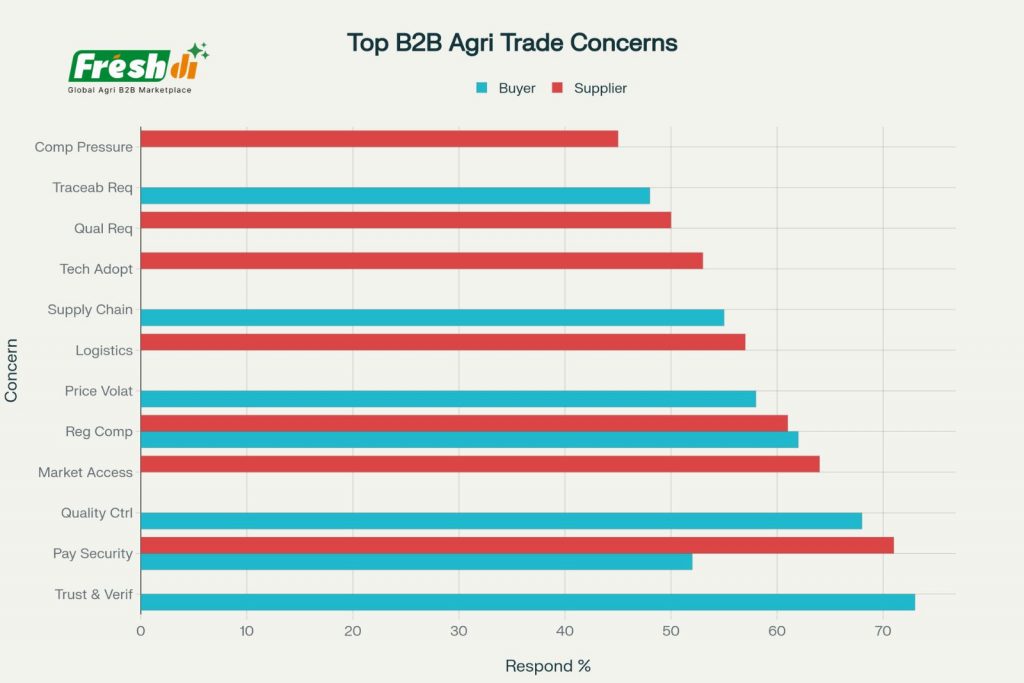
Major Concerns in Global Agricultural B2B Trading: Buyers vs Suppliers Perspectives
1. The Authenticity Crisis in Digital Agricultural Markets
In agricultural B2B trading, 73% of buyers rank trust and verification as their top concern. Unlike standardized goods, agri-products vary by season, quality, and perishability—making reliable verification essential. In digital marketplaces, where physical inspection isn’t possible, 70% of buyers prefer dealing only with verified sellers. Strong third-party verification builds buyer confidence and drives trade success.
2. Sophisticated Fraud Schemes Targeting Agricultural Trade
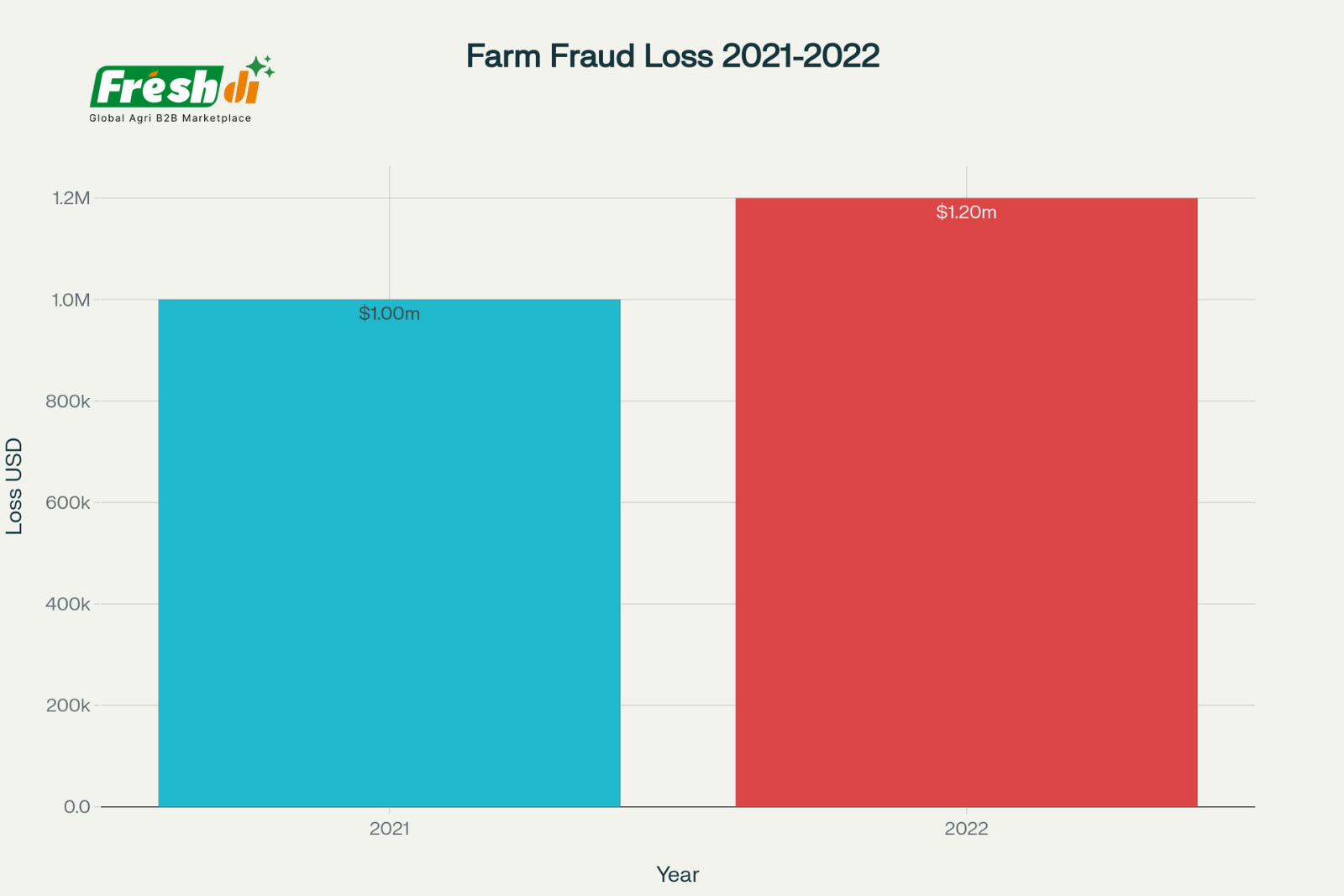
The agricultural sector faces rising fraud threats, with Australian farms losing over $1.2 million to scams in 2022 (20% YoY). Common tactics include fake business identities and scams involving non-existent farm machinery sold online.
Looking to Source Agricultural Products?
Connect with verified suppliers, discover matching products, and explore sourcing opportunities from global markets.
3. The Verification Infrastructure Gap
Despite the clear need for robust verification systems, many agricultural B2B platforms struggle with standardization of verification processes. The lack of global standards for supplier verification creates inconsistencies that buyers must navigate. Therefore often leading to increased due diligence costs and extended procurement timelines.
Blockchain technology has emerged as a potential solution platform. By implementing immutable record-keeping systems to track supplier credentials, product histories, and transaction records. However, widespread adoption remains limited due to technical complexity, cost considerations, and interoperability challenges between different platform systems.
4. Quality Control Solutions and Technologies
Modern agricultural B2B platforms are increasingly incorporating advanced quality control technologies, including AI-powered image recognition for visual quality assessment, IoT sensors for real-time monitoring of storage and transportation conditions. that provide end-to-end visibility of product quality metrics.
External certification programs have also gained prominence, with survey data showing that 48% of U.S. food plants use both internal testing and outsourced testing to contract laboratories, while 18% rely solely on outside laboratories. This trend toward external verification helps build buyer confidence while reducing the compliance burden on individual suppliers.
5. The Regulatory Maze
Regulatory compliance remains a major hurdle for 62% of buyers and 61% of suppliers in agricultural B2B trade. Varying food safety, environmental, and quality standards across countries create complexity and higher costs. Sanitary and Phytosanitary (SPS) measures—covering inspections, additives, and pesticide limits—are especially difficult to navigate, as inconsistent implementation adds to trade friction.
6. Payment Risks in Agricultural B2B Transactions
Payment security is the top concern for 71% of suppliers and a key issue for 52% of buyers in agricultural B2B trade. Large transaction values, extended terms, and cross-border complexities heighten fraud risk. Common payment methods like letters of credit (L/C), telegraphic transfers (TT), and open accounts each pose unique risks—especially with documentation errors or disputes causing costly delays.
7. Technology Solutions and Digital Transformation
Digital logistics solutions—like real-time tracking, blockchain traceability, and AI route optimization—are streamlining agri-supply chains. IoT and GPS tools enhance visibility and alert users to delays or temperature shifts. While integrated platforms connect transport, storage, and customs, adoption remains slow due to infrastructure gaps and cost barriers, especially for smaller operators.
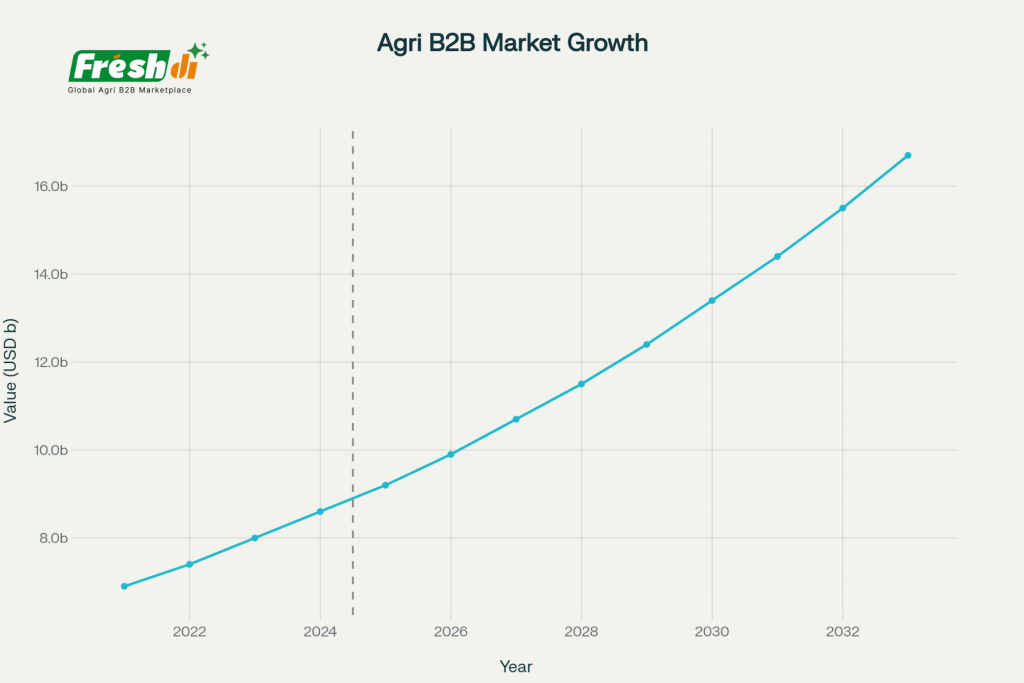
Global Agricultural B2B E-commerce Market Growth Trajectory 2021-2033
To address these urgent concerns, Freshdi.com has emerged as a next-generation B2B platform purpose-built for the agricultural and food trade. By combining robust supplier verification, real-time inquiry matching, and AI-powered sourcing, Freshdi directly tackles the trust deficit cited by 73% of buyers. All businesses are screened through multi – layered verification protocols – covering company registration, certifications, and trade activity – ensuring that only credible, export-ready partners operate on the platform. For suppliers, Freshdi offers secure quotation workflows and transparent buyer profiles, reducing payment risks and enabling direct connections without intermediaries. By embedding smart logistics tools, compliance alerts, and category – specific support, Freshdi lightens the operational burden and empowers both smallholders and exporters to trade smarter, faster, and more securely. As global B2B agriculture races toward $16.7 billion by 2033, Freshdi is helping define a trusted, digitized future for food and agri – trade.
8. Conclusion
The analysis reveals that global agricultural B2B trading faces a complex web of interconnected challenges that require comprehensive, coordinated solutions. While trust and verification emerge as the primary concern for buyers (73%) and payment security dominates supplier concerns (71%), the underlying issues of regulatory complexity, infrastructure inadequacy, technology gaps, and market volatility affect all participants in the agricultural trading ecosystem.
The projected growth of the agricultural B2B e-commerce market from $8.6 billion in 2024 to $16.7 billion by 2033 indicates strong momentum toward digital transformation, but this growth trajectory depends critically on addressing the fundamental concerns identified in this analysis. Successful agricultural B2B platforms of the future will need to provide integrated solutions that simultaneously address verification, quality control, payment security, regulatory compliance, and logistics coordination within comprehensive digital ecosystems.
About us
Freshdi.com is the world’s leading global B2B marketplace for agricultural products and food, connecting directly between global buyers and suppliers. Freshdi.com has over 3M+ suppliers, 2M+ active buyers, and 1,000+ buying requests updated daily in agri-food.