
Edible oils are essential products in the global food supply chain. From sunflower oil and soybean oil to palm oil, coconut oil, olive oil, and rapeseed oil, international buyers source different types of cooking oils for food manufacturing, wholesale distribution, retail packaging, and food service.
For exporters, reaching international buyers requires more than offering a competitive price. Buyers need to understand the oil type, refining process, quality parameters, packaging options, available volume, and export conditions before considering a supplier.
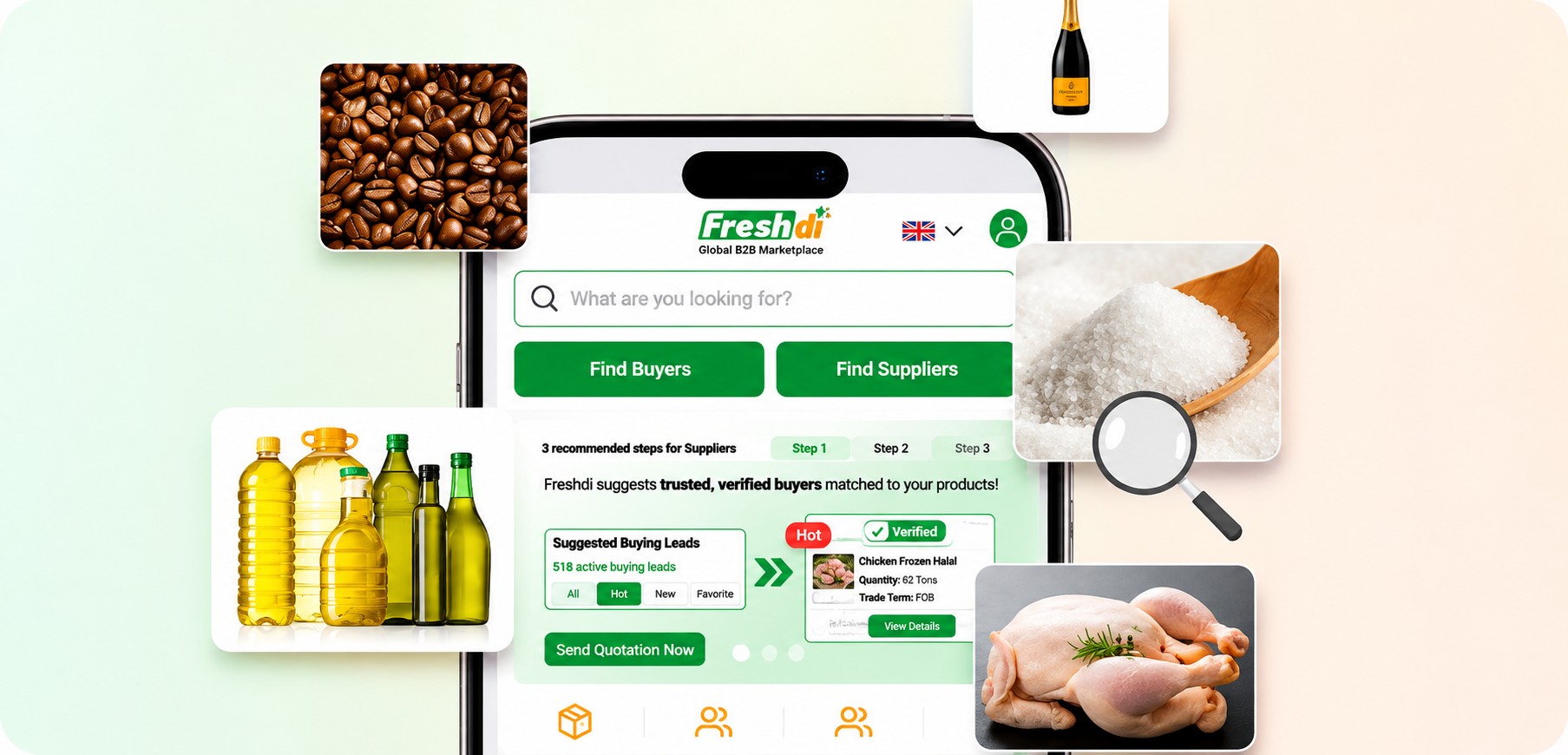
Freshdi is a global B2B marketplace, powered by AI, that helps suppliers showcase their products, explore buying opportunities, and develop international business connections.
If you are an edible oil exporter looking to expand your international reach, this guide explains how to get started on Freshdi and present your products to potential buyers.
Key Takeaways
- Build a complete supplier profile that explains your business activities, product range, and export capabilities.
- Create separate listings for different edible oil types and specifications.
- Include important product information such as refining status, quality parameters, packaging, MOQ, and supply capacity.
- Explore edible oil buying leads and prepare quotations based on each buyer's actual requirements.
- Use Freshdi Account Manager support and membership features to support your business development activities.
1. Register for a Supplier Account on Freshdi
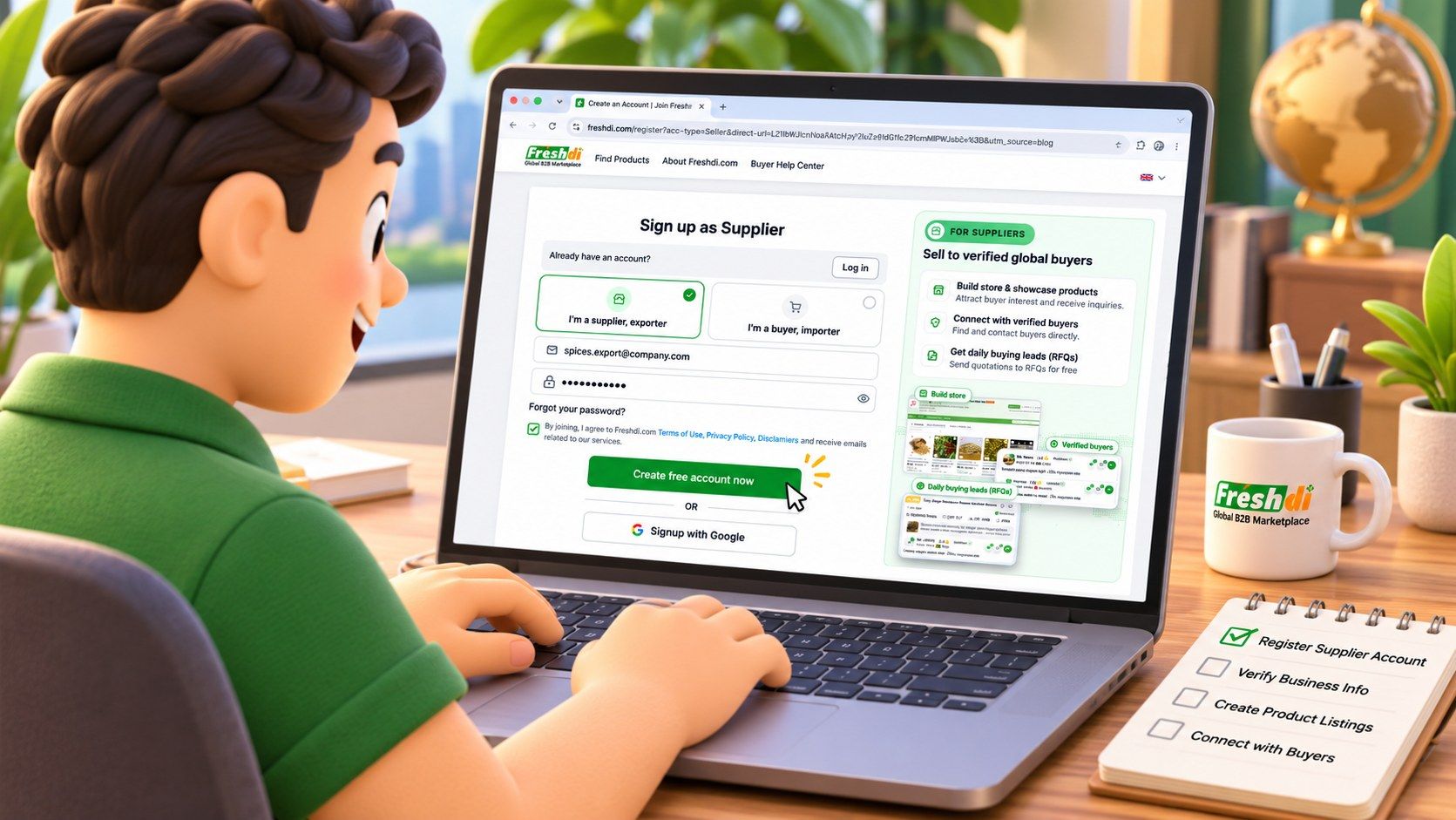
The first step is to create a supplier account on Freshdi. This gives your company a starting point to establish an online business presence and introduce its edible oil products to potential international buyers.
You can register through Freshdi Supplier Registration →
When setting up your account, provide accurate and consistent business information, including:
- Company or factory name.
- Country and business address.
- Main business activities.
- Contact person's name.
- Business email and phone number.
- Company website, if available.
- WhatsApp or other business communication channels, where applicable.
Choose the business type that best describes your operation, such as manufacturer, refinery, exporter, distributor, wholesaler, or trading company.
AI-generated image
Practical tip: If your company operates an oil refinery, explain the processing activities and products you manufacture. If you source products from partner refineries, describe your actual sourcing and supply arrangements. Clear information helps buyers understand your role in the supply chain.
2. Complete Your Company Profile and Build Business Credibility
A professional company profile helps potential buyers understand your business, product range, and ability to meet sourcing requirements.
For edible oil exporters, your profile should cover:
- Company overview: Introduce your business, location, and main activities.
- Product range: List the edible oil types your company supplies.
- Processing capabilities: Explain whether you handle refining, filtration, blending, bottling, or bulk supply, where applicable.
- Supply capacity: State your actual monthly or annual production or supply volume.
- Export experience: Identify the destination markets your company has served.
- Quality management: Describe relevant quality-control and storage procedures.
- Certifications: Upload valid certificates that apply to your company, facility, or products.
You can also complete the business verification process by submitting the documents requested by Freshdi.
Depending on your business and destination markets, relevant supporting documents may include business registration documents, food safety certifications, quality management certificates, or product-related documentation.
Only display certificates that your company actually holds or is authorized to use. Keep company information consistent across your profile and supporting documents.
Business verification can provide additional information about your company to potential buyers, but it does not replace independent checks of product quality, certifications, or transaction details.
Looking to Sell Edible Oil?
Connect with verified buyers, receive relevant buying leads, and explore sourcing opportunities from global markets.
3. Publish Detailed Edible Oil Product Listings
Your product listings are an important part of your online store. Instead of publishing one general listing for all cooking oils, create separate listings for products with different oil types, refining processes, specifications, and packaging formats.
Common Edible Oil Products to List
Depending on your actual supply range, you may create listings for:
- Sunflower Oil: Refined or unrefined sunflower oil for food manufacturers, wholesalers, and distributors.
- Soybean Oil: Refined or crude soybean oil for food processing and commercial distribution.
- Palm Oil: Products such as crude palm oil, refined palm oil, RBD palm olein, and other grades your company supplies.
- Coconut Oil: Virgin coconut oil, refined coconut oil, or other available coconut oil products.
- Olive Oil: Extra virgin, virgin, refined, or other olive oil categories, where applicable.
- Rapeseed and Canola Oil: Refined or crude products for food manufacturing and wholesale markets.
- Corn Oil: Edible corn oil supplied in bulk or consumer packaging.
- Other Vegetable Oils: Sesame oil, rice bran oil, peanut oil, and other edible oils your company can supply.
Clearly distinguish refined, unrefined, crude, virgin, and other product categories. These descriptions are not interchangeable and should accurately reflect the product being offered.
What Buyers Want to Know About Edible Oils
A useful product listing should provide enough information for buyers to evaluate the product and determine whether it fits their requirements.
| Specification | What to Include |
|---|---|
| Product name | Sunflower oil, soybean oil, palm oil, coconut oil, etc. |
| Oil type | Vegetable oil, seed oil, palm-based oil, or other applicable type |
| Refining status | Crude, refined, unrefined, virgin, RBD, or other applicable description |
| Origin | Country or region of origin |
| Appearance | Color, clarity, and physical characteristics where relevant |
| Quality parameters | Relevant values such as free fatty acid (FFA), acid value, peroxide value, moisture, and impurities |
| Fatty acid profile | Where available and relevant to the product |
| Packaging | PET bottles, jerry cans, tins, drums, flexitanks, ISO tanks, or bulk |
| Shelf life | Actual shelf-life information and storage conditions |
| MOQ | Minimum order quantity |
| Supply capacity | Available volume and production schedule |
| Trade terms | FOB, CIF, CFR, or other terms your company can offer |
| Payment terms | T/T, L/C, or other arrangements accepted by your company |
| Documents | Certificate of Analysis (COA), applicable food safety certificates, and export documents |
The exact quality parameters vary by oil type, processing method, applicable standards, and buyer requirements. Avoid using one set of specifications for every edible oil product.
For example, a buyer sourcing refined sunflower oil may request a Certificate of Analysis and details about packaging, shelf life, and product quality. A buyer sourcing crude palm oil may require a different set of technical parameters.
Choose Packaging That Matches Your Target Buyers
Packaging can influence which buyer segments your products may serve.
Common edible oil packaging formats include:
- PET bottles: Common retail formats such as 1L, 2L, 3L, and 5L.
- Jerry cans: Often available in larger consumer or commercial sizes.
- Metal tins: Used for selected retail and food-service applications.
- Drums: Suitable for certain industrial and wholesale supply arrangements.
- Flexitanks: Used for transporting eligible liquid cargo in bulk within containers.
- ISO tanks: Used for suitable bulk liquid transportation.
- Bulk shipments: Supplied according to the buyer's logistics and handling requirements.
Only list packaging formats that your company can actually provide. Confirm material compatibility, food-grade suitability, filling capacity, labelling requirements, and shipment conditions with the buyer.
You can publish your edible oil products through Freshdi Product Posting →
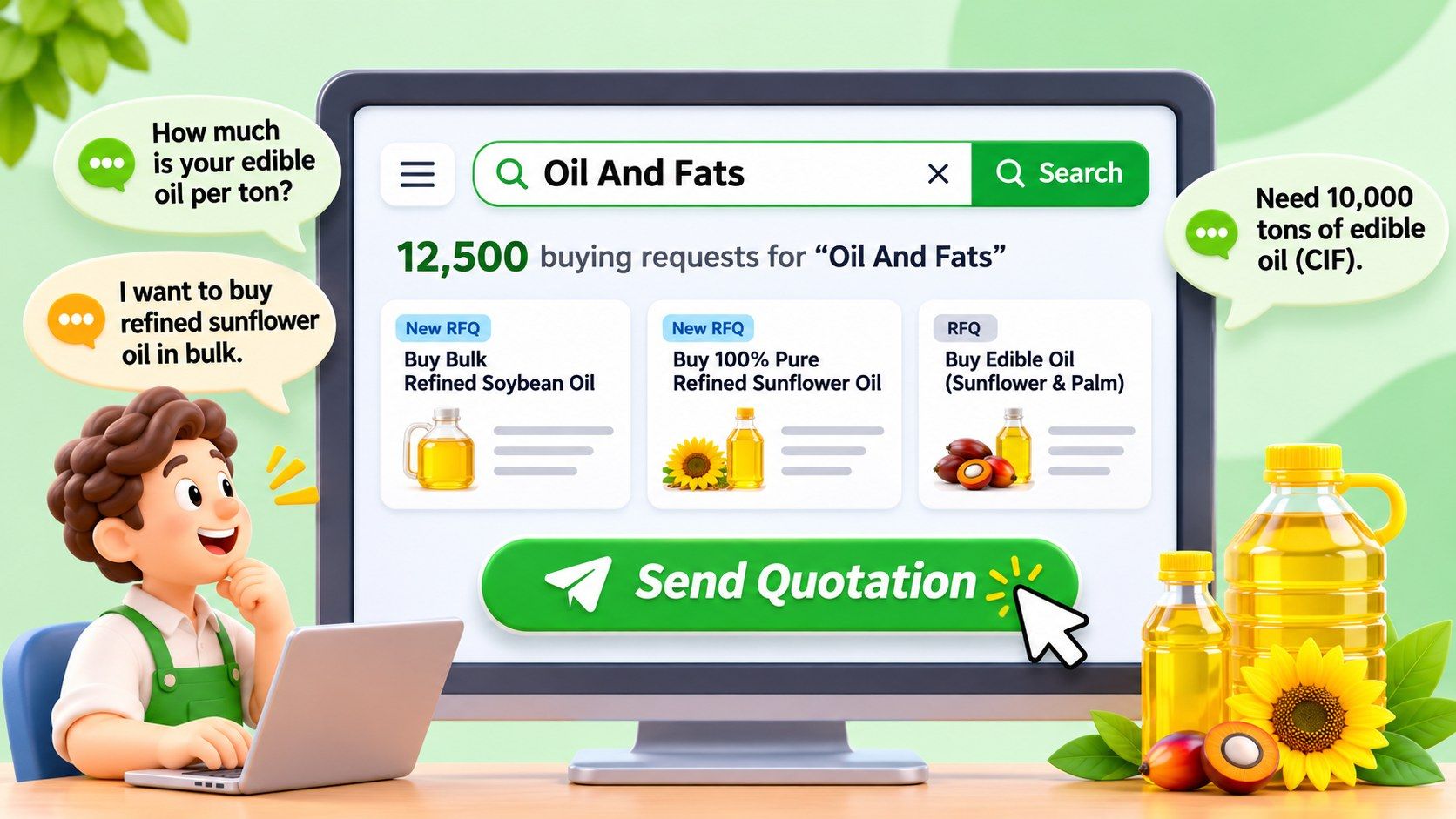
4. Explore Edible Oil Buying Leads and Send Relevant Quotations
After publishing your products, explore buying opportunities on Freshdi.
Buyers may source different edible oils for food manufacturing, wholesale distribution, retail packaging, and commercial use. Their requirements can vary significantly in terms of product type, volume, packaging, quality, destination, and payment arrangements.
Start by exploring:
Refined Edible Oil Buying Leads →
Edible Vegetable Oil Buying Leads →
Unrefined Edible Oils Buying Leads →
AI-generated image
How to Evaluate an Edible Oil Buying Request
Before sending a quotation, review the buyer's requirements carefully.
- Product type: Does the buyer need sunflower oil, soybean oil, palm oil, coconut oil, or another vegetable oil?
- Refining status: Is the request for crude, refined, unrefined, virgin, or another specific product?
- Quality specifications: Can your product meet the requested technical parameters?
- Quantity: Can your company supply the requested volume consistently?
- Packaging: Can you provide the required bottles, jerry cans, tins, drums, or bulk packaging?
- Destination: Can you arrange export to the requested destination and meet applicable requirements?
- Trade terms: Does the buyer request FOB, CIF, CFR, or another Incoterm?
- Payment terms: Can your company accept the proposed payment arrangement?
What to Include in Your Quotation
A professional quotation should include:
- Product name and oil type.
- Refining status.
- Country of origin.
- Detailed product specifications.
- Available quantity and MOQ.
- Price and currency.
- Price basis and Incoterm.
- Packaging format and capacity.
- Lead time and shipment schedule.
- Payment terms.
- Validity period of the offer.
- Available certificates and supporting documents.
For example, if a buyer requests refined sunflower oil in 1L, 2L, and 5L PET bottles, your quotation should confirm the available packaging sizes, product specifications, minimum order quantity, monthly supply capacity, and price under the requested trade terms.
Avoid sending a generic quotation that only states your company can supply edible oil. Address the buyer's specific requirements so they can evaluate your offer more efficiently.
5. Work with a Freshdi Account Manager for Industry Guidance
Edible oil exporters may benefit from discussing their business goals, product presentation, and buyer outreach activities with a Freshdi Account Manager.
Freshdi's Account Manager team includes support for the Oil & Fats, Dairy, Packaged Foods category. Ngô Ái Ngọc Diệu is listed as an Account Manager for this industry group on Freshdi's Account Manager page.
An Account Manager can provide ongoing support and consultation, including:
- Reviewing your company profile and product presentation.
- Advising on how to communicate your edible oil specifications.
- Providing guidance on exploring relevant buyer opportunities.
- Recommending ways to improve your business presence on Freshdi.
- Explaining platform features that may support your business development activities.
Before arranging a discussion, prepare your product range, refining status, origin, available volume, packaging options, quality specifications, certifications, target markets, and preferred trade terms.

AI-generated image
You can find the relevant specialist and arrange a discussion through Freshdi Account Manager →
6. Explore Freshdi Premium Membership as Your Business Grows
As your export activities develop, you may want to consider additional platform features to support product visibility and buyer outreach.
Freshdi offers Free, Advance, and Superior supplier membership options. Features and usage limits differ by plan.
Depending on the selected plan, Premium membership may provide:
- Daily credits to access buyer profiles and contact opportunities.
- Access to buying leads and quotation tools.
- Higher product-posting limits.
- Additional store and product visibility.
- Advertised product posts.
- Account Manager support, depending on the plan.
For edible oil exporters managing multiple products, packaging formats, and target markets, these tools may help organize product promotion and buyer outreach.
However, membership does not guarantee buyer inquiries, orders, or completed transactions. Results still depend on product suitability, pricing, supply capacity, buyer requirements, and commercial terms.
Review the current features and conditions on Freshdi Membership Plans → before choosing a plan.
Conclusion: Build Your Edible Oil Export Presence on Freshdi
Growing an edible oil export business internationally starts with presenting your products clearly and connecting with buyers whose requirements match your supply capabilities.
On Freshdi, you can create a supplier profile, publish edible oil product listings, explore buying leads, and send quotations to potential buyers. You can also consult an Account Manager for guidance on product presentation and relevant platform opportunities.
Start with accurate company information, detailed product specifications, suitable packaging options, and responsive communication. These fundamentals can help your business build a professional online presence and develop international trade connections over time.
Ready to introduce your edible oil products to potential international buyers? Get started on Freshdi → and build your supplier presence today.
Frequently Asked Questions
How can I start selling edible oil on Freshdi?
Create a supplier account, complete your company profile, submit the required business verification information, and publish detailed edible oil product listings. You can then explore relevant buying leads and send quotations based on buyer requirements. Keep your product specifications accurate and only offer volumes, packaging and trade terms that your company can actually support.
What types of edible oil can I list on Freshdi?
You can list the edible oils your company actually supplies, such as sunflower oil, soybean oil, palm oil, coconut oil, olive oil, rapeseed oil, corn oil and other vegetable oils. Create separate listings for products with different refining processes or specifications, so buyers can compare the exact product they need without confusion.
What information should I include in an edible oil product listing?
Include the oil type, refining status, origin, quality parameters, packaging, shelf life, MOQ, available quantity, trade terms, payment terms and relevant product documents or certificates. Accurate, specific details help buyers judge whether your product fits their requirements and reduce unnecessary back-and-forth before a quotation is sent.
What is the difference between refined and unrefined edible oil?
Refined edible oil has undergone processing steps intended to remove certain impurities and improve characteristics such as color, odor, or stability. Unrefined oils undergo less processing, and their characteristics depend on the source material and production method. Buyers should confirm the specific product grade and technical parameters before purchasing, because the two categories are not interchangeable.
What packaging options are commonly used for edible oil exports?
Common formats include PET bottles, jerry cans, metal tins, drums, flexitanks, ISO tanks, and bulk shipments. The appropriate format depends on the oil type, buyer requirements, transportation arrangements, and destination-market regulations. Confirm food-grade suitability, filling capacity and labelling requirements with the buyer before committing to a packaging format.
Can edible oil exporters find international buyers on Freshdi?
Freshdi allows suppliers to showcase products, explore buying leads and connect with potential buyers. You can review product requirements, quantities, destination ports, trade terms and payment terms before deciding whether to send a quotation. Focus on requests that match your refining status, packaging and supply capacity, and verify each buyer's details before committing stock.
Does Freshdi Premium guarantee edible oil export orders?
No. Premium membership provides access to additional platform features and tools, depending on the selected plan. It does not guarantee buyer inquiries, orders, or completed transactions. Results still depend on product suitability, pricing, supply capacity, buyer requirements and commercial terms, so review the current membership conditions before subscribing.
References
- freshdi.com
Disclaimer: This article is compiled by Freshdi for general informational purposes based on platform information and product-trading terminology available at the time of writing. Platform features, membership conditions, supplier listings, and buyer requirements may change and may not be independently audited. Product specifications, quality parameters, packaging suitability, and regulatory requirements should be confirmed between trading parties. Buyers and suppliers should independently verify business information, product quality, certifications, documents, and transaction terms before entering into any agreement. This content does not constitute a guarantee of business results or professional trade, legal, or financial advice.