Introduction
Vietnam rice export price rose sharply in late October. Vietnamese 5% broken white rice was quoted at US$470–480 per metric tonne on 29 October, its highest level in nearly two years, up from US$440–450 a week earlier. This update explains what is moving prices, where import demand is concentrated, and what buyers and suppliers should do next.
Key Takeaways
- Vietnam 5% broken rice: reached US$470–480/MT on 29 October, about US$30/MT above the previous week's reported range.
- India and Thailand: India's comparable 5% broken white rice was quoted at US$389–394/MT, while Thai 5% broken rice was around US$480/MT. Specification and contract differences still matter.
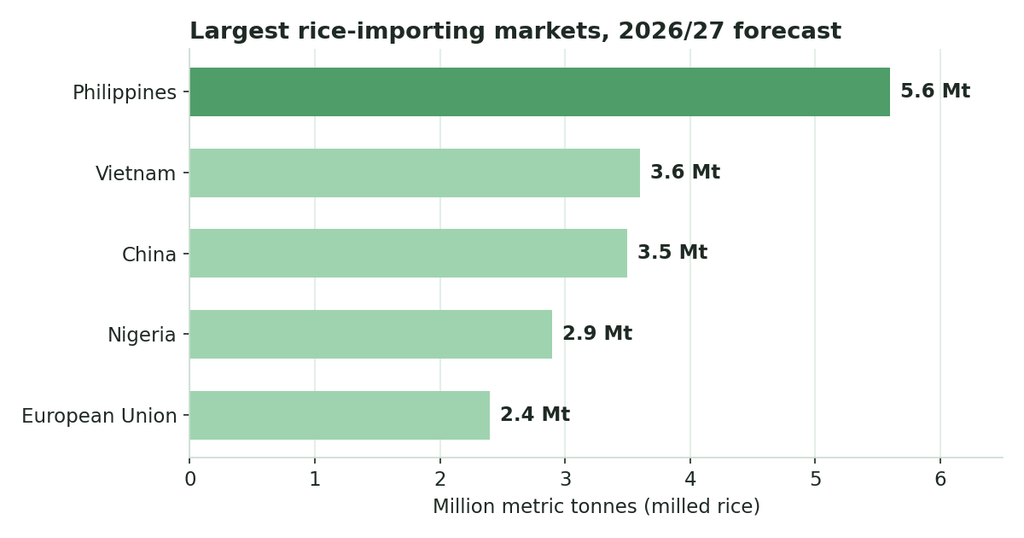
- Import demand: the Philippines is forecast to remain the world's largest rice importer in 2026/27, followed by Vietnam and China.
- Vietnam's destinations: the Philippines, China and Ghana were Vietnam's three leading rice export destinations in the first nine months of 2026.
- Next step: buyers should compare landed cost and exact specifications, and suppliers should keep offers current and respond to relevant buying requests.
A higher quote does not automatically mean a stronger market. A US$30 per tonne increase is hard to ignore for an importer comparing offers this week. Vietnam's rice export performance was still below the previous year during much of 2026, however, and buyer demand varied sharply by destination. The latest rebound is better understood as a market tightening before the next harvest, combined with expectations of renewed buying. It does not prove that every rice grade or export market is strengthening at the same pace.
1. Where Are Rice Export Prices Now?
The latest trader quotations reported on 29 October put Vietnamese 5% broken white rice at US$470–480 per metric tonne. The same market report placed Thai 5% broken rice at about US$480/MT and Indian 5% broken white rice at US$389–394/MT. On those reported offers, Vietnam had moved close to Thailand's price level, while India remained the lower-priced origin.
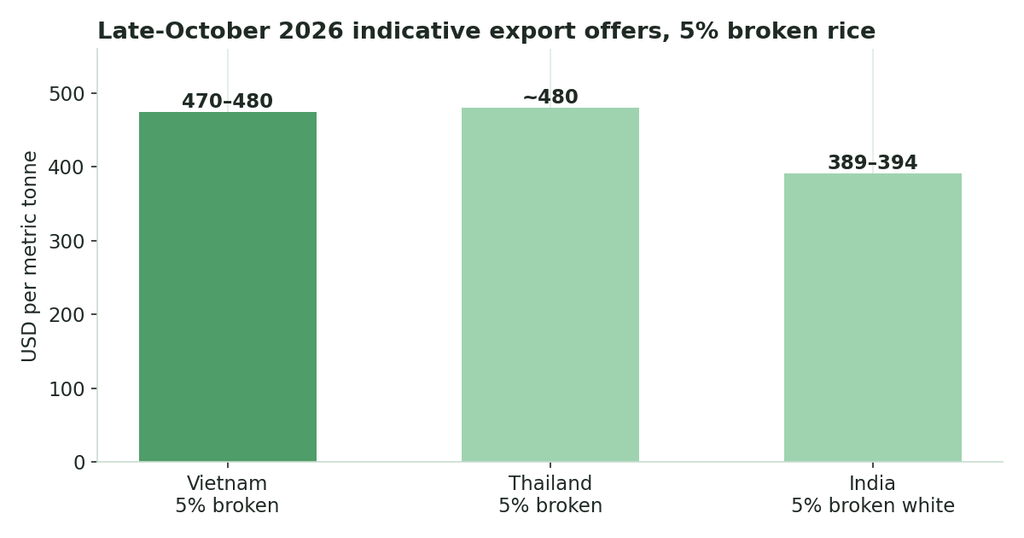
A buyer should not treat every product labelled "5% broken" as identical. The one-week change in Vietnam's reported range is especially notable. Using the midpoints of US$445 and US$475, the increase is approximately 6.7%.
A separate measure tells a different story. Vietnam's average export unit value for all rice shipments in January–September 2026 was estimated at US$484.8 per tonne, down 5.1% year on year. That average covers a wider mix of grades and export transactions over nine months, so it should not be compared directly with the late-October 5% broken quotation.
2. Why Did Vietnamese Rice Prices Rise?
Tighter nearby supply before the next harvest
Traders cited thin domestic stocks as a key reason for the late-October increase. The autumn–winter harvest was expected to begin toward the end of November, leaving a tighter nearby supply window before new crop volumes became available. Market participants estimated that output from this crop could be around half the size of the summer–autumn harvest. That is a market estimate, not a confirmed final production figure.
Import demand expectations are influencing sentiment
The Philippines remains a major destination for Vietnamese rice. On 4 August 2026, the Philippine Department of Agriculture said it would not suspend rice imports that year, citing food-security preparations ahead of El Niño risks. That policy position helps explain why buyers and traders continued to watch Philippine demand. It does not confirm a specific tender or purchase schedule, so buyers should verify current permits, tenders and approved supplier requirements before treating market expectations as confirmed orders.
Regional competition is not moving in one direction
India's 5% broken white rice remained around US$389–394/MT in the 29 October report, supported by new-season paddy arrivals. Thailand was quoted at about US$480/MT. Flooding in some Thai growing areas was reported as a source of uncertainty, while traders also pointed to exchange rates and domestic prices. The comparison shows why buyers need to evaluate origin, grade and delivery conditions together.
Weather risks are a watchpoint, not a price guarantee
Traders also raised concerns about possible El Niño effects on production from 2027. This is a forward-looking risk, not a confirmed production loss. For procurement planning, buyers should monitor official crop forecasts and supplier availability rather than building a purchase decision around a single weather scenario.
Looking to Source Rice?
Connect with verified suppliers, discover matching products, and explore sourcing opportunities from global markets.
3. Which Countries Import the Most Rice?
For a global sourcing decision, it helps to separate two questions: which countries are expected to import the most rice overall, and which countries are currently important destinations for Vietnamese rice. These rankings describe different things.
October 2026 USDA FAS PSD projections, as compiled by Commo Atlas, place the Philippines first for 2026/27 rice imports at an estimated 5.6 million tonnes. Vietnam and China follow at 3.6 million and 3.5 million tonnes. Nigeria and the European Union complete the top five in this forecast.
For Vietnamese exporters, the current destination mix is more specific. Ministry of Agriculture and Environment figures for January–September 2026 identified the Philippines as the largest destination, accounting for 40.9% of Vietnam's rice export shipments. China accounted for 17.4%, and Ghana 12.7%. Export value to China increased 76% year on year, while value to the Philippines declined 16.8%.
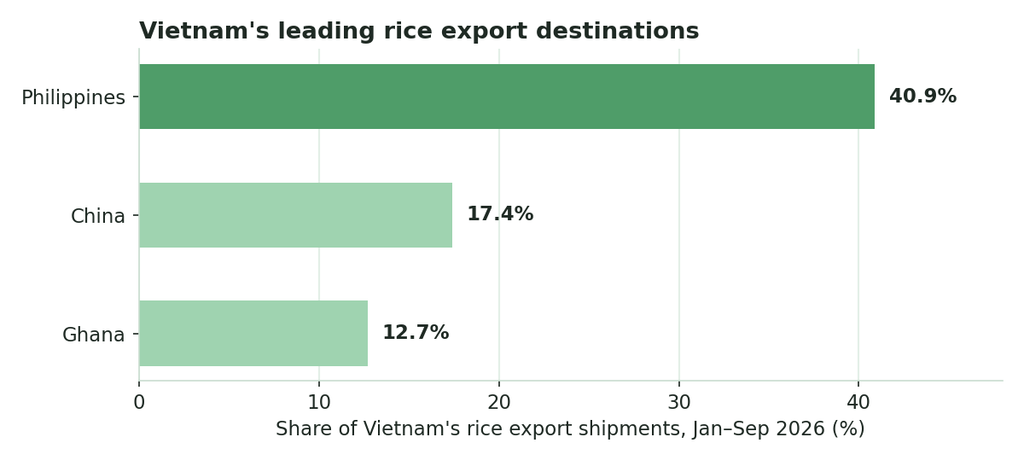
The concentration is commercially important. The Philippines remains a key volume market, China is showing stronger momentum in the reported period, and Ghana remains an important West African destination. Suppliers should not assume that demand in one market represents the wider global market.
4. Where Can Buyers Source Rice at a Good Price?
A lower export offer is a useful starting point, but it is not the same as the lowest delivered cost. In the 29 October comparison, India's 5% broken white rice was quoted below Vietnamese and Thai offers. That may make Indian-origin rice attractive for some buyers, but the right choice depends on destination freight, import rules, product consistency, packaging, inspection, payment terms and shipment availability.
Compare the full specification, not just the headline price
- Rice type and variety: white, parboiled, fragrant, Jasmine, Basmati or another variety.
- Broken percentage and quality tolerances: confirm the exact grade, moisture, foreign matter and other agreed parameters.
- Crop year and origin: ask whether the offer is from current crop or carryover stock.
- Quantity and packaging: compare the same volume, bag size, bulk format and loading arrangement.
- Delivery basis: distinguish FOB, CFR and CIF, and include freight, insurance and destination charges when calculating landed cost.
- Payment and inspection: clarify T/T or L/C terms, sample approval, pre-shipment inspection and documents.
A US$390/MT offer from one origin is not automatically better than a US$420/MT offer from another if the first has higher freight, a different variety, less suitable quality parameters or a longer lead time. Ask several suppliers to quote against the same written specification, then compare the total cost to your destination port.
5. What Does the Latest Demand Look Like on Freshdi?
Beyond national trade statistics, buyers and suppliers also need to see what other businesses are actively sourcing. Freshdi's rice buying requests showed 2,141 rice buying leads from 1,869 buyers and importers, with the page updated on 1 November 2026. It also listed 271 rice buying requests posted in the preceding 30 days. These are platform figures, not a measure of total global rice demand, and request status should be checked before responding.
The visible requests show how varied buyer specifications can be. Some ask for parboiled rice, others for Basmati varieties, Matta boiled rice or white rice with different broken percentages. Quantities and destination ports also vary, which is why suppliers should avoid sending the same generic quotation to every inquiry.
For buyers: browse rice suppliers, compare product listings and send a buying request with clear specifications so that potential suppliers can assess whether their products match your requirements.
For suppliers: review current rice buying requests, check the buyer's required variety, quantity, destination and trade terms, and respond only when your offer is a genuine fit.
6. What Should Buyers and Suppliers Do Next?
For rice buyers and importers
- Prepare one specification sheet and send it to multiple suppliers.
- Compare quotations on the same Incoterm and destination basis.
- Check the supplier's origin, export experience, capacity, quality documents and current availability.
- Ask for samples or independent inspection where appropriate.
- Review the buying request and quotation details before moving to payment or contract discussions.
For rice exporters and suppliers
- Keep the listing current, including variety, grade, broken percentage, crop year, moisture, packaging and available quantity.
- State the loading port, quote currency, Incoterm and validity period clearly.
- Upload real product and facility images that accurately represent the goods offered.
- Explain relevant certificates and quality-control processes without making unsupported claims.
- Monitor buying requests and tailor each quotation to the buyer's destination and specification.
How Freshdi Helps Buyers and Suppliers Connect
Rice prices can change quickly, but the strongest sourcing decisions come from more than timing the market. Buyers need suppliers whose quality, quantity, delivery terms and documentation fit the order. Suppliers need a clear way to present their products and discover relevant demand.
Freshdi brings buyers and suppliers together through product listings and buying requests. Buyers can find potential suppliers in the rice category and outline their sourcing requirements, while suppliers can find new rice buying requests and present offers that match the buyer's needs.
Frequently Asked Questions
Conclusion: Find the Right Rice Trading Partner
Rice prices moved up sharply in late October, but one price change does not show the whole market. Buyers should compare landed cost and exact specifications across origins. Suppliers should keep offers current and respond only to requests that match their product and destination.
Visit Freshdi's supplier directory to compare rice suppliers and review current sourcing needs.
Sources
- Reuters market quotations, reported by Business Recorder (29 October 2026)
- DTiNews: Vietnam rice export prices jump USD 30 to near two-year high (2 November 2026)
- Vietnam Ministry of Agriculture and Environment figures, reported by Agro.gov.vn (5 October 2026)
- USDA Economic Research Service: Rice Outlook, October 2026 (14 October 2026)
- USDA FAS PSD October 2026 importer projections, compiled by Commo Atlas
- Philippine Department of Agriculture statement on rice imports (4 August 2026)
- VOV: China rises to become Vietnam's second-largest rice export market (5 October 2026)
- Freshdi rice buying requests platform snapshot (updated 1 November 2026)