Share on
22 views
5 Inquiries
2 replies
Price valid until 05 Jun 2026
Minimum order quantity: 24 Tons
Open to price negotiation
Supplier Country: Indonesia
Export market: Albania, Canada, Malaysia, Brunei Darussalam, Belgium
Key Takeaways
Freshdi AI is analyzing this product...
4.4
 Indonesia
Farming / Production / Processing / Packing
East Java.
Inquiry Open Rate
100%
Total inquiries received
35
Inquiries Read
35
Year Established
2020
Based on the information provided by the supplier.
 Albania
 Canada
 Malaysia
 Brunei Darussalam
 Belgium
Western Europe
36%
Middle East
24%
Eastern Europe
15%
East Asia
15%
North America
9%
Verification information
Verify business documents
By Freshdi Verification System
Verify work email
By Freshdi.com
Verify phone number
Buyer Verification Team
Verify account email
By Freshdi.com
External Validation
Company website
Supplier confirmed with Freshdi
Company Address
Supplier confirmed with Freshdi
No reviews yet
Be the first to share your experience - your feedback helps other buyers trade with confidence.
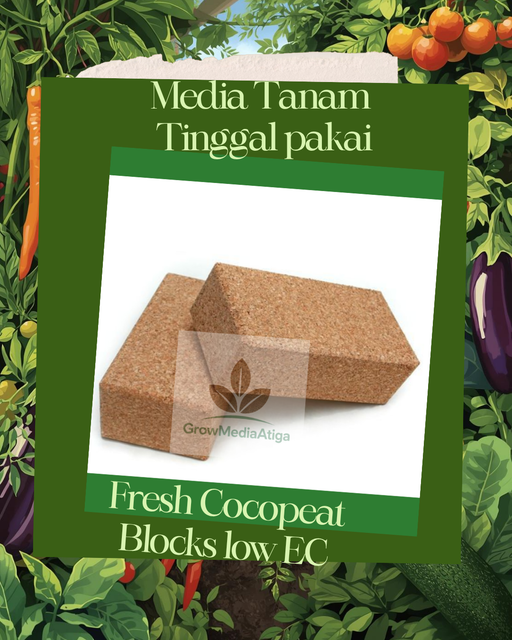
Cocopeat, also known as coconut coir pith or coir dust, is a natural by-product derived from coconut husks — the outer shell of the coconut fruit.
It is the fine, powdery material that remains after extracting long coir fibers from the husk.
Cocopeat has a soft, soil-like texture and a high water-holding capacity, making it an excellent organic growing medium.
Husk Separation
The outer husk of mature coconuts is removed from the hard shell.
Retting or Soaking
The husks are soaked in water for several days to soften the fibers and reduce tannins, salts, and other impurities.
This step also helps lower the electrical conductivity (EC) level.
Defibering / Grinding
The softened husks are processed through a defibering machine that separates the long fibers from the fine dust — the cocopeat.
Washing
The cocopeat is thoroughly washed with clean water to remove residual salts, ensuring a low EC value suitable for plant growth.
Drying
The washed material is sun-dried or mechanically dried to reduce the moisture content below 15%.
Sieving and Compressing
The dried cocopeat is screened to obtain uniform particle size and then compressed into blocks, briquettes, or grow disks for packaging and export.
Property Typical Range Description
Property Typical Range Description
Color
Light to dark brown
Depends on drying level
pH
5.5 – 6.8
Slightly acidic, ideal for most plants
Electrical Conductivity (EC)
< 0.6 mS/cm (washed)
Low salt content
Water holding capacity
5–7 times its dry weight
Excellent moisture retention
Lignin content
~30%
Provides durability and elasticity
Cellulose content
~25%
Contributes to structure and porosity
Bulk density
~0.4 g/cm³
Lightweight
Ideal storage moisture
≤15%
Prevents mold growth
You are viewing details for cocopeat. The information provided here is either posted directly by the supplier, who is responsible for its accuracy, or collected by Freshdi AI from publicly available sources. Freshdi strives to make product information as useful and reliable as possible, but we do not guarantee complete accuracy. If you notice any incorrect or misleading details, please use the Report Product option so our team can review and address it quickly.
$510
/ Tons
Min. order: Negotiable

Haryanto (Founder/ Owner)
Active
Year Established: 2020
Business type
Farming / Production / Processing / Packing
Main Export Markets