

Introduction
Finding reliable global suppliers is essential for importers, wholesalers, distributors, and procurement teams. The right supplier can influence product quality, purchasing costs, delivery schedules, and long-term business relationships.
Successful international sourcing involves more than comparing prices. Buyers must assess business credentials, product specifications, supply capabilities, and commercial conditions before placing an order.
Key Takeaways
- Define your sourcing requirements before searching for suppliers.
- Use B2B marketplaces and industry networks to discover international manufacturers and wholesalers.
- Verify business information, product quality, and export capabilities.
- Compare supplier quotations, MOQ, payment terms, and shipping conditions.
- Seek industry-specific guidance when exploring new sourcing opportunities.
1. Define Your Sourcing Requirements
Prepare a sourcing brief covering product name and specifications, quantity, packaging, origin, destination market, and required delivery schedule.
For Arabica coffee, specify bean grade, processing method, moisture level, packaging, and quantity. Also define MOQ, target price, payment terms, and applicable Incoterms so suppliers can prepare comparable quotations.
Looking to Source ?
Connect with verified suppliers, discover matching products, and explore sourcing opportunities from global markets.
2. Search for International Suppliers Through Different Channels
Discover potential suppliers through trade exhibitions, business directories, industry associations, professional networks, and online B2B marketplaces. These channels help buyers explore businesses beyond their existing networks.
An online B2B marketplace such as Freshdi.com helps buyers explore supplier profiles, product listings, and potential sourcing opportunities across categories.
Use Find Suppliers on Freshdi with specific searches. For example, “1121 Sella Basmati Rice Exporters India” is more targeted than “rice suppliers.”
3. Verify Supplier Business Information
Review a potential supplier’s business identity and available documentation. Check:
- Business registration and company address.
- Official website and business contact information.
- Company activities and product portfolio.
- Relevant business or product certifications.
- Available export experience and references.
Marketplace verification indicators can support initial screening, but they do not guarantee product quality, financial stability, or successful transactions. Conduct independent checks before committing to a purchase.
4. Evaluate Product Quality and Supply Capabilities
A competitive quotation does not prove that a supplier can meet your requirements. Request specifications, relevant certificates of analysis, product photographs, and samples where appropriate.
Confirm MOQ, production or inventory capacity, quality consistency, lead time, and repeat-order capability. For larger orders, consider independent inspections or third-party testing.
5. Compare Supplier Quotations and Trade Terms
Compare quotations against the same specifications, quantity, packaging, payment terms, and delivery conditions, not just the lowest unit price.
| Criteria | What to compare |
|---|---|
| Price | Unit price and currency |
| MOQ | Minimum purchasing quantity |
| Quality | Product grade and specifications |
| Payment | L/C, T/T, or agreed arrangements |
| Shipping | Applicable Incoterms and named destination |
| Lead time | Production and delivery schedule |
Compare total landed cost too, including freight, insurance where applicable, customs duties, and destination charges.
6. Conduct Due Diligence Before Placing an Order
Before signing or paying, independently confirm the supplier’s business details and payment beneficiary. Document specifications, delivery responsibilities, required documents, inspections, and dispute-resolution provisions in the agreement.
For an unfamiliar supplier, consider a manageable trial order. No online profile or verification badge replaces proper due diligence.
7. Get Industry-Specific Guidance from Freshdi Account Managers
Supplier discovery is only one part of sourcing. Businesses may also need guidance on product categories, market opportunities, and next steps.
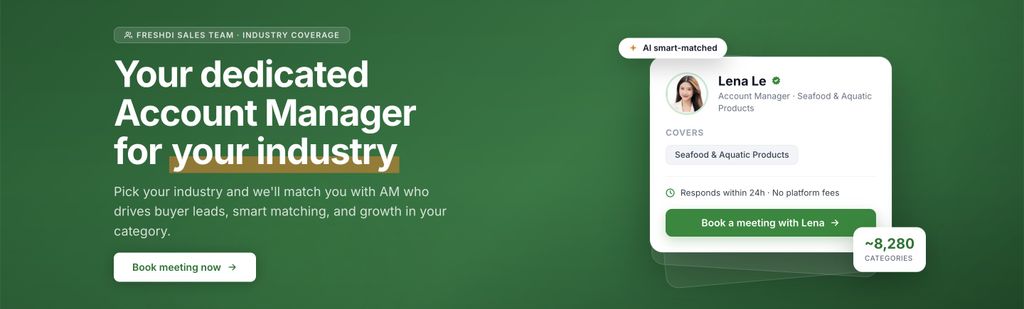
Freshdi provides industry-focused Account Manager support alongside its online B2B marketplace. On the Account Manager page, users can explore industry coverage and book a meeting with a relevant specialist.
AI-generated image
- Free consultations with industry-focused Account Managers.
- Guidance on category-specific buyer leads and matching opportunities.
- Advice on improving company profiles and product listings.
Freshdi highlights free consultations, no platform fees, and a meeting-booking option. Users can book a meeting with an Account Manager to discuss their category and next steps.
Start Exploring Global B2B Opportunities with Freshdi
Finding suitable suppliers takes clear requirements and careful evaluation. Freshdi brings supplier discovery, product listings, buying opportunities, AI-supported matching, and industry-focused Account Manager support into one B2B marketplace.
Explore Freshdi as another channel for discovering suppliers and international business opportunities.
Explore Freshdi: Find Suppliers →
Frequently Asked Questions
How can I find reliable global suppliers?
Start with a clear sourcing brief that lists the product specification, quantity, packaging and destination. Search relevant B2B marketplaces, trade exhibitions and industry networks, then verify company information, product quality and export experience. Request quotations with the same specification from several suppliers and compare them before placing an order, ideally starting with a manageable trial shipment.
What should I check before choosing an international supplier?
Review the supplier’s business registration, company address, product specifications, certifications, production capacity and export experience. Confirm the MOQ, payment terms, trade terms and delivery arrangements in writing. Ask for samples and supporting documents, and check that the claims in the listing match the documents provided. Independent due diligence is important before you pay or sign a contract.
Are online B2B marketplaces useful for finding suppliers?
Yes. B2B marketplaces help buyers discover international businesses, compare product offerings and explore sourcing opportunities in one place, which saves time compared with searching channel by channel. Verification indicators and ratings can support initial screening, but they do not replace your own checks. Always confirm specifications, certificates and commercial terms directly with the supplier.
Can Freshdi Account Managers help with sourcing?
Yes. Freshdi users can book a free consultation with an Account Manager who covers their industry. Account Managers can offer guidance on sourcing opportunities, buying leads, profile and product optimization, and the platform’s services. This is a practical starting point if you are exploring a new product category or market and want to understand your next steps.
Where can I find global suppliers on Freshdi?
You can use the Find Suppliers section on Freshdi to search supplier profiles and product listings by product name, category or country. Use specific keywords, such as the product grade or form, to narrow the results. Open each profile to review the company information and product details, then contact the suppliers that match your requirements and request quotations.
Disclaimer: This article is compiled from platform data, public sources and information provided by third parties, for general informational purposes only. We do not guarantee its accuracy or completeness. Mentions and rankings of suppliers do not constitute an endorsement or guarantee, and strategies and examples are illustrative; results may vary. Please conduct your own due diligence before making business decisions.