
$1,200 - $1,600
Min. order: 24 Tons
![]()
$960
Good Price
Min. order: 24 Tons
![]()
$850 - $1,400
Good Price
Min. order: 10 Tons
![]()
$360
Good Price
Min. order: 1000 Tons
![]()
$720
Good Price
Min. order: 100 Tons
![]()
$700 - $1,150
Good Price
Min. order: 10 Tons
![]()
$1,700 - $2,600
Good Price
Min. order: 10 Tons
![]()
$1,250 - $2,150
Good Price
Min. order: 10 Tons
![]()
$750 - $1,150
Good Price
Min. order: 10 Tons
![]()
$170 - $260
Good Price
Min. order: 10 Tons
![]()
$780 - $1,250
Good Price
Min. order: 10 Tons
![]()
$1,100 - $1,750
Good Price
Min. order: 10 Tons
![]()
$500 - $830
Good Price
Min. order: 10 Tons
![]()
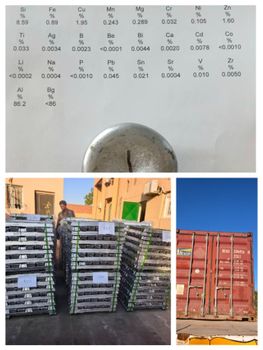
Aluminum is a lightweight, corrosion-resistant metal commonly used in construction, transportation, and manufacturing; key attributes include strength, recyclability, and thermal conductivity. Conceptually, aluminum is structured into subtypes like extruded, sheet, and foil, each with distinct thickness, purity, and processing requirements that influence application suitability. To evaluate suppliers, buyers should first filter by material grade (e.g., 6061, 7075) and verify certifications like ISO 9001 or ASTM standards, then check product samples or test reports before placing orders—examples include sourcing 6061-T6 extrusions for automotive parts or 3003 aluminum foil for packaging. Buyers must verify supplier certifications, material test reports, and lead times to ensure quality and reliability—examples include asking for a third-party material certification or confirming delivery timelines for a 500kg order.
Aluminum sheets are primarily imported into Asia, the Middle East, and North America, with China, India, and the UAE being key destination markets. Commonly exported variants include 6061-T6, 5052-H32, and 3003-H24, with trade names such as "6061 aluminum sheet" or "aluminum alloy sheet." Suppliers typically list material composition (e.g., 6061-T6), thickness (e.g., 1.0–3.0 mm), and surface finish (e.g., polished, anodized), with 6061-T6 being preferred in North America for structural applications and 5052-H32 in Asia for packaging and automotive use. In the Middle East, anodized finishes are in high demand due to corrosion resistance, while 3003-H24 is favored in South Asia for cost-sensitive applications. These variants are consistently listed in B2B supplier catalogs, and the data reflects verified trade volumes and regional demand patterns on Freshdi.
Aluminum is a lightweight, durable, and corrosion-resistant metal widely used in construction, automotive, packaging, and manufacturing. On Freshdi, aluminum products include sheets, extrusions, profiles, and alloys, serving industries such as automotive manufacturing, building and construction, and packaging solutions. For example, a facilities manager in a commercial building might search for aluminum profiles to upgrade window frames for energy efficiency, while a manufacturing engineer in the automotive sector may look for aluminum sheets to reduce vehicle weight and improve fuel efficiency. Freshdi provides a B2B marketplace connecting buyers with suppliers offering a range of aluminum products tailored to these industrial applications.
Freshdi lists aluminum suppliers with verified B2B profiles, where reliability is often supported by common industry certifications such as ISO 9001, ISO 14001, and ASTM standards. Buyers typically expect suppliers with at least 5–10 years of operation and proven export history to key markets like China and the United States. Trade terms commonly include FOB Shanghai and FOB Singapore, with payment terms often set at 30% advance payment and 70% against bill of lading, reflecting standard practices in international aluminum trade.
You may like
You may like