This is the supplier profile page of ANA MARIA AZUMENDI SANCHEZ, where buyers can explore products, connect directly with the supplier for pricing inquiries.

1.1
MINA 306 NUEVO CASAS GRANDES NUEVO CASAS GRANDES CHIHUAHUA 31700
Add Favorite
Report Supplier
Business Description
In 2015 I was working on a project which involved finding maritime data to create a visualisation of boats, which you can see in this link:
http://lumacode.com/projects/gttw/
and I was planning to develop it further into a poetic visualisation of the boats from the port of Buenos Aires, when I remembered that my grandfather had lived in Argentina.
http://www.mariamencia.com/pages/gatewaytotheworld.html
I had only just recently found an ID card at my mother's house in their place of origin, a village from the province of Guadalajara in España. As nowadays we look for everything online, I decided to google his name, Franciso Mencía Roy and the name of the city where he lived in Argentina, Comodoro de Rivadavia, and to my surprise I found his name together with that of his brother Cosme, on the passengers' list of a boat called the Winnipeg. I was astonished as I didn't expect to find their names online and from this moment on, the project took a different direction. I was too curious not to carry on researching and exploring the possibilities to create an artistic project based on such a personal and intimate event, as well as historical to present it at the E-Poetry Festival in Buenos Aires, Argentina.
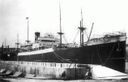
Therefore, I started to research about the Winnipeg, nobody in my family knew they had travelled on this boat. After the Civil War in Spain, there were many Spanish Republicans that fled to France and were kept in concentration camps in the south of the country and it seems as though my grandfather and his brother were in these camps. This news was a massive surprise for all the family and more so when I also discovered that the famous poet Pablo Neruda from Chile, who worked as the Consul Immigration Officer, living in Chile at the time, with his love for Spain and moved by this situation, in a gesture of solidarity, had decided to help these refugees with the assistance of Pedro Aguirre Cerda, the Prime Minister of Chile at the time. He organised the Winnipeg and interviewed every passenger on the boat, being able to accommodate 2,200 Spanish civil war exiles to travel from Trompeloup, France to Valparaiso, Chile on the 4 of August 1939. (You can read Neruda's beautiful poem "Misión de amor" in his book Memorial de Isla Negra. It might be translated like “A Labour of love” or “Love mission” where he explains how he was calling them and they were appearing with their different professions. He also compares them to seeds he is spreading over the sea on their way to peace.)
It is said, that when the Winnipeg was about to leave, Pablo Neruda was so touched by the emotional atmosphere created at the port with the people leaving, that to keep this memory, he wrote: "Que la crítica borre toda mi poesía, si le parece. Pero este poema, que hoy recuerdo, no podrá borrarlo nadie". "The critics may erase all of my poetry but this poem that I today remember, nobody will be able to erase".
I was completely astonished that thanks to Pablo Neruda, my grandfather had been saved from the concentrations camps in France and given a place to travel on this vessel. As far as I know, he was a medic so I presume this must have been a valuable skill to have in a long trip like this one. I tried to find any long lost family who might have any information about the Winnipeg, perhaps have family in Chile but I had not much luck until recently, when I was told Cosme, his brother, had been married in Chile and had family there. This unfortunately came after I had already had been to Chile and I am yet to be in touch with them.
Thus, starting with the exploration of the visualisation of maritime data and the use of mobile Apps, my artistic research evolved into reading about historical events of the Spanish Civil War and the Historical Memory including Spanish and Chilean Memory. I have found books, exhibitions about the Winnipeg, its passengers, their lives, family and a very useful link to the archive of La Memoria Chilena. It was amazing to see not only my grandfather's story unravelled in front of my eyes- at discovering stories and information about this important historical event, which as a matter of fact, it is still lost in the memory of Spain as it is not that well known- but also how this fact had impacted and influenced my own life.
To start with I was interested in creating a poetic visualisation of the ships traveling to Latin America during the month of August 1939, with the Winnipeg being the star as the cargo ship of many feelings, hopes and farewells. I contacted libraries to find the log of the Winnipeg or any digitised information about the boats sailing on that year from France or Spain to Latino America but I have yet to find the route of the Winnipeg digitised. The data and coordinates would have been useful to visualise an accurate route but I found a map in the archive of La Memoria Chilena showing the trajectory from Trompeloup to Valparaiso, which now has become part of the project with the name of the passengers appearing as a string of text delineating the route of the Winnipeg.
I travelled to Buenos Aires and presented the first prototype of the project at the E-Poetry 2015 Festival, getting the audience engaged and curious about the story. The day of the opening at the Museo de la Inmigración (MUNTREF), which in the past had been the hotel of the immigrants because of its vicinity to the port, I had another amazing surprise. I found out they had digitised all the passengers’ arrivals to the port and consequently, I found documents stating the arrival of my grandmother and her four children on their visit to my grandfather on the 12th of February 1951 in the vessel of Cabo de Buena Esperanza. She had travelled with all her children apart from my father because due to his age he had to do the military service in Spain. My aunts and uncles were young, with ages from twenty the oldest girl, eighteen and sixteen the two boys and thirteen the youngest girl. The date revealed that they hadn't seen my grandfather for very long eleven years, and on top of it all, we found out the reason why my grandmother and her youngest daughter had shortly come back to Spain, was because my grandfather died soon after they arrived. The three other children stayed in Latino America looking for a better live until they finally settled in Caracas, Venezuela. Years later my father travelled with my mother to visit his family, this visit was extended to seven years and there I was born.
I would have never thought I was going to be indebted to the poet responsible for the "Twenty Love Poems: And A Song of Despair” that I had so many times recommended to my students of Spanish in London, the Pablo Neruda of the “The book of questions”- for how he had forged and contributed somehow to my interests in life: travelling, cultures, languages, literature, art, the need to explore and be curious, the always feeling like being from somewhere else and somehow different, of being melancholic and happy at the same time, of being able to stand up on my own two feet with perseverance and determination, because somehow I had inherited this from my family. And finally for having saved my grandfather and his brother. I also need to add that my father was always surrounded by a sadness and bitterness due to losing his father when he was about eleven years old, when my grandfather went to war and later to exile and never to see him again, and for the consequences it all brought.
It could be said that this story that has accompanied me, without me knowing, is the fruit of many of my projects and especially of those very related to this "Poem that crossed the Atlantic" such as: "Cityscapes: Social Poetics / Public Textualities" 2005 and "Connected Memories" 2009. How unaware we are of some of our deeply ingrained feelings!
After the E-Poetry Festival in Buenos Aires, I wanted to research this further and went to the wonderful and magical city of Valparaiso in Chile, I visited Neruda's houses, Isla Negra, and Santiago de Chile where I carried on researching on archives, community centres, galleries, videoing, taking photographs, talking to people and when they asked me why I was visiting Chile, I told them my grandfather had taken me there. It was a beautiful feeling, which warmed my heart and made me feel welcomed as if somehow part of me belonged to that country, I felt at home in a country where I had never been and had gratitude for its generosity.
Finally, now we have created this website which invites the reader, the passengers’ families and anybody interested in this event to add their stories, so these become the material for the poetic visualisation of the journey of the Winnipeg, what I have tiled “The Poem that Crossed the Atlantic”, I think I saw this title somewhere on line or in the readings and I liked the idea of the vessel with its many stories to be the poem. These interconnected stories of the passengers and family which this cargo vessel carried, with their feelings, hopes and farewells, are now represented in the sea of the World Wide Web, together with the poems by Pablo Neruda and relevant information about this event.
A poem created with love to a grandfather I never met, and to my father who never saw his father again from the age of eleven. And to all of those who are currently in similar situations of hardship, displacement, lost and in exile.
Here you can add any story or facts you know about the Winnipeg to the archive. These stories will be the underlined material used for the interactive poem created in tribute to the passengers from the Winnipeg and Pablo Neruda.
Artistic Director, concept creation, researcher: María Mencía
http://www.mariamencia.com
Creative Programming: Alexandre Dupuis
I never thought I would be indebted to Pablo Neruda for saving my grandfather FRANCISCO MENCÍA ROY and his brother COSME MENCÍA ROY from the concentration camps in France.
The initial document where I found my grandfather Francisco Mencía Roy and his brother Cosme Mencía Roy. Memoria Chilena: Los españoles del Winnipeg, List of passengers. http://www.memoriachilena.cl/archivos2/pdfs/MC0001872.pdf
Neruda and the support from Chile
El largo viaje a Chile: http://www.andalucia.cc/winnipeg/capitulo_4.htm
Refugiados españoles desmienten en Chile las leyendas del barco Winnipeg
“Los historiadores Jaime Ferrer y Julio Gálvez afirmaron que en el Winnipeg viajó
“gente de todas las regiones de España” y con “oficios de todo tipo”, pertenecientes
a hasta 33 movimientos y partidos políticos distintos, según las fichas de los pasajeros
que se encontraron”.
“La pintora Roser Bru declaró que el Gobierno chileno pidió que entre los pasajeros
del Winnipeg se encontraran profesionales de todo tipo, con el fin de que pudiesen
aportar conocimientos al pueblo chileno, y descartó que solo hubiese gente afiliada
al Partido Comunista”.
Source: http://www.soitu.es/soitu/2009/09/02/info/_693424.html
“Pedro Aguirre Cerda, the president at the time, supported the cause and designated Chilean Pablo Neruda as the consul in charge of transferring the refugees. That is how, on September 3, 1939, more than 2.300 Spanish refugees arrived at the port of Valparaíso on the Winnipeg cargo ship”.
Source: http://www.thisischile.cl/the-winnipeg-is-commemorated-after-75-years-of-its-arrival-to-chilean-coasts/?lang=en
El Imborrable Poema de Neruda
Torrús A. (2012) El imborrable poema de Neruda in Público.es http://www.publico.es/espana/imborrable-poema-neruda.html
http://radio.uchile.cl/2014/08/08/winnipeg-el-poema-de-pablo-neruda-que-jamas-han-podido-borrar
La misión de amor de Pablo Neruda. El Winnipeg, Un poema que surcó mares y océanos.
http://winnipeg70.wordpress.com/la-historia-del-winnipeg/
Alonso, Ovidio Oltra (1999) Winnipeg 60 años. Leaflet with activities and testimonials by exiles. Santiago de Chile Centro Cultural de España.
Barraza, J.G. (2014) Winnipeg, Testimonios de un exilio. Biblioteca del exilio. Editorial renacimiento. Sevilla, España.
Barraza, J.G. (2003) Neruda y España, © Julio Gálvez Barraza. RIL. Santiago de Chile, Chile.
Carcedo D. (2006) Neruda y el barco de la esperanza, editorial temas de hoy.
http://cepam.cesga.es/article.php3?id_article=210
Escalona Ruiz, J.F. (1998) Una aproximación al exilio chileno: La Editorial Cruz del Sur, El exilio literario español de 1939. Edición de Manuel Aznar Soler, 2 vols. GEXEL, Barcelona, 1998,I, pp.367-378.
Ferrer, J. (1989) Los españoles del Winnipeg, El barco de la esperanza. Ediciones Cal Solgas. Santiago de Chile, Chile.
Fajardo, Marco. (2014) “Conmemoran los 75 años de la Llegada del Winnipeg con Exposición Artística.” El Mostrador, 4 Aug 2014, elmostrador.cl/cultura/2014/08/04/conmemoran-los-75-anos-de-la-llegada-del-winnipeg-con-exposicion-artistica/. Accessed 14 Oct 2018.
Ferrer Mir, Jaime (2010). Los Españoles del Winnipeg, El barco de la Esperanza. Ediciones Cal Sogas.
Florenchie, Amélie (2019) Viaje en la transliteratura con El Winnipeg, el barco de la esperanza de María Mencía, in Transmedialidades en la literatura hispanoamericana, M. Audran & G. Schmitter (ed.), América, no. 52, online journal.
Florenchie, Amélie (2018, 25-26 Oct) El Winnipeg: el poema que cruzó el Atlántico de María Mencía o la construcción digital la memoria del exilio republicano. Conference “A vueltas con el retorno”, Instituto Cervantes/Universidad Bordeaux-Montaigne.
Gálvez, Barraza Julio (2003) Neruda y España. Ril.
Gálvez, Barraza Julio (2014) Winnipeg: Testimonios de un Exilio. Editorial Renacimiento.
Lemuse,E. (1998) La investigación de “los refugiados españoles” en Chile: fuentes y hallazgos en un exilio de larga duración. Exils et migrations ibériques vers l´Amérique latine, 5, (pp.273-293)
Lloréns, V. La emigración republicana de 1939, El exilio español de 1939, dirigida por J.L.Abellán, 6 vols.
Llagaria Vázquez, Fernando (2016) “Cuando Quieras Entender Tu Presente, Pregúntate por el Pasado.” Copihue Rojo, no. 16, Sep.
Mancebo, Maria Fernanda. “El Exilio en Chile. Testimonio de Ovidio Oltra,” Presentation at the Universidad de Valencia, Cuadernos Republicanos, no. 51, 2003, pp. 65-79. dialnet.unirioja.es/servlet/articulo?codigo=1195950. Accessed 14 Oct 2018.
1.- Recuerdos Insistentes. Ovidio Oltra. Inédito.
2.- El Exilio en Chile. Testimonio de Ovidio Oltra. Mª Fernanda Mancebo Universidad de Valencia.
3.- Historia de los pasajeros del Winnipeg. Mesa redonda: Ovidio Oltra. 60º Aniversario de la llegada del Winnipeg a Chile. Centro Cultural de España. Santiago de Chile. 7 de Septiembre de 1999.
Mencia, María (2019) The Winnipeg: The Poem that Crossed the Atlantic. Hyperrhiz : New Media Cultures, 20, ISSN (online) . http://hyperrhiz.io/hyperrhiz20/moving-texts/2-mencia-the-winnipeg.html
Mencia, María. Pold, Soren & Portela, Manuel (2018) Electronic Literature Translation: Translation as Process, Experience and Mediation. Electronic Book Review
Mencia, María (2018) The Winnipeg: Poem that Crossed the Atlantic in M Boria, A Carreres, M Noriega-Sánchez & M Tomalin (eds) Translation and Multimodality: Beyond Words, 1st Edition, Routledge.
Meza N. (2019), Visualising Latin American Discourses through a Digital Rhetoric Perspective, in Digital Narrative Network, Bergen, Norway.
Meza N. (2019) Voces y figuras: hacia una retórica digital de las obras de literatura electrónica latinoamericana. Revista Texto Digital v. 15, n. 1 online: https://periodicos.ufsc.br/index.php/textodigital/article/view/v15n1p39/40647
Meza N. (Leeds Univ) 2018, The Winnipeg: TPCA: The City and the Sea: Archetypal Settings in Lain American Electronic Literature in Women in Spanish and Portuguese Studies. UoL, London, UK
Miñana Luisa, 14 June 2018, Review about my work “El Winnipeg, el barco de la esperanza”, Published in Artes & Letras -Heraldo de Aragón (main newspaper in Spain).
Morales Malva, J.R. El delito de pensar, una razón del destierro, Léxili cultural de 1939. Seixanta anys després, Edición de Mª Fernanda Mancebo, Marc Baldó y Cecilio Alonso, 2 vols. Universitat de Valencia, Biblioteca Valenciana, Fundación Max Aub, Valencia, 2002, II, (pp.613-)
Neruda P. (1974) El Libro de las preguntas. Planeta.
Neruda, P. (1974) Confieso que he vivido. Memorias. Seix-Barral, Barcelona, (pp. 204-206)
Oltra Alonso O. (1999) Texto en Winnipeg 60 años. Folleto con las actividades y el testimonio de varios exiliados editado por el Centro cultural de España, Santiago de Chile. pp. 14-15.
Pablo Neruda, el Winnipeg y los republicanos españoles.
Film director Dominique Gautier and Jean Ortiz, professor from Pau University are the authors of the documentary documental ‘La travesía solidaria’.
‘El Winnipeg sale de Pauillac, puerto cercano a Burdeos, el 4 de agosto de 1939, con destino a Valparaiso en Chile, a donde llega el 2 de septiembre.
http://www.espanol.rfi.fr/cultura/-pablo-neruda-el-winnipeg-y-los-republicanos-espanoles
http://www.bbc.co.uk/mundo/america_latina/2009/09/090830_galeria_exilio_winnipeg_pea.shtml
http://www.nuestro.cl/notas/rescate/winnipeg2.htmSongs from the trip
Songs they were welcomed with when they arrived to Chile:
El quinto regimiento.
¿A dónde vas, morena? https://www.youtube.com/watch?v=eUX9GwN5Se4″
El tamborilero.
Canción de los catalanes.
Photography – Fotografía
http://www.eldiario.es/el-holocausto-español/
Exhibitions – Exposiciones
Como conmemoración a los 75 años de llegada del Winnipeg a Chile.
Juan José Santos curator of the exhibition Reflotamiento del Winnipeg 7-27 August 2011, in the Casa de la Ciudadanía de Montecamerlo in Santiago de Chile.
En Español:http://www.gobo.tv/jwp/en/curatorias/todas/reflotamiento-del-winnipeg/
In English http://www.gobo.tv/jwp/curatorias/todas/reflotamiento-del-winnipeg/
Casa Municipal de Montecarmelo:http://www.providencia.cl/agenda/categoria/182-casa-de-la-ciudadania-montecarmel
Exhibitions/ Exposiciones in Spain, Canada, Mexico
El Winnipeg: el Poema que cruzó el Atlántico
Mencía, María (2018) The Winnipeg: Poem that Crossed the Atlantic, in Máquinas de escritura, Galería Libertad curated by Mónica Nepote from the E-literatura, Centro de Cultura Digital, Querétaro, Mexico.
Mencía, María (2018) in Lorem BITsum: Literatura electrónica, curated by María Goicoechea and Laura Sánchez, in the Cultural Centre, La Casa del Lector, Madrid, Spain.
Mencía, María (2018) in Mind The Gap exhibition, ELO 2018 Conference, Montreal, Canada.
Nov 2019, The Winnipeg: The Poem that Crossed the Atlantic in SPANISH EXILES IN THE UK: HISTORY AND LEGACIES, Birkbeck and Instituto Cervantes, London, UK.
March 2019,The Winnipeg: The Poem that Crossed the Atlantic, Universidad Bordeaux, France.
Feb 2019, The Winnipeg: TPCA, Case study and research methodologies, Digital Culture Studies in Modern Languages. Royal Holloway University of London, UK.
Business Overview
Avg Response Time
≤ 1h
Trade Capabilities
Business Terms
Trade Ability