
Introduction
The latest dated black pepper export references located for this update are from 13 to 16 November 2026. They put Vietnamese 500 g/l pepper at US$5,700 per metric tonne and 550 g/l at US$5,900/MT. These are origin-market references, not prices for delivery to Australia.
Australia’s latest full-year import figures located here cover 2025 and include dried pepper that is whole, not crushed or ground. They provide a customs unit-value proxy, not a current Australian wholesale quote or a black-pepper-only price. This update keeps that historical import measure separate from the November export references.
Key Takeaways
- On 13 November 2026, the International Pepper Community listed Vietnamese black pepper 500 g/l at US$5,700/MT and 550 g/l at US$5,900/MT. Its price page does not state a delivery basis or Australian destination.
- The International Pepper Community listed Brazil ASTA 570 at US$5,550/MT, Indonesia black pepper at US$6,770/MT and Malaysia ASTA black pepper at US$9,100/MT on 13 November. Product specifications differ, so the figures are not a fully like-for-like comparison.
- Australia imported 1,696.44 tonnes of dried pepper, whole and neither crushed nor ground, valued at US$16.208 million in 2025, according to World Bank WITS data sourced from UN Comtrade. The code is broader than black pepper alone.
- Dividing reported import value by quantity gives an approximate 2025 Australian import unit value of US$9.55/kg, compared with US$7.83/kg in 2024. This is a customs-data proxy, not a current market offer or a matched-grade price series.
- Australian buyers should request quotations with the same grade, cleaning, packaging, quantity, shipment timing and Incoterm, then compare the cost to their destination rather than relying on an origin reference alone.
1. Australia’s black pepper market depends on imported supply
Australia imported 1,696.44 tonnes of dried pepper classified as whole and neither crushed nor ground in 2025, valued at US$16.208 million. World Bank WITS reports these figures from UN Comtrade under HS 090411. The customs category does not identify black pepper separately from all other pepper covered by the code, and it does not show density, cleaning standard or food-use specification.
The category’s 2025 import volume was lower than in 2024, when Australia recorded 2,116.94 tonnes valued at US$16.579 million. On those annual totals, volume fell about 19.9% and value about 2.2%. The resulting unit values rose from roughly US$7.83/kg to US$9.55/kg, but that arithmetic does not establish why the average changed. Differences in product mix, origin, grade, shipment timing and declared value can all affect an annual unit-value comparison.
The November origin references add a more recent market signal, but they answer a different question from Australian customs data. The International Pepper Community’s 13 November 2026 page lists prices reported from pepper origins; it says it does not set prices. The listed amounts do not identify an Australian destination, a named loading or discharge port, or a shared delivery basis.
For buyers, the available evidence therefore supports two separate checks: track current origin references for a starting point, and use a written quotation and freight calculation to establish an Australia-bound cost. Do not treat the 2025 customs unit value as a November 2026 offer.
Looking to Source Black Pepper?
Connect with verified suppliers, discover matching products, and explore sourcing opportunities from global markets.
2. Latest black pepper export prices and origin comparisons
2.1 Current export references by grade
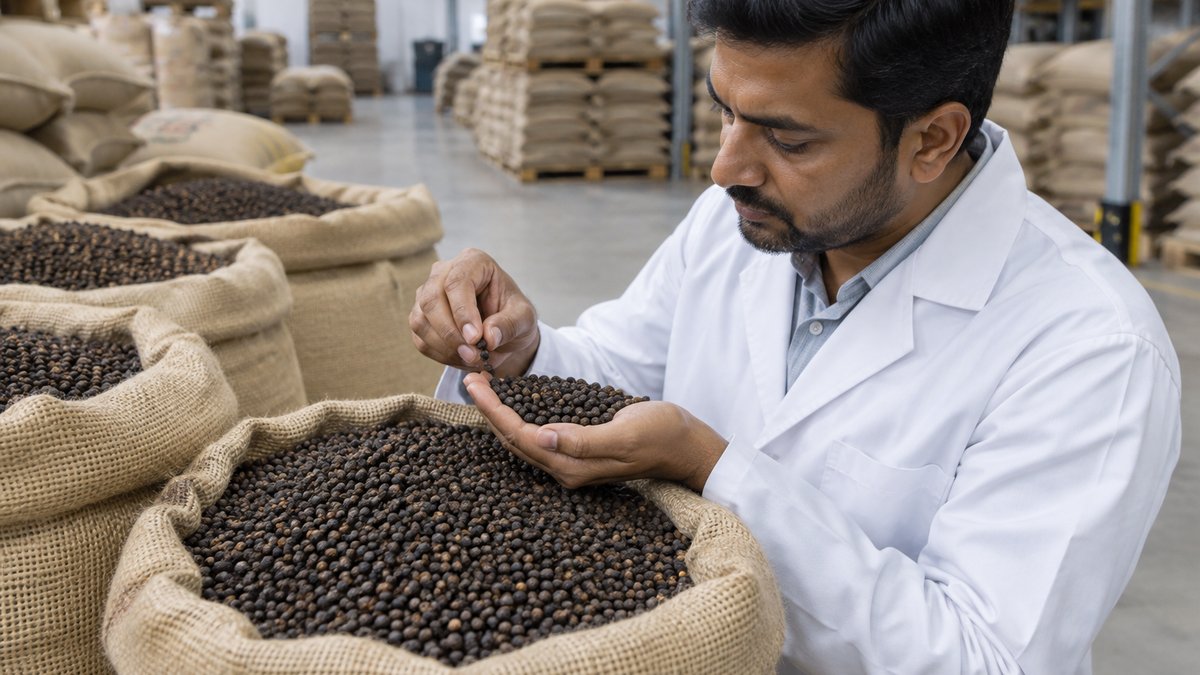
The International Pepper Community’s daily price page dated 13 November 2026 listed Vietnam black pepper 500 g/l at US$5,700 per metric tonne and 550 g/l at US$5,900/MT. The 500 g/l and 550 g/l labels indicate different density specifications. The page does not state an Incoterm or name a destination market, so these figures are origin references rather than Australian delivered prices.
The same IPC page listed Brazil ASTA 570 at US$5,550/MT, Indonesia black pepper at US$6,770/MT and Malaysia ASTA black pepper at US$9,100/MT. The Indonesia entry does not state a grade. The IPC comparison is useful for identifying dated reference levels, but it does not establish that the entries share the same specification or commercial basis.
Tridge’s 16 November 2026 report also put Vietnamese 500 g/l black pepper at US$5,700/tonne and 550 g/l at US$5,900/tonne. It reported the 500 g/l reference down US$250, or 4.2%, over the week, and the 550 g/l reference down US$95, or 1.58%. Those are reported changes in origin-market references, not a measured change in Australian import prices.
2.2 How to read the price movement
The mid-November reports show a fall in the cited Vietnamese export references over the week covered by Tridge, followed by IPC listings at the same Vietnamese levels on 13 November. The source dates and stated grades matter: this evidence does not establish a continuous Australian price series or show that every supplier reduced offers by the same amount.
Australia’s customs unit-value proxy moved in the opposite direction between the annual 2024 and 2025 datasets, rising from about US$7.83/kg to US$9.55/kg. That comparison uses annual import value divided by weight for a broad whole-pepper customs category. It covers neither a single grade nor a single month, and it cannot be directly compared with November origin quotations.
3. Factors behind black pepper price changes
The recent price evidence shows a weekly decrease in the Vietnamese references reported by Tridge, but the sources used here do not quantify how much any one supply or demand factor caused that movement. Buyers should check the stated grade and shipment timing with exporters rather than assigning the change to an unverified cause.
Harvest availability, inventories and exportable stocks can affect the volume suppliers can offer for a shipment period. A buyer comparing a prompt offer with a later shipment should ask which crop or stock the offer covers and whether the quantity is available for the stated loading window. The cited price pages do not provide a matched Australian inventory or harvest series.
Demand also needs a defined measure. Australia’s annual import data records customs entries, not open orders, current tender activity or forecasts. A change in annual import weight alone cannot establish whether Australian buyers are increasing or reducing orders in November 2026.
Currency, freight and insurance can change an Australian buyer’s landed cost even when an exporter’s US-dollar reference is unchanged. The available November origin references do not include the costs required to calculate a shipment’s Australian landed value. Buyers need a current freight quote, insurance amount where applicable, and the relevant destination charges for their own shipment.
Origin competition also needs matched specifications. The IPC’s Brazil ASTA 570 entry and Vietnam’s 500 g/l entry describe different specifications, while the Indonesia entry does not state its grade. A buyer should not interpret the price difference as a quality-adjusted saving without matching the product description and delivery terms.
4. Which countries import the most black pepper?
4.1 Major importing markets
The sources used for this update support an Australia-specific import measure, but they do not provide a current, comparable ranking of the world’s largest black pepper importers. The 2025 Australian WITS figure covers HS 090411, dried pepper whole and not crushed or ground, rather than black pepper alone. It should not be presented as a black-pepper-only import total or a global rank.
For Australian buyers, the clearest market signal in the available customs data is the scale and value of Australia’s whole-pepper imports: 1,696.44 tonnes and US$16.208 million in 2025. The separate 2025 import category for pepper crushed or ground recorded 2,155.27 tonnes valued at US$18.647 million. That is a different customs code and product form, so it should not be merged with the whole-pepper figure.
4.2 Australia’s supplier origins and export destinations
The WITS data retrieved for this update gives Australia’s total 2025 imports under HS 090411, but not a verified country-by-country breakdown. It therefore does not support naming Australia’s leading supplier origins or calculating their shares here. Importers seeking an origin comparison should check partner-level customs data and verify that its product code matches the goods they intend to buy.
Likewise, the IPC price page gives origin references for Vietnam, Brazil, Indonesia and Malaysia, but those price entries do not establish that each origin shipped to Australia in the reported period. They are price references, not evidence of Australian orders or export destinations.
4.3 What import demand means for exporters
Australia’s recorded whole-pepper imports confirm an established import channel, while the annual figures do not confirm a current buyer order or forecast. Exporters considering Australia should first establish the buyer’s required pepper type, density or ASTA specification, packaging, quantity and delivery basis. A market-level import total cannot substitute for a confirmed purchasing requirement.
5. How Australian buyers can compare black pepper offers
An origin reference is a starting point for a quote request, not the final cost of pepper delivered to an Australian buyer. Before comparing offers, put the product specification and delivery basis on the same footing. In particular, do not compare the IPC Vietnam 500 g/l price with an offer for a different density, cleaning standard or ground product as if the goods were equivalent.
- Product and grade: state whole or ground pepper and the required density or named grade, such as the specification used in the supplier’s offer.
- Quality and preparation: agree cleaning, moisture, foreign matter and any other contract tolerances that apply to the purchase.
- Quantity and packaging: request the same order weight and pack format from each supplier, and check whether the quoted quantity is available for the shipment window.
- Price basis: identify the named port and Incoterm. FOB means free on board at the named port; CFR includes cost and freight to the named destination port, while CIF also includes insurance. Confirm the exact contract basis rather than comparing the abbreviations alone.
- Landed-cost components: add freight, insurance where applicable, destination charges and other shipment-specific costs to the exporter’s offer. Use the same destination and cost assumptions for each origin.
- Validity and timing: record the quote date, expiry or validity period, shipment window and currency. The November origin references are dated snapshots, not guaranteed offers.
A lower FOB number may not produce the lower delivered cost if freight, insurance, shipment timing or destination charges differ. Ask each supplier to quote the same specification and destination basis, then compare the resulting cost per agreed unit. Keep the IPC and Tridge reference dates beside the quote so that the benchmark is not mistaken for a live offer.
Buyers comparing offers can review relevant black pepper suppliers on Freshdi. The platform page is a sourcing directory, not a substitute for confirming the specification, current availability and commercial terms directly through a quotation.
Once the grade and delivery basis are clear, buyers can review suppliers listed for black pepper.
View Related Suppliers for This Product →
6. What does the latest demand look like on Freshdi?
No dated Freshdi buying-request snapshot is included in this update, so no current request count, buyer quantity, destination or preferred trade term can be reported. Freshdi request details should be treated as platform observations only when a dated record or snapshot supplies them; they are not a measure of total Australian or global demand.
For a supplier assessing an inquiry, the practical checks remain the product specification, quantity, destination, shipment timing and stated trade term. If an inquiry leaves one of those items unstated, the exporter should ask for clarification rather than assume a grade, port or delivery requirement.
The November export references and 2025 customs totals provide context for a price discussion, but neither confirms an active Freshdi buyer request. Exporters should keep those sources separate from individual buyer requirements and quote only against details the buyer has actually stated.
7. Next steps for buyers and exporters
7.1 For buyers and importers
- Use the 13 November IPC prices as dated origin references only. Request a current offer for the same black pepper specification and shipment window.
- Ask suppliers to state the density or grade, cleaning specification, package, quantity, loading port, delivery basis, quote currency and validity period.
- Compare the same Incoterm and destination across offers. Add shipment costs that are not included in the quoted price before comparing delivered values.
- Check the applicable Australian import and food requirements for the product and shipment with the relevant authorities or qualified import advisers before contracting.
- Keep the 2025 Australian customs unit value separate from a live quote. It is an annual average proxy for a broad customs category, not a current price for a specified black pepper grade.
7.2 For exporters and suppliers
- Date each offer and state the quotation currency, product form, density or grade, cleaning specification and package.
- Specify the loading port, Incoterm, shipment period and quote validity. If the offer excludes freight or insurance, state that clearly.
- Confirm the available quantity and the documents or product evidence the buyer requests. Do not imply a certificate or capability that has not been confirmed.
- Review Australia’s import data as historical trade context, not proof of a current order. Match each quotation to the buyer’s actual destination and stated requirement.
- Use the Vietnamese, Brazilian, Indonesian and Malaysian IPC entries only as origin references; identify the source date and avoid presenting them as Australian delivered prices.
8. How Freshdi helps buyers and suppliers connect
Freshdi has category pages where buyers can review potential black pepper suppliers and suppliers can review relevant buying requests. These pages support discovery; they do not confirm a supplier’s current availability, a buyer’s order status or a completed transaction.
Buyers can review black pepper supplier listings and prepare a request that specifies the required grade, quantity, packaging, destination and delivery basis. Suppliers can review black pepper buying requests and assess whether their listed product and available quantity match what a buyer states.
A useful inquiry or quotation carries the specification and delivery basis through every price comparison. The category pages are a place to find relevant listings and requests; commercial details still need to be confirmed for the transaction.
Buyers and exporters can use the relevant category pages to review black pepper listings and sourcing requests.
View Latest Herbs, Spices & Seasonings Buying Requests →View Potential Herbs, Spices & Seasonings Suppliers →
9. Australia black pepper market outlook
The latest dated origin references found for this update show Vietnamese black pepper at US$5,700/MT for 500 g/l and US$5,900/MT for 550 g/l on the IPC page dated 13 November 2026. Tridge reported that those Vietnamese references had fallen over the week covered by its 16 November report. Neither source establishes a price delivered to Australia.
Australia’s latest full-year WITS figures retrieved here are for 2025. They show 1,696.44 tonnes of imports worth US$16.208 million under HS 090411, a broad whole-pepper category. The derived unit value rose compared with 2024, but differences in specification and product mix prevent treating that change as a price series for a particular black pepper grade.
For procurement, the defensible next step is to request fresh, matched quotations and calculate the delivered cost to the relevant Australian destination. Exporters should state grade, quantity, port, Incoterm and validity so buyers can compare the offer with dated origin references.
Freshdi’s black pepper pages can help buyers review relevant suppliers and sourcing requests.
Buyers ready to compare current offers can review Freshdi’s black pepper supplier listings.
View Related Suppliers for This Product →
Frequently Asked Questions
What is the latest black pepper price for Australia?
The sources used here do not provide a current Australian wholesale quote or a price delivered to an Australian port. The latest dated origin references located are the International Pepper Community’s 13 November 2026 listings: Vietnam 500 g/l at US$5,700/MT and 550 g/l at US$5,900/MT. Those figures are not Australian landed prices.
Did black pepper prices fall in November 2026?
Tridge’s report dated 16 November said the Vietnamese 500 g/l reference fell US$250/tonne, or 4.2%, over the week to US$5,700/tonne. It reported the 550 g/l reference down US$95/tonne, or 1.58%, to US$5,900/tonne. These were origin-market references, not Australian import prices.
Which origin had the lowest IPC reference on 13 November 2026?
Among the listed IPC entries, Brazil ASTA 570 was US$5,550/MT, below the listed Vietnam 500 g/l reference at US$5,700/MT. The specifications differ, and the IPC page does not state a shared delivery basis. This comparison does not show which origin would have the lowest cost for an Australian shipment.
How should buyers compare FOB, CFR and CIF black pepper quotations?
Confirm the named port and the contract’s exact Incoterm. FOB is free on board at the named port; CFR includes cost and freight to the named destination port, while CIF also includes insurance. Request the same pepper specification and destination from each supplier, then add any costs excluded from the quotation before comparing landed cost.
Does Australia’s 2025 import data show demand for black pepper specifically?
Not precisely. The cited HS 090411 category covers dried pepper that is whole and neither crushed nor ground, and does not separate black pepper by species, grade or density. It records customs imports, not current buyer orders or a November 2026 demand forecast.
Where can Australian buyers find black pepper suppliers on Freshdi?
Buyers can review black pepper supplier listings on Freshdi and prepare a request with the required product specification, quantity, packaging, destination and delivery basis. A listing does not confirm current availability or guarantee a transaction, so buyers should verify commercial details for each order.
References
1. International Pepper Community – Daily Prices, 13 November 2026, 2026-11-13.
2. Tridge – Pepper Prices Decline Domestically and Internationally in Mid-November, 2026-11-16.
3. World Bank WITS, using UN Comtrade data – Dried pepper (excl. crushed or ground) imports by country, 2025, 2025.
4. World Bank WITS, using UN Comtrade data – Dried pepper (excl. crushed or ground) imports by country, 2024, 2024.
Disclaimer: This article is compiled from platform data, public sources and information provided by third parties, for general informational purposes only. We do not guarantee its accuracy or completeness. Prices, volumes and forecasts are indicative, reflect conditions as of 2026-11-22 and may change without notice. This is not financial, investment or trading advice.