
Introduction
Germany has an active cocoa bean trade, but a futures benchmark and a physical supplier quotation measure different things. The latest dated benchmark located for this update is the International Cocoa Organization's daily cocoa price for 10 November 2026: US$4,906.39 per metric tonne, equivalent to €4,399.81 per tonne in the reported series.
That benchmark is not a German delivered price or an offer for a specific grade, origin, shipment date, or Incoterm. This update covers the reported benchmark through 10 November 2026 and German customs data for 2025, the latest full-year trade data cited here.
Key Takeaways
- The ICCO daily cocoa price was US$4,906.39 per tonne, or €4,399.81 per tonne, on 10 November 2026. It is a futures-based benchmark, not a physical-bean quotation for Germany.
- The reported ICCO benchmark fell from US$5,625.00 per tonne on 26 October to US$4,906.39 per tonne on 10 November 2026, a decline of about 12.8% between those dates.
- World Bank WITS, using UN Comtrade data, reports Germany's 2025 cocoa bean imports at US$1.636 billion and 180,112 tonnes. Its partner data includes European trading hubs, so partner country does not always identify where beans were grown.
- A 2025 customs unit value calculated from those WITS totals is about US$9.09 per kilogram. It is an aggregate import value divided by reported mass, not a current price or a like-for-like grade comparison.
- Buyers should compare physical offers against matching origin, grade, quality terms, volume, shipment timing, and delivery basis, then calculate the cost to their destination.
1. Germany's Cocoa Bean Market Depends on Imports
Germany is a major European cocoa market, importing beans for processing as well as cocoa products for its food industry. The Centre for the Promotion of Imports from Developing Countries, citing Eurostat, reported that Germany imported nearly 400,000 tonnes of cocoa beans in 2024 and accounted for about 19% of European cocoa bean imports.
Germany's 2025 import figures use a different source and report a different volume. World Bank WITS, drawing on UN Comtrade for HS 180100, reports imports of 180,112 tonnes valued at US$1.636 billion. Because that total differs substantially from the Eurostat-based 2024 figure, these two series should not be used to claim a year-on-year change without reconciling their reporting coverage and methods.
The partner list also needs care. In WITS's 2025 data, Côte d'Ivoire was the largest named partner by value and quantity, followed by Belgium, Ghana, Cameroon, and the Netherlands. A partner in customs statistics may be a trading or processing hub; it does not always identify the farm origin of the beans.
For procurement, the distinction affects both price comparisons and traceability checks. Buyers should ask suppliers to specify the producing country, lot, crop or harvest information when available, grade, and delivery basis. A country listed as the immediate trade partner cannot by itself establish the beans' origin.
Looking to Source Cacao Beans?
Connect with verified suppliers, discover matching products, and explore sourcing opportunities from global markets.
2. Latest Cacao Beans Export Prices for the German Market
2.1 Current cocoa price reference
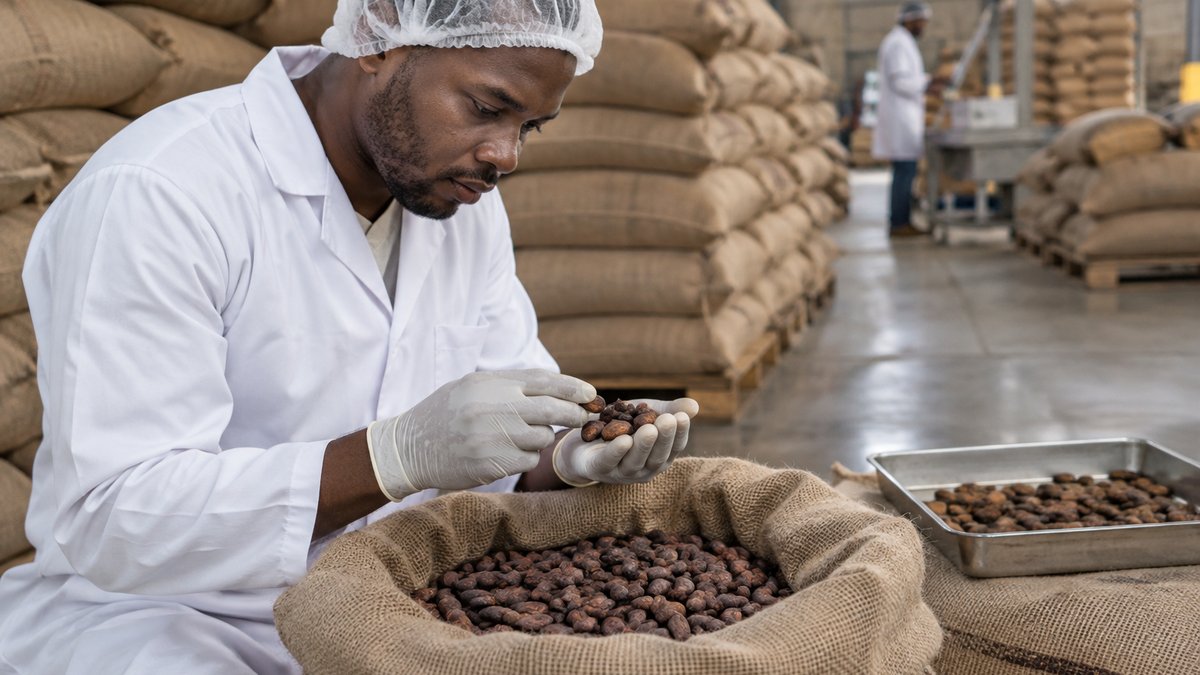
The latest dated cocoa price reference located for this update is the ICCO daily price on 10 November 2026: US$4,906.39 per tonne and €4,399.81 per tonne. ICCO calculates its daily price from the nearest three active futures months on ICE Futures Europe and ICE Futures US at the London close, converting the London component into US dollars using the six-month forward exchange rate.
This benchmark tracks exchange-traded cocoa futures. It does not state a physical export price for a particular producing country or a delivered price into Germany. Physical bean offers can include a differential to the benchmark and depend on origin, bean quality, contract terms, shipment timing, freight, insurance, and other costs.
For a customs-based reference, WITS reports German 2025 imports of HS 180100 at US$1.636 billion for 180,112,000 kilograms. Dividing the reported value by the reported mass gives an approximate aggregate import unit value of US$9.09 per kilogram, or US$9,087 per tonne. The calculation combines transactions with differing origins and product details; it is not a quote that a buyer can book.
2.2 Comparison by exporting partner
WITS's 2025 partner data gives values and quantities, but it does not provide matched physical offers for equivalent bean grades, shipment dates, or delivery terms. The following customs unit values are calculated from each partner's reported import value and mass. They describe each partner's reported mix and should not be read as a ranking of comparable supplier prices.
Source for the 2025 values and quantities: World Bank WITS, using UN Comtrade data for HS 180100. Unit values are calculated as reported import value divided by reported quantity. The values are not adjusted for grade, quality, contract date, or whether the partner is the producing origin.
2.3 Recent benchmark movement
The ICCO daily price series reported by BVCocoa Products was US$5,625.00 per tonne on 26 October 2026 and US$4,906.39 per tonne on 10 November 2026. The difference between those dated observations is a decline of about 12.8%. From 9 to 10 November, the same reported series fell from US$5,144.51 to US$4,906.39 per tonne, or about 4.6%.
Those movements describe a futures-based benchmark over specific dates. They do not establish that physical cocoa offers into Germany fell by the same percentage. Buyers need a dated supplier quote to assess the price of a specific lot.
3. Factors Behind Cocoa Price Changes
The ICCO benchmark reflects prices in futures markets, while a German buyer's physical cost also depends on the bean and the shipment. Market participants should separate changes in the exchange reference from changes in a supplier's origin differential, freight, currency conversion, and delivery charges.
3.1 Supply, harvests, and inventories
Cocoa production is seasonal and concentrated in producing regions, so harvest timing, crop conditions, and the volume of beans available for export can affect the supply offered to buyers. These factors should be checked against current crop and export information from producing-country authorities or the ICCO. A futures price movement alone does not confirm a change in a particular country's harvest or in a supplier's stock.
3.2 Demand and buying decisions
Processors and traders may change purchasing pace as they assess futures prices, their inventory, and expected consumption. Import data records completed trade over a reporting period; it does not confirm current buyer orders. A forecast or market expectation should therefore be kept separate from a confirmed contract or shipment.
3.3 Currency, freight, and delivery terms
A cocoa benchmark quoted in US dollars does not equal a German buyer's euro cost. Exchange rates affect conversion, while freight, insurance, port charges, and the chosen Incoterm affect the amount paid and the party responsible for each leg of transport. The ICCO's euro figure is a benchmark conversion, not a destination quote.
3.4 Trade policy and shipment conditions
Buyers should verify the current import, food-safety, and traceability requirements that apply to their product and transaction in the European Union and Germany. Requirements may depend on the product, origin, and shipment circumstances. Obtain current guidance from the responsible authorities before agreeing shipment documents or delivery dates.
4. Which Countries Import the Most Cocoa?
4.1 Major importing markets
ICCO's report for cocoa year 2024/25 presents country import figures that convert cocoa products into bean equivalents as well as counting bean imports. On its three-year average for 2021/22 to 2023/24, the European Union accounted for 3,629,117 tonnes, or 52.60% of the listed total, and the United States accounted for 742,771 tonnes, or 10.77%. Germany's three-year average was 842,700 tonnes, or 12.21%.
These ICCO figures cover cocoa imports on a bean-equivalent basis, not only raw beans entering customs under HS 180100. They offer a broader view of cocoa demand than Germany's raw-bean customs series and should not be combined with it as though both measures had the same scope.
4.2 Germany's reported supply partners
For Germany's raw or roasted cocoa beans under HS 180100, World Bank WITS reports that Côte d'Ivoire supplied 70,401.9 tonnes in 2025. Belgium was the next-largest named partner at 48,200.7 tonnes, followed by Cameroon at 11,123.9 tonnes, the Netherlands at 11,020 tonnes, and Ghana at 10,988.2 tonnes. The source identifies trade partners, which may differ from producing origins.
CBI's Eurostat-based account for 2024 identifies Côte d'Ivoire, Ghana, and Nigeria as important direct suppliers from producing countries. The source reports 122,780 tonnes from Côte d'Ivoire, 21,403 tonnes from Ghana, and 19,941 tonnes from Nigeria. These 2024 figures use a different year and source presentation from WITS's 2025 partner data, so the rankings should not be compared as a single continuous series.
4.3 What import demand means for exporters
Germany's import position can help exporters identify a relevant destination, but aggregate imports do not demonstrate demand for a particular origin, grade, or delivery window. Exporters should match an offer to the buyer's requested specification and confirm current order requirements before treating market statistics as sales opportunities.
5. How Buyers Can Compare Cocoa Bean Offers
A competitive offer is the one that meets the buyer's specification at a workable delivered cost. The ICCO futures benchmark and German customs unit values are reference points; neither replaces a current quotation for the intended lot and delivery.
- Ask each supplier to identify the producing country and describe the lot, including grade or agreed quality parameters and available quantity.
- Request the quote date, currency, unit, shipment window, packaging, and price basis. Define the Incoterm and named place or port so each offer assigns costs and responsibilities on the same basis.
- Compare origin differentials and product characteristics alongside the benchmark. The customs partner in German trade data may be a trading hub rather than the producing country.
- Calculate the landed cost using the same destination and shipment assumptions. Include the costs relevant to the chosen delivery basis, such as freight, insurance, port charges, and import-related costs.
- Confirm required documents, inspection arrangements, payment terms, and the quotation's validity before approving an order.
Buying consideration: Ask suppliers to quote the same specification, quantity, destination, shipment window, and delivery basis. That gives the buyer a sounder comparison than ranking offers by a benchmark or an aggregate customs unit value.
6. Finding Current Cocoa Bean Buying Requests on Freshdi
Freshdi's cocoa bean buying-request category can help suppliers review posted sourcing requirements. Each request is an individual platform listing, not a measure of Germany's total imports or market demand. Suppliers should check the destination, requested bean specification, quantity, delivery terms, and posting status in the current listing before preparing an offer.
For buyers, a clearly written request helps potential suppliers assess whether their product fits the requirement. State the intended origin if relevant, the quality parameters, quantity and unit, destination, packaging, delivery basis, and target shipment timing.
7. What Buyers and Suppliers Should Do Next
7.1 For buyers and importers
- Treat the 10 November 2026 ICCO daily price as a dated futures benchmark, not a German physical offer.
- Request current quotes with the same specification, unit, currency, destination, and delivery basis.
- Check the producing origin and lot details separately from the immediate customs partner.
- Compare total landed cost and confirm shipment availability, documents, and quotation validity.
7.2 For exporters and suppliers
- Date each quotation and state its currency, unit, grade or quality terms, quantity, shipment period, and price basis.
- Identify the producing origin and explain any price differential to the futures benchmark when applicable.
- Keep availability and delivery assumptions current, and state the loading port and agreed Incoterm clearly.
- Review relevant buying requests and tailor an offer to the stated destination and specification.
8. How Freshdi Helps Buyers and Suppliers Connect
Buyers can review potential suppliers in Freshdi's Cocoa Beans supplier category. Suppliers can review posted requirements in the Cocoa Beans buying-request category. Listings and requests are starting points for checking fit; they do not guarantee a transaction or a particular price.
Buyers comparing origins and suppliers can review relevant cocoa bean listings and sourcing requests.
View Latest Cocoa Beans Buying Requests →View Potential Cocoa Beans Suppliers →
9. Germany Cacao Beans Market Outlook
The latest dated benchmark located for this update, the ICCO daily price on 10 November 2026, was US$4,906.39 per tonne. The benchmark had declined from its 26 October level, but it does not establish the price of a physical German import or predict a future move.
German import statistics show a substantial cocoa trade, while differences between customs series and partner-country reporting require care. Buyers should work from current physical quotations and a like-for-like landed-cost comparison. Exporters should provide dated, specific offers and verify that the stated delivery and documentation match the buyer's requirements.
Buyers and suppliers can use Freshdi to review relevant cocoa bean suppliers or buying requests before assessing whether a listing fits the transaction.
When a sourcing requirement or supplier search is ready, review the relevant cocoa bean listings on Freshdi.
View Latest Cocoa Beans Buying Requests →View Potential Cocoa Beans Suppliers →
Frequently Asked Questions
What was the latest cocoa price reference available for this November 2026 update?
The latest dated reference located was the ICCO daily cocoa price on 10 November 2026: US$4,906.39 per tonne and €4,399.81 per tonne. ICCO calculates the benchmark from futures quotations. It is not a physical supplier quotation for delivery into Germany.
Did cocoa prices fall in November 2026?
The reported ICCO daily benchmark declined from US$5,625.00 per tonne on 26 October to US$4,906.39 per tonne on 10 November 2026, about 12.8%. Those are two dated futures-benchmark observations; they do not show that all physical bean offers into Germany fell by the same amount.
What is the import unit value for cocoa beans in Germany?
World Bank WITS reports that Germany imported 180,112 tonnes of HS 180100 cocoa beans valued at US$1.636 billion in 2025. Dividing those totals gives an approximate aggregate unit value of US$9.09 per kilogram. This is a customs-data calculation across a mix of transactions, not a current offer for a particular grade.
Which countries supply cocoa beans to Germany?
World Bank WITS's 2025 HS 180100 partner data lists Côte d'Ivoire as the largest partner by reported quantity, followed by Belgium, Cameroon, the Netherlands, and Ghana. Customs partner countries can include trading hubs, so the partner is not always the producing origin. CBI's Eurostat-based 2024 account identifies Côte d'Ivoire, Ghana, and Nigeria as important direct suppliers from producing countries.
How should a buyer compare FOB and CIF cocoa bean prices?
FOB and CIF offers assign transport costs and responsibilities differently. Compare quotes only after confirming the named place or port and the Incoterm, then add the costs that remain the buyer's responsibility to calculate a comparable landed cost. Check the contract and shipment details rather than comparing the quoted numbers alone.
Where can suppliers find cocoa bean buying requests on Freshdi?
Suppliers can review cocoa bean buying requests in Freshdi's cocoa bean category. Check each current request's destination, specification, quantity, delivery terms, and status before deciding whether to prepare an offer. A platform listing is not a guarantee of an order.
References
1. International Cocoa Organization – Statistics, 2026.
2. BVCocoa Products – International Cocoa Market Prices, ICCO Daily Price Recent Sessions, 2026-11-21.
3. World Bank WITS, using UN Comtrade data – Germany Cocoa Beans, Whole or Broken, Raw or Roasted Imports by Country, 2025, 2026.
4. Centre for the Promotion of Imports from Developing Countries – The German Market Potential for Cocoa, 2025.
5. International Cocoa Organization – TD/COCOA.26/CRP.1, Annex B: Imports of Cocoa, 2026.
Disclaimer: This article is compiled from platform data, public sources and information provided by third parties, for general informational purposes only. We do not guarantee its accuracy or completeness. Prices, volumes and forecasts are indicative, reflect conditions as of 2026-11-23 and may change without notice. This is not financial, investment or trading advice.