
Introduction
India’s black pepper prices were firm in the first half of November 2026, but the quoted level depends on the market, grade and price series. The latest Agmarknet-based national snapshot located for this update was dated 14 November: its median modal price was ₹710 per kg across five reporting mandis. The Spices Board of India’s latest located Cochin quotation was dated 10 November and listed garbled pepper at ₹764 per kg and ungarbled pepper at ₹744 per kg.
This update covers Indian wholesale and mandi references from November 1 to 14, 2026, alongside international origin quotations dated November 13. These are reference prices, not firm offers. Mandi prices, local market quotations and export benchmarks describe different transactions, so buyers should compare them only after confirming grade, basis, quantity and delivery terms.
Key Takeaways
- Agmarknet-based data presented by Acrop.app put the median Indian mandi modal price at ₹710/kg on 14 November 2026, based on five reporting mandis; the reported range was ₹360 to ₹850/kg.
- The Spices Board of India listed Cochin prices on 10 November 2026 at ₹764/kg for garbled pepper and ₹744/kg for ungarbled pepper. The Board describes these local-market prices as indicative.
- International Pepper Community quotations on 13 November 2026 included Vietnam 500 g/l black pepper at US$5,700/MT, Brazil ASTA 570 at US$5,550/MT and Indonesian black pepper at US$6,770/MT. They are origin references, not landed prices into India.
- The International Pepper Community’s report for November 9 to 13 described moderate, mixed movement across reporting origins and firmer quotations in India and Sri Lanka. A recent Indian news report attributed higher domestic prices to winter demand and tight arrivals; those are reported market explanations, not a price forecast.
- Buyers should match grade and quality limits, then compare quotations on one delivery basis and calculate landed cost. The reported Indian mandi median and international export references are not directly comparable.
1. India’s black pepper market combines domestic supply and import demand
India is both a black pepper producing market and a trading destination, so an Indian wholesale price is not automatically an export quotation or an import-parity price. The current price references show a firm domestic market in November, while International Pepper Community (IPC) origin quotations offer context on competing export origins.
IPC’s Global Pepper Market Report for November 9 to 13, 2026 described moderate, mixed price movements across its reporting origins. It said India and Sri Lanka recorded firmer quotations, while Indonesia, Cambodia and China were broadly stable; Malaysia and Brazil showed some softer domestic prices. The report gives market context, but it does not establish a single global price or a complete measure of Indian supply and demand.
The IPC’s Annual Review 2025 and Outlook 2026 estimated annual global pepper production at 550,000 to 600,000 metric tons and international trade at about 400,000 to 450,000 metric tons. These are broad estimates in the IPC review, not final production or trade totals for calendar 2026. India’s position in this market therefore needs to be assessed using product-specific production and customs data, not inferred from a daily price table.
A price bulletin is not a market-share report. The current price sources used here do not rank global importing countries or provide India’s leading export destinations and their year-on-year shares. Buyers and exporters should use dated customs statistics for those comparisons rather than treating quotations as evidence of destination demand.
Looking to Source Black Pepper?
Connect with verified suppliers, discover matching products, and explore sourcing opportunities from global markets.
2. Latest black pepper prices in India and competing origins
2.1 Indian wholesale and mandi references
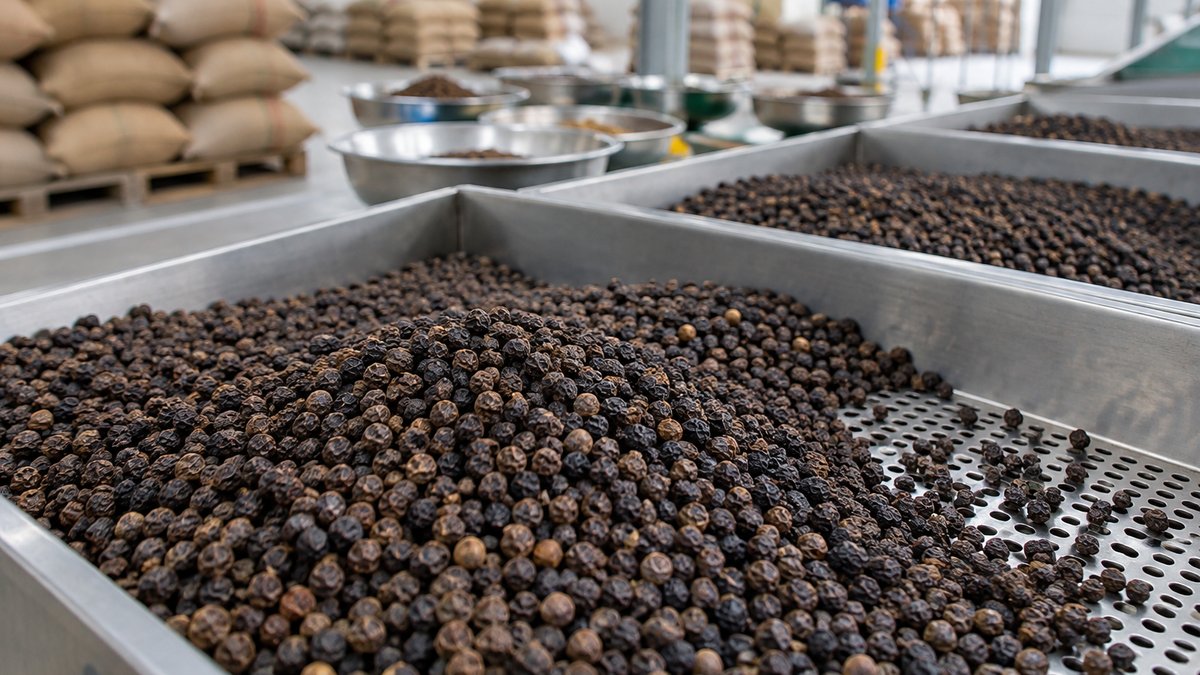
The latest national mandi snapshot located for this update was dated November 14, 2026. Agmarknet data presented by Acrop.app showed a median modal price of ₹71,000 per quintal, equivalent to ₹710/kg, across five reporting mandis. The reported market prices ranged from ₹36,000 to ₹85,000 per quintal. With only five mandis in that day’s median, the figure is a snapshot of reporting markets, not a fixed national buying price.
The Spices Board of India’s latest located Cochin market quotation was dated November 10, 2026. It listed garbled pepper at ₹764/kg and ungarbled pepper at ₹744/kg. Garbled refers to cleaned and screened pepper; ungarbled pepper has not undergone that same cleaning and screening. The Board calls these daily averages indicative and notes that prices vary by quality, grade and origin.
The two Indian snapshots are not interchangeable. The mandi figure is a median across five reporting markets on November 14, while the Spices Board prices are Cochin quotations for two named grades dated November 10. Their difference reflects different dates, market coverage and specifications; it should not be presented as a clean four-day price change.
2.2 Export-origin price comparison
IPC’s daily price table dated November 13, 2026 gives export-origin references in US dollars per metric ton. The listed products have different specifications, so the figures are useful for screening potential origins but not for ranking equivalent pepper without a shared grade and contract basis.
The IPC table does not state a matching Indian export quotation for the same date and specification. The Indian domestic quotations above are in rupees per kilogram and refer to local markets, while the IPC values are origin price references in dollars per metric ton. Currency conversion alone would not make the prices comparable: grade, shipment basis, packing, freight, insurance and import charges would still differ.
2.3 Price movement through the reporting period
The Spices Board’s November 10 Cochin quotations were ₹764/kg for garbled and ₹744/kg for ungarbled pepper. CommodityMarketLive, which reproduces the Board’s daily series, listed the previous reported day at ₹762/kg and ₹742/kg respectively. On that source’s one-day comparison, each grade rose ₹2/kg. The Board’s figures are indicative local-market averages, not export offers.
For November 9 to 13, IPC described prices as mixed but generally moderate across the major reporting origins and said Indian quotations had firmed. Its November 13 table gives several current origin references, but the displayed values alone do not establish a complete week-on-week percentage change for each origin. Buyers should avoid turning a qualitative weekly description into an unsupported rate of increase.
3. What is changing black pepper prices in India?
The latest sources point to firm Indian quotations, but they do not provide a single verified calculation of how much each market factor contributed. Buyers should distinguish documented prices from explanations reported by traders and market publications.
3.1 Domestic arrivals and seasonal buying
Onmanorama reported on November 15, 2026 that black pepper at the Kochi terminal market reached ₹760/kg on November 13, with the price depending on grade. The report attributed the rise to winter buying, low arrivals and tight available supply. These are explanations reported in the article; they do not prove that every grade or Indian market followed the same price path.
The same report described the next harvest as more than two months away and quoted market participants expecting prices to rise further. That expectation is a forecast attributed to the report’s market sources, not a confirmed future price. Importers should use current supplier offers and shipment availability when budgeting.
3.2 Origin competition and product specification
IPC’s November 13 origin references show that exporters quote different pepper specifications. Vietnam’s 500 g/l and 550 g/l quotations differ, while Brazil’s ASTA 570 quotation uses another named specification. A buyer who compares only the headline amount may overlook density, cleanliness, moisture, defects, microbial limits or the contract’s inspection method.
International offers can also move differently from Indian domestic mandi or Cochin quotations. IPC’s November 9 to 13 report described mixed movement by origin, including firmer Indian quotations and broadly steady markets in Indonesia, Cambodia and China. The report does not establish that one origin’s movement caused the change in India.
3.3 Currency, freight and delivery basis
An import offer quoted in US dollars per metric ton must be evaluated against the buyer’s rupee cost at the payment date and the agreed delivery basis. Freight, insurance, port charges, customs duties, taxes and inland transport can change the landed cost. Since the sources do not provide one equivalent Indian import offer and delivered-cost calculation for November 2026, this update does not estimate a landed price.
4. Which countries import the most black pepper?
4.1 Major global importing markets
The current IPC price report and daily origin table do not rank black pepper importing countries or publish comparable 2026 import volumes. A ranking requires customs data for a defined period and product code, with quantity units and product coverage checked. Without that evidence, this update does not assign positions or import forecasts to individual markets.
For sourcing teams, a country-level import total is only a starting point. Customs categories can include different pepper forms or related products, and a national total does not identify the grade, buyer segment or supplier qualification required for a specific order. Confirm the applicable product classification and destination requirements before using trade totals to estimate addressable demand.
4.2 India’s export destinations
India’s leading black pepper export destinations and current market shares cannot be derived from domestic price quotations. The cited November price sources do not state export volumes by destination or year-on-year changes. Exporters should verify a dated Indian customs or Spices Board export series before choosing a target market on the basis of ranking or growth.
4.3 How exporters can assess demand
A market forecast and a confirmed buyer order answer different questions. Import data shows recorded trade over a past period; a forecast describes an expected outcome under its publisher’s assumptions; a buying request records a particular buyer’s stated requirement. Use each for its own purpose and do not treat an increase in national imports as a confirmed order for a supplier.
5. How buyers can source black pepper at a competitive price
A competitive black pepper purchase depends on the buyer’s required specification and landed cost, not the lowest unqualified origin quote. IPC’s November 13 prices provide origin references, while Indian mandi and Cochin prices provide domestic market context. They should be compared only after the supplier confirms the product and delivery basis.
- Write one specification for every supplier: whole or ground pepper, grade or density, moisture limit, foreign matter, damaged or light berries, crop or harvest period if required, and testing method.
- Set the same order quantity, bag material and bag weight, shipment window and destination for each quotation request.
- Ask whether the offer is FOB, CFR or CIF. FOB places the export-port loading arrangement in the quote; CFR includes freight to the named destination port, while CIF also includes insurance. Confirm the named port and applicable Incoterms edition in the contract.
- Add freight, insurance, port handling, customs charges, taxes and inland delivery to the same cost sheet. Do not compare an FOB offer directly with a CIF offer as if both cover the same services.
- Check sample approval, pre-shipment inspection, certificate requirements, payment terms, quote validity and the supplier’s ability to meet the shipment schedule.
Buying consideration: Ask each supplier to quote against the same written specification and destination. A lower origin reference can lose its advantage after freight, quality differences or import charges are included.
Buyers comparing black pepper quotations can review suppliers listed for the product and check whether their stated offers match the required grade and shipment basis.
View Related Suppliers for This Product →
6. What does the latest demand look like on Freshdi?
Freshdi’s black pepper buying-request category is a place for suppliers to review individual sourcing requirements, while the supplier category lets buyers browse product listings. These platform pages describe business-to-business activity; they are not a national import series or a measure of total Indian demand.
When reviewing a request, suppliers should check the buyer’s stated product form, grade, quantity, destination and delivery term before preparing a quotation. Buyers should assess each supplier against the specification and documentation needed for their shipment. A listed request is a buyer’s stated requirement, not a confirmed order or a promise of a transaction.
7. What buyers and suppliers should do next
7.1 For buyers and importers
- Use the November 14 mandi median and November 10 Cochin grade quotations as dated reference points, not as live supplier offers.
- Compare garbled and ungarbled pepper only when the purchase specification calls for the same processing level and quality limits.
- Request competing-origin quotations in a common currency and on the same Incoterm, destination port, quantity and shipment period.
- Calculate landed cost and check applicable import requirements, documentation, sampling and inspection before agreeing a contract.
7.2 For exporters and suppliers
- State grade, quality parameters, origin, available quantity, packaging and shipment window in every offer.
- Name the loading port, currency, Incoterm, quote validity period and whether the price is indicative or firm.
- Keep product information current and distinguish a local market reference from an export quotation.
- Review relevant buyer requests and respond with a price and specification tailored to the stated destination and order size.
8. How Freshdi helps buyers and suppliers connect
Freshdi provides category pages where buyers can browse potential black pepper suppliers and suppliers can review black pepper buying requests. Those pages support discovery; buyers and sellers still need to verify product specifications, documentation, commercial terms and availability for each transaction.
Buyers can browse potential black pepper suppliers and compare the information listed against their sourcing requirements. Suppliers can review black pepper buying requests and decide whether a request fits their product, quantity and delivery capability.
Once the required grade and shipment basis are clear, buyers and suppliers can review relevant black pepper listings and requests on Freshdi.
View Latest Herbs, Spices & Seasonings Buying Requests →View Potential Herbs, Spices & Seasonings Suppliers →
9. Conclusion: India black pepper market outlook
Indian black pepper references were firm in the first half of November 2026. The latest located national mandi snapshot was ₹710/kg on November 14 across five reporting mandis, while the Spices Board’s November 10 Cochin quotations were ₹764/kg for garbled and ₹744/kg for ungarbled pepper. Different dates, market coverage and grades explain why these figures should not be combined into one price trend.
IPC’s November 13 origin references show competing export benchmarks, but those figures do not include a matching Indian quotation with equivalent grade and delivery terms. Buyers should compare like specifications and calculate landed cost; suppliers should state exactly what their quotation covers. Freshdi can help buyers find potential suppliers and exporters review relevant buying requests.
Frequently Asked Questions
What was the latest reported black pepper price in India in this update?
The latest located national mandi snapshot was dated November 14, 2026: an Agmarknet-based median modal price of ₹710/kg across five reporting mandis. The Spices Board of India’s latest located Cochin quotation was dated November 10, listing garbled pepper at ₹764/kg and ungarbled pepper at ₹744/kg. These are different price series and specifications, not one directly comparable quote.
Why do black pepper prices differ between Indian markets?
Prices vary by market, date, grade, cleaning and screening, origin and quality. On November 14, 2026, the Agmarknet-based snapshot presented by Acrop.app covered five mandis and ranged from ₹360 to ₹850/kg, with a median of ₹710/kg. That small daily market sample should not be treated as a fixed price across India.
Were Indian black pepper prices rising in November 2026?
The Spices Board of India’s Cochin daily quotations rose by ₹2/kg for both garbled and ungarbled pepper between the previous reported day and November 10, according to the Board series reproduced by CommodityMarketLive. IPC also described Indian quotations as firmer in its report for November 9 to 13. Those dated references do not establish a uniform increase across all Indian grades and markets.
Which countries offer competing black pepper export prices?
IPC’s November 13, 2026 table listed Vietnam black pepper at US$5,700/MT for 500 g/l and US$5,900/MT for 550 g/l, Brazil ASTA 570 at US$5,550/MT and Indonesian black pepper at US$6,770/MT. The specifications differ, and the listed origin references are not landed prices into India.
How should buyers compare FOB, CFR and CIF black pepper quotations?
FOB, CFR and CIF quotes cover different cost and responsibility arrangements. Confirm the named ports and the Incoterms edition, then add any costs excluded from each offer, including freight, insurance where applicable, destination charges, duties, taxes and inland delivery. Compare the same pepper specification and order quantity.
How can black pepper suppliers find relevant buyer requirements on Freshdi?
Suppliers can review black pepper buying requests on Freshdi and check each buyer’s stated product, grade, quantity, destination and delivery terms. A request is not a guaranteed order, so suppliers should respond only when their available product and shipment terms fit the requirement.
References
1. Spices Board of India – Current Market Price, 10 November 2026 prices; page updated 12 November 2026.
2. International Pepper Community – Daily Prices 13-11-2026, 13 November 2026.
3. International Pepper Community – Global Pepper Market Report No. 46/26, 09-13 November 2026; Annual Review 2025 and Outlook 2026, 2025; report dated 13 November 2026.
4. Agmarknet, Government of India Open Data Platform, presented by Acrop – Black Pepper Mandi Prices in India, 14 November 2026.
5. Onmanorama – Pepper prices hit historic high of Rs 760/kg; traders struggle to meet supply, 15 November 2026.
6. CommodityMarketLive – Pepper Price Today: India, Indonesia, Viet Nam, Malaysia, Brazil, 10 November 2026 prices.
Disclaimer: This article is compiled from platform data, public sources and information provided by third parties, for general informational purposes only. We do not guarantee its accuracy or completeness. Prices, volumes and forecasts are indicative, reflect conditions as of 2026-11-16 and may change without notice. This is not financial, investment or trading advice.