
Introduction
Finding a Brazilian fresh mango supplier starts with a clear product specification and a defined destination market. Buyers then need to check whether a supplier can meet that market’s plant-health rules, pack the fruit to the agreed requirements and ship within the requested schedule.
This guide explains where importers can find suppliers, what to verify in company and product information, and how to compare quotations and shipment conditions. It is written for buyers new to sourcing from Brazil and small and midsize businesses building a supplier shortlist.
Key Takeaways
- The Vale do São Francisco, especially areas in Bahia and Pernambuco, is Brazil’s main mango production and export zone.
- Set the destination, variety or product specification, quantity, packaging and delivery window before requesting quotations.
- Check a Brazilian company’s CNPJ registration and confirm its mango export experience and supply arrangements independently.
- Ask which phytosanitary requirements and documents apply to your destination; importing-country rules can change.
- Compare quotations using the same product specification, Incoterm, quantity, payment terms and shipment schedule.
1. Brazil’s mango supply is concentrated in the Northeast
Brazil has a substantial fresh mango supply base, with production concentrated in the Northeast and Southeast. Embrapa’s update using IBGE agricultural data reports that Brazil harvested about 1.84 million tonnes of mango in 2024. The Northeast accounted for about 82% of that volume.
The Vale do São Francisco is the central area to investigate when sourcing for export. In the same 2024 data, the valley produced more than 1.24 million tonnes, or about 67.5% of national production. Juazeiro in Bahia and Petrolina in Pernambuco were the two largest producing municipalities.
Brazil’s 2024 export figures give buyers a sense of the trade’s scale. The São Paulo Institute of Agricultural Economics reports that Brazil exported 258,300 tonnes of mango worth US$349.9 million FOB that year; Europe received 200,900 tonnes, or 77.8% of the volume. These are annual figures for 2024, not a current quotation or a forecast.
Production in Bahia and Pernambuco is a useful starting point for a supplier search, but the state or municipality alone does not confirm that a company grows, packs or exports the fruit. Ask for the supplier’s role in the chain, the location of the orchard and packing facility, and the route by which the shipment will reach your destination.
Plant-health conditions depend on the importing country. Brazil’s Ministry of Agriculture and Livestock says exporters must meet the destination’s phytosanitary requirements and obtain certification when required. The ministry’s T-Rex system lists known export requirements and advises exporters to confirm them with the destination’s plant-protection authority because they can change.
For example, South Korea’s revised mango import protocol dated 10 October 2024 requires Brazilian export orchards, packinghouses and hot-water treatment facilities to register for shipments to Korea. That rule applies to that destination and should not be assumed to apply to other markets.
Looking to Source Fresh Mango?
Connect with verified suppliers, discover matching products, and explore sourcing opportunities from global markets.
2. How do you find fresh mango suppliers in Brazil?
2.1 Define your sourcing requirements
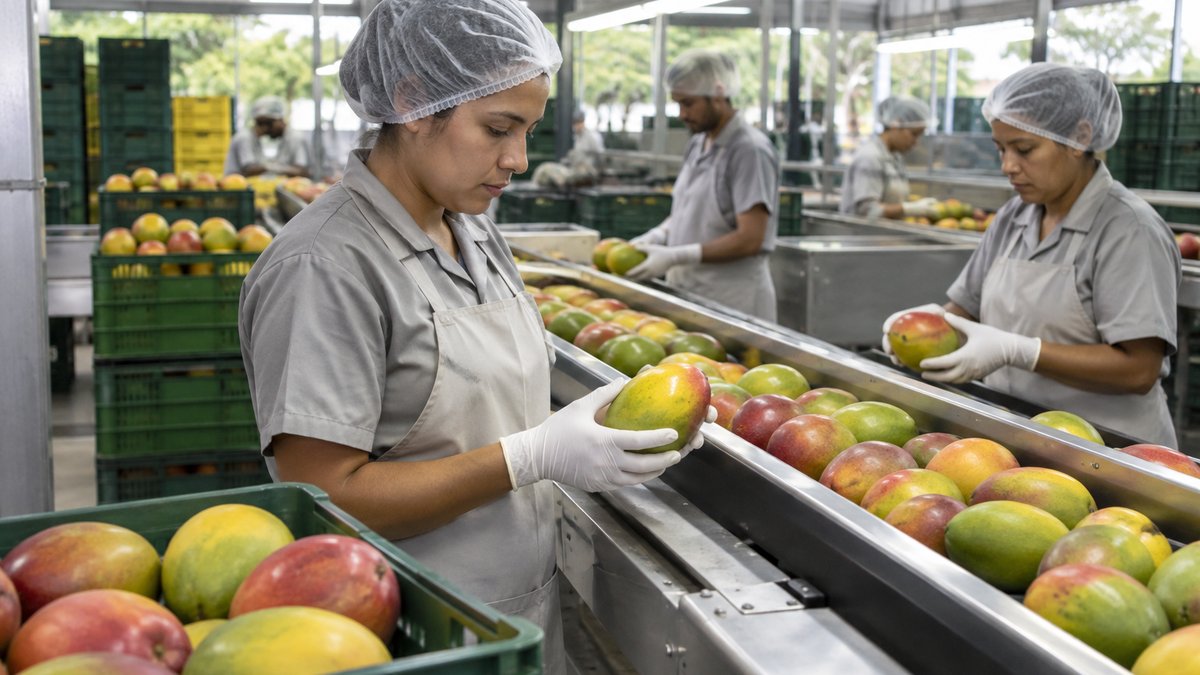
Write a sourcing brief before searching. State the destination country, intended arrival window, required quantity, packaging, preferred variety or product specification, and any market-specific requirements. A supplier cannot quote fruit consistently if the request leaves the maturity stage, size range or pack format open.
Describe quality using measurable terms that the buyer and supplier can confirm before shipment. Ask the supplier to specify the variety, size or count per carton, maturity or ripeness criteria, permitted defects, packaging material and net weight. If the destination requires a treatment, registration or inspection, include it in the brief and ask the supplier to confirm capability with supporting documents.
Give the quantity in a clear unit and state whether you need a trial shipment or recurring supply. Ask for the minimum order quantity (MOQ), meaning the smallest order the supplier accepts, and whether the quoted quantity is available from one packing facility or several. That distinction can affect consistency and shipment planning.
Name the destination port or delivery location and request a quotation under a specific Incoterm. FOB, or Free On Board, and CIF, or Cost, Insurance and Freight, assign different responsibilities for transport costs and risk. CFR, or Cost and Freight, includes carriage to the named destination port but does not require the seller to insure the shipment. Specify the named port and the Incoterms® 2020 rule so quotations can be compared on the same basis.
2.2 Where can buyers search?
Search several channels rather than relying on a single listing. B2B marketplaces can help buyers discover supplier profiles and product offers. Freshdi has a Fresh Mango supplier category; its broader Fruit supplier category can help buyers widen the search when they want to compare related supplier listings.
Industry directories, trade fairs and fruit-sector associations can provide additional company names and opportunities to meet exporters. Official business and export directories may help establish whether a company exists and what activities it reports. Treat each channel as a source of leads, not as proof of product quality or export capacity.
For every candidate, record the source of the lead and the date you checked it. Ask for the company’s full legal name and CNPJ, the Brazilian business registration number, then confirm that the name and registration details match the quotation and payment beneficiary.
2.3 Verify the supplier’s business information
Use Brazil’s Receita Federal CNPJ service to check the company’s registration and cadastral status. Compare the legal name and address in the public record with the supplier’s profile, invoice details and contract. A registration check confirms public business details; it does not establish that the company owns orchards, packs mangoes or can perform a specific export shipment.
Ask whether the company is a grower, packinghouse, exporter, broker or trading company. Request the name and location of the packing facility and clarify which company will issue the commercial invoice and appear as exporter on shipping documents. Where the supplier buys fruit from other growers, ask how it keeps lot identity and traceability through packing.
Check contact and payment details through an independent channel before sending funds. Confirm that the account beneficiary matches the contracting entity or that the supplier explains the relationship in writing. Review the company’s operational information, product history and references, then verify important claims with documents or third parties where appropriate.
2.4 Evaluate product and supply capabilities
Request a current product specification for the exact mango offer. It should identify the variety, grading basis, size or count, tolerances, carton details, net weight and any post-harvest treatment. Ask how the supplier checks fruit condition before packing and how it records lot or orchard information.
Confirm the quantity the supplier can commit for your shipment period, not only its annual capacity. Ask whether the offer is based on fruit already available or a planned harvest, how much notice it needs, and what could affect the loading date. For a first order, request representative sample information and agree how inspection or sample approval will relate to the commercial lot.
Ask for copies of relevant certificates and documents, then check their issuer, validity period, scope, site and product coverage. A certificate for a company or facility does not automatically cover every orchard, product lot or destination. Confirm any required treatment records, phytosanitary certificates, inspection documents and labeling details against the importing country’s current rules.
2.5 Compare quotations and commercial terms
Request quotations against one written specification and compare the total commercial offer. Each quotation should state product variety and grade, quantity, packaging, currency, unit price, quotation validity, shipment window, payment terms and named Incoterm location. If the quotations use different units or delivery bases, ask suppliers to restate them before deciding.
FOB, CFR and CIF are maritime rules under Incoterms® 2020. The International Chamber of Commerce explains that the rules allocate obligations, costs and risks between seller and buyer. For containerized shipments, ask the freight forwarder whether another rule, such as FCA, better fits the point where the carrier takes the goods. Compare freight, insurance, destination charges and duties separately when they are outside the quoted price.
2.6 Conduct due diligence before ordering
Before signing or paying, match the contract, invoice and bank beneficiary to the supplier’s verified legal identity. Put the product specification, quantity, price basis, delivery term, shipment window, inspection method, document list and process for handling rejected or damaged fruit in writing. Agree on who bears each cost if a shipment misses the required phytosanitary or product specification.
Check destination requirements with the relevant authority or a qualified customs and plant-health professional. Brazil’s MAPA notes that known phytosanitary export requirements appear in T-Rex, but importing-country authorities can amend their rules. Do not rely on an old certificate or a supplier’s general statement that it exports worldwide.
For a new supplier, consider a trial quantity that fits your risk and handling capacity. Arrange an independent inspection or testing when the product, route, contract or destination makes it appropriate. Set the inspection scope before loading so both parties know which lot, sampling method and acceptance criteria apply.
2.7 Common sourcing mistakes to avoid
- Choosing the lowest unit price without matching variety, size, pack weight, delivery term and shipment timing.
- Treating a marketplace badge or company registration as proof of fruit quality, financial stability or export performance.
- Leaving maturity, tolerances or packaging undefined, then comparing quotations that describe different products.
- Assuming one export certificate or treatment covers every destination and shipment.
- Paying before checking the contracting company, payment beneficiary, document requirements and contract responsibilities.
3. How can you build a practical mango supplier shortlist?
Use the same screening criteria for each candidate so the shortlist reflects comparable evidence. A simple worksheet can record company identity, role in the supply chain, production or packing location, product specification, available quantity, MOQ, documents, quotation basis and shipment timing.
Mark each item as confirmed, pending or not stated. Do not give a supplier a favorable score for information it has not provided. A missing certificate, capacity figure or shipment date is a question to resolve before selection, not evidence that the supplier has or lacks that capability.
Shortlist candidates whose documented offer meets the destination requirements and whose remaining questions can be answered before a purchase commitment. Send the same clarification questions to each candidate, then compare their written replies and supporting documents.
Buying consideration: Keep the shortlist as a screening record, not a guarantee of performance; verify the shipment lot and contract details again before payment and loading.
4. How does Freshdi help buyers find suppliers?
Freshdi’s Find Suppliers area lets buyers search supplier profiles and product listings by product and category. Buyers can use the fresh mango category to begin a focused search, then review the information shown on individual profiles and ask suppliers for details that are missing from a listing.
Use listing information as an initial filter. Compare only stated details such as product, country, MOQ, packaging, trade terms and certificates, and confirm them directly with the supplier before ordering. A profile or verification indicator does not replace independent checks of legal identity, product quality, documents or shipment capability.
When a profile appears relevant, send a concise inquiry with the destination, variety or specification, quantity, packing requirement, shipment window and requested Incoterm. Ask the supplier to confirm its role, packing location and destination-specific documents in the same reply.
Buyers with a defined specification can use Freshdi’s Find Suppliers area to review fresh mango supplier listings and begin direct screening.
View Related Suppliers for This Product →
5. A careful shortlist starts with a clear specification
Brazil’s mango supply is concentrated in the Northeast, with the Vale do São Francisco providing a strong place to start a supplier search. Buyers still need to verify each company’s role, facility, product specification, export documents and ability to meet the destination’s requirements.
Define the product and shipment first, compare written quotations on the same basis, and resolve missing information before committing funds. Freshdi’s Find Suppliers area is one place to discover fresh mango listings for further review.
Once your destination and product requirements are clear, use Freshdi’s Find Suppliers area to explore fresh mango supplier listings.
View Related Suppliers for This Product →
Frequently Asked Questions
Where are most Brazilian mangoes produced?
Embrapa’s update based on IBGE data reports that the Northeast accounted for about 82% of Brazil’s mango harvest in 2024. The Vale do São Francisco, spanning areas in Bahia and Pernambuco, produced about 67.5% of national volume. Juazeiro and Petrolina were the two largest producing municipalities that year.
What should I include in an inquiry to a Brazilian mango supplier?
State the destination country and port, required variety or product specification, size or count, maturity criteria, quantity, packaging, shipment window and preferred Incoterm. Ask for the MOQ, available volume, quotation validity, payment schedule and documents required for your destination.
How can I check whether a Brazilian mango supplier is a registered business?
Ask for the company’s legal name and CNPJ number, then use Brazil’s Receita Federal CNPJ service to check its registration and cadastral status. Compare those details with the contract, invoice and payment beneficiary. The check confirms public registration details, not the supplier’s product quality or export capability.
Which documents are required to import fresh mango from Brazil?
Requirements depend on the destination country and can change. Ask the supplier which documents apply to your shipment, then confirm the current rules with the destination’s plant-protection authority or a qualified trade professional. Brazil’s MAPA provides known export phytosanitary requirements through T-Rex and advises confirming them because importing-country rules may change.
Should I compare Brazilian mango quotations by unit price?
Compare unit prices only after matching variety, grade or size, maturity criteria, packaging, quantity, currency and delivery basis. Check the named Incoterm location, freight and insurance responsibilities, payment schedule and shipment window. If the offers use different bases, ask suppliers to restate them before comparing.
Does a verification badge guarantee a supplier’s reliability?
No. A marketplace badge or public company registration can support initial screening, but neither proves fruit quality, financial stability, export performance or successful delivery. Check the supplier’s documents, confirm the shipment specification and payment beneficiary, and use independent inspection or testing where appropriate.
References
1. Embrapa – Observatório de Mercado da Manga: atualização com dados da PAM/IBGE até 2024, 2025.
2. Instituto de Economia Agrícola, São Paulo State Secretariat of Agriculture and Supply – Manga: produção e comercialização de 2020 a 2024, 2025.
3. Ministry of Agriculture and Livestock of Brazil – Requisitos fitossanitários de exportação, 2026.
4. Ministry of Agriculture and Livestock of Brazil – Revision of the Plant Quarantine Import Requirements for Fresh Mango Fruits from Brazil, 2024.
5. Receita Federal do Brasil – Comprovante de Inscrição e de Situação Cadastral, Current service, accessed 2026.
6. International Chamber of Commerce – Incoterms® 2020, 2020.
Disclaimer: This article is compiled from platform data, public sources and information provided by third parties, for general informational purposes only. We do not guarantee its accuracy or completeness. Mentions and rankings of suppliers do not constitute an endorsement or guarantee, and strategies and examples are illustrative; results may vary. Please conduct your own due diligence before making business decisions.