
Introduction
Indonesia’s latest published national consumer-price snapshot puts premium rice at Rp16,214 per kilogram and medium rice at Rp13,715 per kilogram as of 5 November 2026. These are domestic retail-category averages, not import offers or export quotations. For buyers assessing imported supply, Thailand’s 5% broken white-rice export quotation was reported at US$505 to US$510 per metric tonne on 19 November.
This update covers published November 2026 figures available through 19 November. It separates Indonesian consumer prices from origin-based export quotations because they describe different products, transaction stages and price bases. Neither figure is a supplier offer for a specific shipment to Indonesia.
Key Takeaways
- Indonesia’s National Food Agency reported national average consumer prices of Rp16,214/kg for premium rice and Rp13,715/kg for medium rice on 5 November 2026.
- The Agency’s November 6 release said premium rice prices had moved up 0.09% and medium rice prices down 0.08% over the previous month.
- Reuters reported Thai 5% broken rice at US$505 to US$510/MT on 19 November 2026. This is an export quotation, not an Indonesian landed or retail price.
- USDA’s November 2026 forecast put Indonesia’s 2026/27 rice imports at 500,000 tonnes, up 25% from its previous-year estimate; it also forecast 33.6 million tonnes of production.
- Buyers should compare the same rice type, broken percentage, packaging, shipment timing and delivery basis, then calculate the full cost to the Indonesian destination.
1. Indonesia’s rice market combines domestic supply with import demand
Indonesia is the destination market in this update. USDA’s November 2026 supply-and-use estimates project 33.6 million tonnes of rice production and 35 million tonnes of domestic consumption in the country for 2026/27. The same forecast estimates imports at 500,000 tonnes, 25% above its previous-year estimate. These are projections for the marketing year, not confirmed purchases or customs totals.
The global balance is also relevant to import planning. USDA’s November Rice Outlook projects world rice production of about 533.2 million tonnes and consumption of about 535.9 million tonnes in 2026/27. Those global totals cover milled rice and reflect the agency’s forecast assumptions. They do not specify the price or grade available to an Indonesian importer.
Domestic Indonesian prices and export quotations answer different questions. A retail average reflects prices within Indonesia and includes local handling and distribution. An origin quotation describes a specified export product at its stated shipping basis. Buyers should keep those measures separate when assessing whether an import offer fits their budget.
The Indonesian National Food Agency reported that rice production from January through August 2026 reached 25.28 million tonnes, based on the agency’s release of 6 November. Its comparison put the same period in 2025 at 25.26 million tonnes. The modest difference is a production comparison, not a forecast of supply available for export or import.
Looking to Source White Rice?
Connect with verified suppliers, discover matching products, and explore sourcing opportunities from global markets.
2. Latest white rice price indicators for Indonesia
2.1 Domestic consumer prices
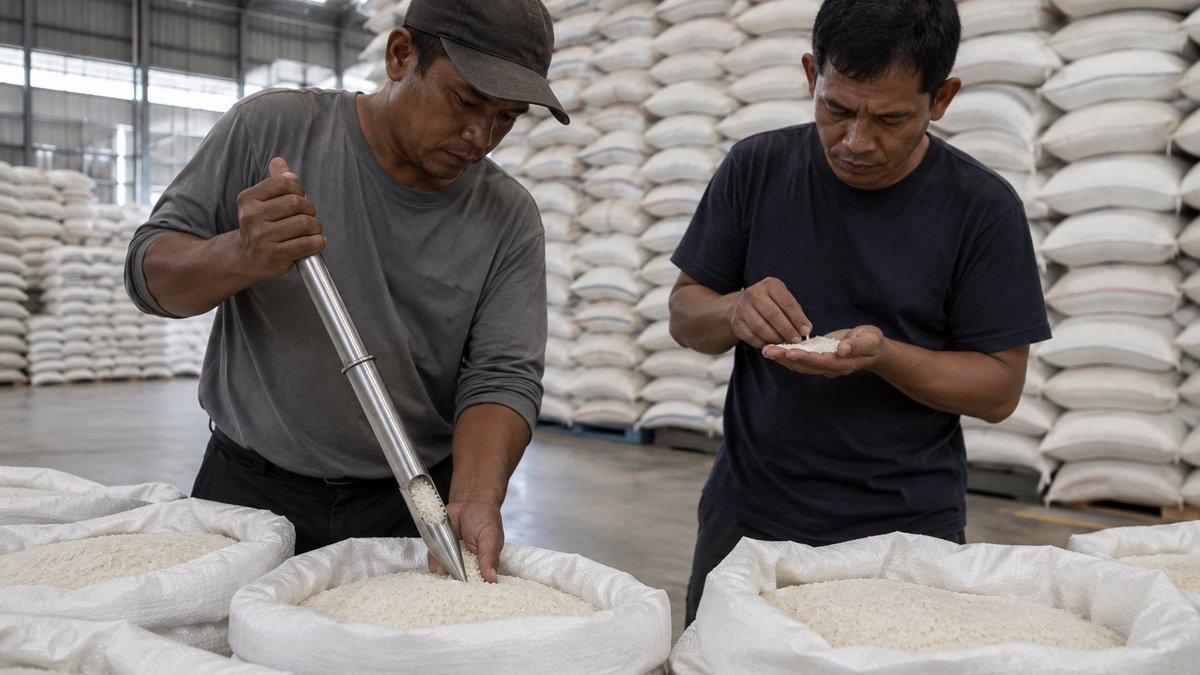
The latest national snapshot located for this update is the National Food Agency’s 5 November 2026 observation, published on 6 November. It reports the midpoint of prices across three zones, with premium rice at Rp16,214/kg and medium rice at Rp13,715/kg. The release says premium prices were up 0.09% and medium prices down 0.08% over the preceding month.
These are consumer-price categories, not a grade specification for imported white rice. The release does not identify a wholesale price, import price, export basis, packaging size or specific variety for these averages. Importers should use them as domestic market context only, rather than as a target price for a supplier quotation.
2.2 Export quotations from competing origins
The latest dated weekly quotation located for this update is Thailand’s 5% broken white rice at US$505 to US$510/MT on 19 November 2026, as reported by Reuters. An earlier Thai Rice Exporters Association listing gives a November benchmark of US$510/MT FOB Bangkok on 11 November. FOB means the seller loads the goods onto the vessel at the named port; the buyer arranges and pays for ocean freight and insurance.
The USDA chart gives approximate November values, while the Reuters and association figures are dated weekly observations. The dates and reporting methods therefore differ. The figures also describe offers at export origin, not delivered prices in Indonesia. Use the weekly Thailand quotation as a dated market reference and check current, specification-matched offers before making a purchase decision.
A 5% broken description is not a complete specification. Before comparing the listed origins, confirm the variety, crop year, moisture, foreign matter, broken-grain tolerance, bag material and bag weight. The USDA chart notes that its Thailand series uses Thai 100B rice while the other country series use 5% broken rice, so its Thailand chart point is not directly equivalent to every 5% broken quote.
3. Why white rice prices are changing
The late-November Thai quotation followed a reported rise in export prices during November. Reuters’ 19 November market report put Thai 5% broken rice at US$505 to US$510/MT, up from US$495 to US$500 the previous week. The same report described higher Indian prices and attributed recent support to domestic paddy prices, demand from African markets and currency movement. Those explanations relate to the exporters’ markets and do not establish a matching price increase in Indonesia.
Supply timing can change the amount exporters are willing to sell at a given price. Harvest arrivals, available stocks and the pace of export shipments affect near-term supply. USDA’s November 2026 outlook lowered its global production estimate for 2026/27 compared with the prior month, while projecting consumption above production. Those are global forecasts; they do not confirm a shortage of a particular grade or a production loss in any one origin.
Import demand also varies by destination and by product. A buyer sourcing white rice for Indonesia may face different competition from a buyer purchasing another variety for a different market. USDA’s forecast of 500,000 tonnes of Indonesian imports in 2026/27 provides a national outlook, not evidence of an order, tender or shipment at a specific price.
Currency and freight affect the price an Indonesian buyer pays after the export offer. A dollar-denominated FOB quote can change in rupiah terms when exchange rates move. Freight, insurance, port charges and inland delivery then add to the cost. Compare quotes from the same date and basis where possible, and record the exchange rate and freight assumptions used.
Weather and policy developments need careful treatment. They can affect crop expectations or the amount exporters can sell, but an announced risk is not a confirmed loss or trade restriction. Buyers should check current official notices, shipment availability and contract terms before changing a purchase plan based on a forecast or market report.
4. Import demand and Indonesia’s place in the market
4.1 Indonesia’s import outlook
USDA’s November 2026 forecast estimates Indonesia will import 500,000 tonnes of rice in marketing year 2026/27, compared with an estimate 25% lower for the previous year. The same forecast places Indonesian production at 33.6 million tonnes and consumption at 35 million tonnes. The import figure is an outlook, not a finalized customs count or a forecast of demand for any single white-rice grade.
4.2 Global importing markets
A ranking of leading importers depends on the reporting period and whether the source measures calendar-year trade or country-specific marketing years. USDA’s November Rice Outlook provides the latest global supply-and-use estimates used here, but this update does not assign an unsupported global rank to Indonesia. Buyers should compare a country’s forecast with the relevant shipment and product data before drawing conclusions about its market size.
4.3 What import forecasts mean for exporters
A higher import forecast can indicate that the national balance may rely more on imported rice than the previous estimate suggested. It does not identify which origin will supply the volume, the grade buyers will request, or when tenders will be issued. Exporters should confirm the Indonesian buyer’s permitted product, specification, quantity, required documents and delivery window before preparing an offer.
5. How buyers can compare white rice offers for Indonesia
Compare the full landed cost rather than choosing by the lowest export quotation. The November figures are origin references. They do not include all costs between the loading port and the buyer’s warehouse in Indonesia, and the retail averages are measured at a different point in the supply chain.
- Set one written specification for every supplier, including rice type, variety if required, broken percentage, moisture limit, foreign matter, crop year and quality tolerances.
- State the order quantity, bag weight, packaging material, destination port and preferred shipment window.
- Compare quotations on the same Incoterm. FOB excludes the buyer’s ocean freight and insurance; CFR includes freight to the named port; CIF includes freight and insurance to that port.
- Add freight, insurance, port and handling charges, inspection, inland transport and applicable import costs to calculate the expected landed cost.
- Check whether the supplier’s shipment documents and product details meet the current Indonesian import requirements for the product and transaction.
- Record the quotation date, validity period, currency and any conditions on price changes or shipment availability.
Illustrative quotation request:
Product: White rice, with variety and broken percentage stated
Quantity and packaging: Required metric tonnes and bag weight
Destination: Named Indonesian port
Quotation basis: FOB, CFR or CIF, with currency and validity
Shipment: Requested loading window and available quantity
This is an illustrative inquiry format. Confirm the actual product specification, import requirements and commercial terms for each shipment.
Buying consideration: Ask all shortlisted suppliers to quote against the same specification and destination. A lower FOB number may not produce a lower delivered cost if freight, packaging, quality terms or shipment timing differ.
6. What current rice buying demand looks like on Freshdi
Freshdi buying requests are a separate, request-level signal from USDA’s national import forecasts and Indonesia’s consumer-price statistics. Buyers and suppliers reviewing current white-rice requests should check each request’s destination, quantity, product description and stated delivery terms. A request is not proof of a completed purchase or a measure of total Indonesian demand.
The price sources in this update do not establish the specifications of an individual buyer’s order. Exporters should respond only when their available grade, volume, shipping window and documents match the request. Importers can use the same checks when comparing supplier listings and quotations.
7. What buyers and suppliers should do next
7.1 For buyers and importers
- Treat Indonesia’s 5 November consumer averages as local market context, not as an import quotation.
- Use dated export prices as benchmarks and request current offers with a stated grade, basis, port and validity period.
- Compare the same specification and delivery basis across origins.
- Calculate landed cost in the buyer’s currency using stated freight, insurance and local cost assumptions.
- Confirm the current import rules and required documents for the product and shipment.
7.2 For exporters and suppliers
- Describe the rice by variety, broken percentage, crop year and measurable quality limits.
- State available quantity, packaging, loading port, Incoterm, currency and quotation validity.
- Separate export price from freight, insurance and destination charges when the offer excludes them.
- Check the buyer’s Indonesian destination, requested shipment window and documentation needs before quoting.
- Update offers when the price basis or available stock changes.
8. How Freshdi helps buyers and suppliers connect
Buyers can use Freshdi’s White Rice supplier category to review supplier listings, while exporters can review buying requests in the White Rice buyer category. Listings and requests help users identify information to check, but they do not verify a product’s suitability or guarantee a transaction.
When comparing a listing with an Indonesian sourcing requirement, check the named product, available quantity, stated origin, quality details and commercial terms. Ask the supplier to confirm any field that is missing from the listing before relying on it.
Buyers and suppliers comparing white rice requirements can review the relevant category listings and requests.
View Latest Rice Buying Requests →View Potential Rice Suppliers →
9. White rice prices in Indonesia: November outlook
The latest Indonesian consumer snapshot located for this update is dated 5 November: Rp16,214/kg for premium rice and Rp13,715/kg for medium rice. Thailand’s 5% broken export quotation reached US$505 to US$510/MT on 19 November, while USDA’s November estimates put Indonesia’s 2026/27 imports at 500,000 tonnes. These measures describe different parts of the market and should not be treated as directly comparable prices.
For a purchase or sales offer, confirm the exact grade, current availability, destination, Incoterm and complete landed cost. Buyers and exporters can use Freshdi to review relevant white-rice suppliers and buying requests, then assess each opportunity against its stated specifications.
Once the specification and destination are clear, buyers can review suppliers listing white rice for trade.
View Related Suppliers for This Product →
Frequently Asked Questions
What was the latest reported rice price in Indonesia in November 2026?
The National Food Agency reported national average consumer prices on 5 November 2026 of Rp16,214/kg for premium rice and Rp13,715/kg for medium rice. These are domestic consumer-price averages, not import or export quotations.
What was Thailand’s 5% broken white-rice export quotation in November?
Reuters reported a quotation of US$505 to US$510 per metric tonne on 19 November 2026. The Thai Rice Exporters Association had listed US$510/MT FOB Bangkok on 11 November. These are origin export references, not delivered prices in Indonesia.
Why do Indonesian retail rice prices differ from FOB export quotations?
The figures measure different stages of trade. A domestic consumer average reflects prices in Indonesia, while an FOB quotation covers a specified export product loaded at the named port. Freight, insurance, handling, import costs and local distribution can affect the delivered or retail price.
What factors should Indonesian buyers compare between white-rice offers?
Compare variety, broken percentage, moisture and other quality limits, crop year, quantity, packaging, loading port, shipment window and Incoterm. Add freight, insurance, port charges and other destination costs before comparing landed prices.
How much rice does USDA expect Indonesia to import in 2026/27?
USDA’s November 2026 forecast estimates 500,000 tonnes of rice imports for Indonesia in marketing year 2026/27, 25% above its previous-year estimate. This is a forecast, not a customs total or confirmed order.
Can Freshdi buying requests be treated as Indonesia’s total rice demand?
No. Buying requests are individual sourcing signals and are separate from national import forecasts and official trade statistics. Check each request’s product details, destination, quantity and terms; a request does not confirm a purchase.
References
1. National Food Agency of Indonesia – Inflasi Beras Melandai, 6 November 2026.
2. USDA Economic Research Service – Rice Outlook: November 2026, 13 November 2026.
3. USDA Foreign Agricultural Service – Grain: World Markets and Trade, November 2026, November 2026.
4. Business Recorder – Asia rice: India rates hit 19-month peak; Thai prices highest in nearly two years, 19 November 2026.
5. Thai Rice Exporters Association – Rice Export Prices and FAO Rice Price Update, November 2026.
Disclaimer: This article is compiled from platform data, public sources and information provided by third parties, for general informational purposes only. We do not guarantee its accuracy or completeness. Prices, volumes and forecasts are indicative, reflect conditions as of 2026-11-21 and may change without notice. This is not financial, investment or trading advice.