
Introduction
Yellow corn prices in Indonesia remain above government reference levels in recent reports. On 5 November 2026, poultry farmers told Indonesia’s Ministry of Agriculture that corn bought outside the government’s SPHP distribution program cost Rp7,800 to Rp7,900 per kilogram. On 17 November, a report on new National Food Agency rules cited poultry producers’ market prices of up to Rp8,000 per kilogram. These are reported domestic feed-corn prices, not export quotations for a specified yellow corn grade.
This update covers Indonesia and the latest price information located through 20 November 2026. It separates observed market prices from government purchase and reference prices, which apply to specified moisture levels and transactions. Indonesia’s 2025 import data also show which origins supplied maize under the broad customs category for maize excluding seed. Those trade figures do not identify a particular yellow corn grade or quote a current offer.
Key Takeaways
- A Ministry of Agriculture report dated in November quoted poultry farmers at Rp7,800 to Rp7,900/kg for corn outside the SPHP program, based on remarks made on 5 November 2026.
- A 17 November report on National Food Agency rules cited market prices of up to Rp8,000/kg. It also stated a Rp5,800/kg reference selling price for corn at 15% moisture sold to livestock farmers.
- The government purchase price is Rp6,400/kg for dried shelled corn at 14% moisture delivered to Bulog warehouses. That procurement price is not interchangeable with a feed mill or import offer.
- Indonesia imported 895,384 tonnes of maize excluding seed in 2025, valued at US$227.3 million. Argentina, the United States and Brazil were the largest reported origins by quantity.
- Buyers should compare the same moisture, grade, delivery point, packaging and Incoterm, then add freight, insurance and destination charges before judging competing offers.
1. Indonesia’s Corn Supply and Demand Picture
Indonesia’s corn market combines domestic harvests, feed demand and regulated imports. The Ministry of Agriculture reported national corn production of 16.16 million tonnes in 2025, up 6.74% from 2024. That production figure is a national total; it does not specify yellow corn grades, moisture, or the volume available to any particular feed mill.
Feed demand links corn prices to poultry production. In a July 2026 Indonesia grain and feed update, USDA’s Foreign Agricultural Service described a possible reduction in harvested area in 2025/26 and 2026/27, citing an early dry season and the possibility of moderate El Niño conditions late in 2026 and early in 2027. The report also said a reduced industrial corn import quota was pushing corn wet millers to seek alternative raw materials. These were forward-looking assessments published in July, not confirmed final crop results.
The import picture depends on product definition. World Bank WITS data using UN Comtrade report 895,384 tonnes of Indonesian imports in 2025 under HS 100590, maize excluding seed. Argentina supplied 460,562 tonnes, the United States 265,961 tonnes and Brazil 168,302 tonnes. This customs category is broader than a specific contract grade of yellow feed corn, so it should not be treated as a grade-by-grade supplier ranking.
These supply measures answer different questions. Production describes domestic output; the customs series records imports across a broad product code; and local market reports describe prices at specific points in the supply chain. Buyers comparing sources should keep those scopes separate.
Looking to Source Yellow Corn?
Connect with verified suppliers, discover matching products, and explore sourcing opportunities from global markets.
2. Latest Yellow Corn Prices in Indonesia
2.1 Recent domestic prices and government reference levels
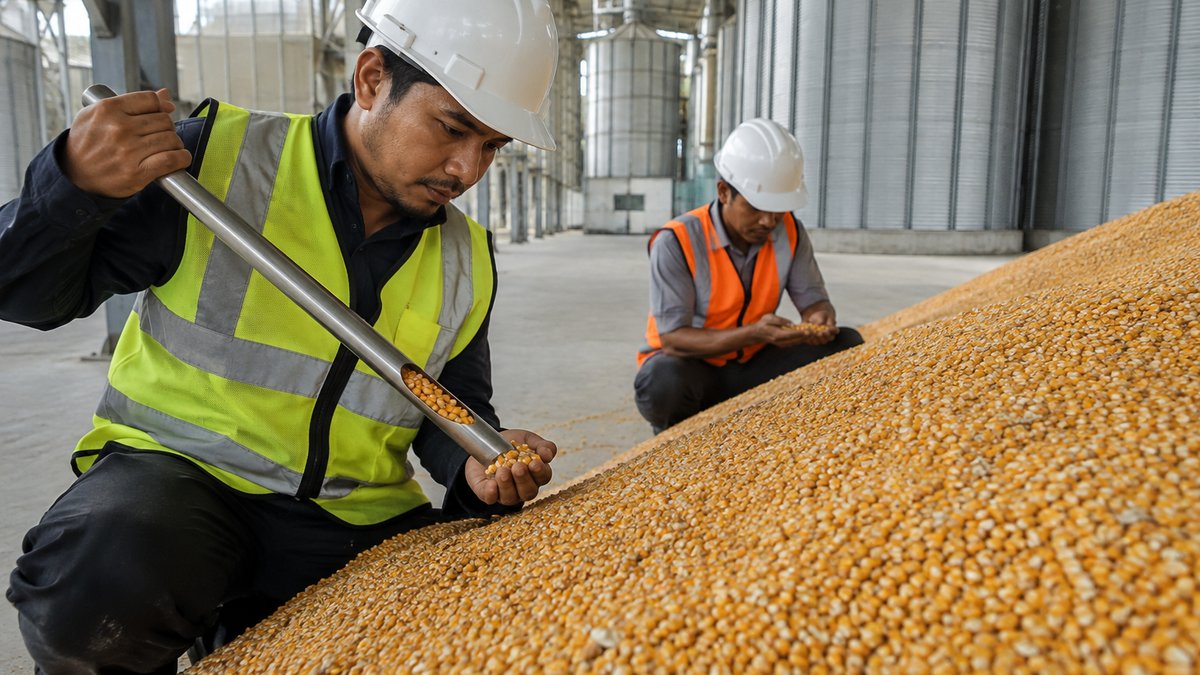
Recent Indonesian reports put commercially purchased feed corn above the government’s stated reference levels. On 5 November 2026, a Ministry of Agriculture report quoted a poultry farmer saying corn outside the SPHP program cost Rp7,800 to Rp7,900/kg, while corn obtained through Bulog cost Rp5,000/kg. The report concerns the farmer’s stated purchase experience, not a national average or an import quotation.
A report published on 17 November described the National Food Agency’s Circular No. 457 of 2026, dated 10 November. It set a government purchase price of Rp6,400/kg for dried shelled corn at 14% moisture delivered to Bulog warehouses, a farm-gate purchase price of Rp5,500/kg for corn at 18% to 20% moisture, and a reference selling price of Rp5,800/kg for corn at 15% moisture sold to livestock farmers. The same report cited poultry producers’ market prices of up to Rp8,000/kg. These values have different transaction points and moisture specifications, so they are not like-for-like quotations.
The latest values found are dated reports, not a real-time price series. The 5 November farmer account and the prices cited on 17 November do not establish that all Indonesian buyers paid those amounts. Location, delivery point, quality, moisture, availability and access to the SPHP program can change the price a buyer actually faces.
2.2 Price comparison by exporting origin
Indonesia’s 2025 customs data identify Argentina, the United States and Brazil as the main origins for imported maize excluding seed. The data provide annual trade value and quantity, not current origin-specific yellow corn export offers. The figures therefore support an origin comparison for recorded import flows, but not a price ranking among exporters.
These customs values are not directly comparable with the reported Indonesian prices per kilogram. The customs figures cover a calendar-year trade category, while the domestic reports describe local feed-corn transactions in November. The available figures also do not state matching grades, moisture, packaging, Incoterms or port basis. A buyer should request dated offers from each origin against one written specification before comparing costs.
2.3 Recent price movement
The November reports indicate a gap between stated government reference prices and some commercial market prices. They do not provide a consistent week-on-week or month-on-month series for the same grade, moisture and delivery point. As a result, a precise percentage change for like-for-like Indonesian yellow corn cannot be calculated from these observations.
An earlier data point offers context but not a direct trend comparison. A report citing National Food Agency data put the national average feed-corn price at farmer level at Rp7,250/kg in the third week of October 2026, up 0.78% week on week. It was a national average at a particular market level; it should not be compared as if it were the same transaction as a farmer’s November purchase report or Bulog’s procurement price.
3. Factors Affecting Indonesian Corn Prices
Domestic availability and feed demand both affect Indonesian corn prices. USDA’s July 2026 report forecast lower corn harvested areas in 2025/26 and 2026/27 under its dry-season and possible El Niño scenario. The report also described continued demand from feed and poultry production. Since the assessment is a forecast, buyers should check newer crop and supply information before using it to set a shipment plan.
Import rules also shape access to supply. USDA reported that the government had reduced the industrial corn import quota for 2025/26, with corn wet millers looking for substitute raw materials. A quota or licensing change can affect which buyers can source imported corn and when. The July report does not establish the current 2026/27 quota allocation, so importers should verify the applicable approvals for their product and transaction.
Government intervention creates separate price references for farmers, Bulog procurement and livestock-farmer sales. The November circular’s prices apply to stated moisture levels and delivery conditions. They are useful benchmarks for the transactions they cover, but they do not set a single national commercial price for every yellow corn purchase.
Imported offers also carry costs that local price reports do not capture. Freight, insurance, port handling, financing, packaging and inland delivery can change the cost at a feed mill. Currency movements affect the rupiah cost of a foreign-currency offer. The cited Indonesian sources do not provide current freight or exchange-rate adjustments for a specific shipment, so those figures need to come from the buyer’s current supplier and logistics quotations.
4. Which Markets and Origins Matter to Corn Buyers?
4.1 Indonesia’s recorded import origins
In 2025, Argentina was Indonesia’s largest reported source of maize excluding seed by quantity, followed by the United States and Brazil. WITS reports 460,562 tonnes from Argentina, 265,961 tonnes from the United States and 168,302 tonnes from Brazil. Those figures identify recent trade flows; they do not confirm current offers, available stocks or future purchase volumes.
A global ranking of importing countries requires a comparable, dated dataset and a consistent product definition. The figures cited here establish Indonesia’s own 2025 import flows, not a ranking of the world’s largest corn importers. For a sourcing decision into Indonesia, the more immediate checks are the importer’s approved access, the destination port, the required grade and the delivery month.
5. How Buyers Can Compare Corn Offers for Indonesia
A low headline price does not establish the lowest delivered cost. Domestic support-program prices, farmer-level transactions and imported offers can refer to different quality, moisture and delivery conditions. Buyers should first align those terms, then calculate the amount payable at the destination point.
- Write the product specification: yellow corn intended use, grade, moisture limit, foreign matter, damaged kernels and any required testing method.
- Set the quantity, packaging, shipment window and destination port. Confirm whether the buyer can use a government distribution program or must buy through a commercial channel.
- Ask each supplier to quote in the same currency and on the same Incoterm. FOB means the seller delivers the goods on board the vessel at the named port; CFR includes cost and freight to the named destination port; CIF also includes marine insurance.
- Add freight, insurance where excluded, port charges, inspection, inland transport and applicable import costs. Compare the landed amount per tonne only after all offers use the same basis.
- Confirm required import approvals and documents for the specific corn product and transaction. Indonesia’s rules and approvals can depend on the product and importer.
A written quotation should state the price date and validity, origin, crop or shipment availability, loading port, moisture, quality tolerances, packaging, quantity, payment terms and Incoterm. If an offer gives only a price per tonne, request the missing basis before comparing it with an Indonesian domestic reference or another origin’s offer.
6. What Does Recent Corn Demand Look Like on Freshdi?
Freshdi’s live buying requests and supplier listings can help buyers and sellers check current sourcing activity for yellow corn. This article has no dated Freshdi request sample, so it makes no count or claim about the number of buyers, quantities or requested trade terms. Platform listings are leads to review, not a measure of national demand.
Buyers can review yellow corn suppliers and state their required grade, quantity, destination and delivery terms in an inquiry. Suppliers can review yellow corn buying requests and respond when their available product and shipment conditions match the request.
7. Next Steps for Buyers and Suppliers
7.1 For buyers and importers
- Use the November government prices as transaction-specific references, not as a substitute for a commercial quote.
- Request offers against one specification and compare the same moisture, grade, quantity, shipment timing and delivery basis.
- Check the current import approval and documentation requirements for the product and importer.
- Calculate landed cost to the destination point, including freight, insurance, handling and inland transport.
- Confirm that the supplier can meet the quantity and shipment window before relying on a quoted price.
7.2 For exporters and suppliers
- Date every quotation and state its validity period, currency, loading port and Incoterm.
- Specify the corn grade, moisture, packaging, available quantity and shipment period.
- Separate the export price from freight, insurance and destination charges where the offer excludes them.
- Provide only documentation and certification claims that apply to the actual product and shipment.
- Check the buyer’s destination, requested terms and import conditions before preparing an offer.
8. Finding Buyers and Suppliers Through Freshdi
Freshdi provides product pages for buyers looking for suppliers and for suppliers reviewing buying requests. Use the relevant pages to check current listings, then assess each opportunity against the written product specification, quantity and shipment requirements.
Buyers comparing Indonesian corn supply channels can review current listings for yellow corn suppliers and buying requests.
View Latest Grains, Cereal & Legumes Buying Requests →View Potential Grains, Cereal & Legumes Suppliers →
9. Indonesia Yellow Corn Market Outlook
Recent November reports place some Indonesian commercial feed-corn purchases at Rp7,800 to Rp8,000/kg, while the National Food Agency’s stated reference prices vary by moisture and transaction point. The figures do not form a single export price or a like-for-like monthly series. Importers should compare current offers with the full landed cost and verify how each reference applies to their purchase.
Indonesia’s 2025 import data show Argentina, the United States and Brazil among the recorded sources of maize excluding seed. Domestic production, feed demand and import approvals remain relevant to supply planning, while the July USDA crop outlook is a forecast rather than a confirmed result. Buyers and exporters can use Freshdi to review relevant supplier listings and buying requests.
Buyers preparing a yellow corn inquiry can review suppliers listed for the product.
View Related Suppliers for This Product →
Frequently Asked Questions
What is the latest reported yellow corn price in Indonesia?
A Ministry of Agriculture report on 5 November 2026 quoted a poultry farmer saying corn outside the SPHP program cost Rp7,800 to Rp7,900/kg, while corn obtained through Bulog cost Rp5,000/kg. A report published 17 November cited market prices of up to Rp8,000/kg. These are reported domestic feed-corn prices, not a single national price or an export quotation.
What is Indonesia’s government reference price for corn?
A report on National Food Agency Circular No. 457 of 2026 states Rp6,400/kg for dried shelled corn at 14% moisture delivered to Bulog warehouses, Rp5,500/kg at farm gate for corn at 18% to 20% moisture, and Rp5,800/kg for corn at 15% moisture sold to livestock farmers. The applicable price depends on the transaction and specification.
Which countries supplied Indonesia’s maize imports?
World Bank WITS data using UN Comtrade report that Indonesia imported 895,384 tonnes of maize excluding seed in 2025. Argentina supplied 460,562 tonnes, the United States 265,961 tonnes and Brazil 168,302 tonnes. The customs category does not specify a particular yellow corn grade.
Why can domestic corn prices differ from import offers?
Domestic reports can describe different moisture levels, local delivery points or access to the SPHP program. An import offer may be quoted FOB, CFR or CIF and can exclude destination charges or inland delivery. Compare the same specification and delivery basis, then calculate landed cost.
How should buyers compare FOB, CFR and CIF corn quotations?
FOB covers delivery on board the vessel at the named loading port. CFR includes cost and freight to the named destination port, while CIF also includes marine insurance. Buyers should confirm which charges remain outside each offer and add destination handling, inland delivery and applicable import costs.
How can buyers and suppliers find yellow corn opportunities on Freshdi?
Buyers can review yellow corn supplier listings, and suppliers can review buying requests for the product. Check each listing or request for product specification, quantity, destination and trade terms before deciding whether the opportunity fits. A listing or request does not guarantee a transaction.
References
1. Ministry of Agriculture of the Republic of Indonesia – Dari Jagung SPHP hingga Pengawasan Integrator, Mentan Amran Tegas Perkuat Peternak Rakyat, 2026.
2. eFeedLink – Indonesia sets Rp6,400/kg corn purchase floor, obliging Bulog to buy when prices drop, 2026-11-17.
3. World Bank World Integrated Trade Solution, using UN Comtrade – Indonesia Maize (excl. seed) imports by country, 2025, 2025.
4. USDA Foreign Agricultural Service – Grain and Feed Update: Indonesia, Report ID2026-0029, 2026-07-23.
5. Ministry of Agriculture of the Republic of Indonesia, Center for Agricultural Data and Information Systems – Analisis Kinerja Perdagangan Jagung Tahun 2026, 2026-07-31.
6. National Food Agency data, reported by eFeedLink – Indonesia's farm-gate egg and broiler prices stay below benchmark as feed corn climbs, 2026.
Disclaimer: This article is compiled from platform data, public sources and information provided by third parties, for general informational purposes only. We do not guarantee its accuracy or completeness. Prices, volumes and forecasts are indicative, reflect conditions as of 2026-11-20 and may change without notice. This is not financial, investment or trading advice.