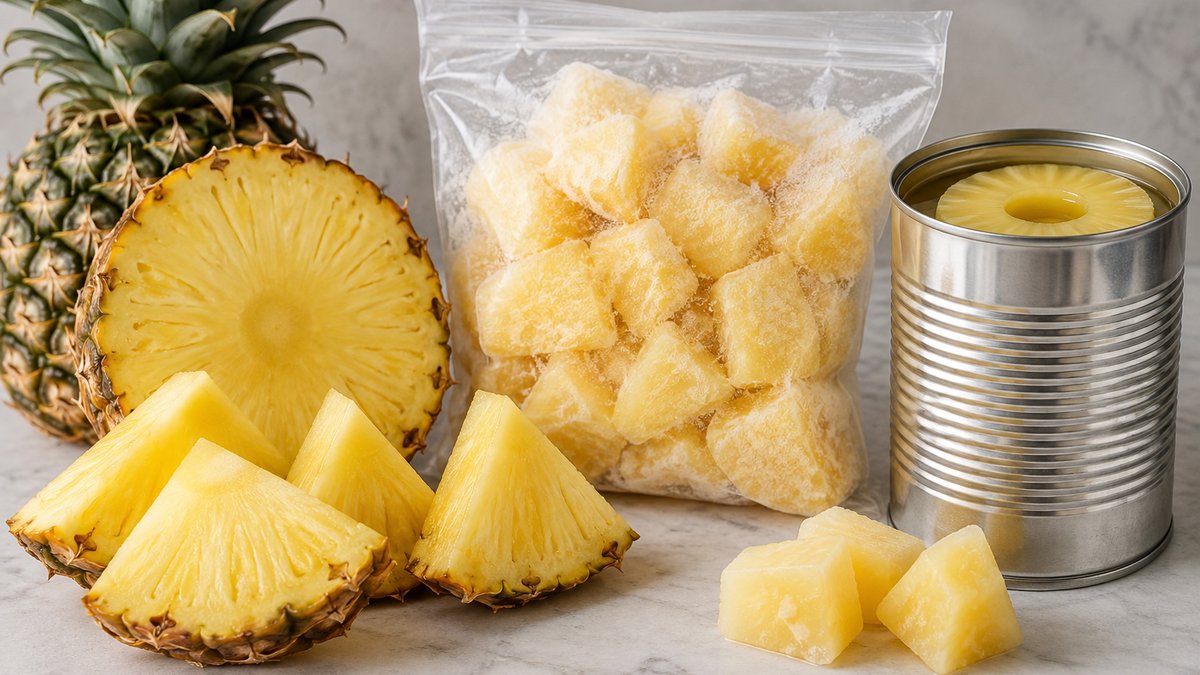

1. Frozen and canned pineapple differ in processing and storage
Frozen pineapple is prepared fruit kept frozen through storage and transport. Canned pineapple is packed in a sealed container and commercially processed for its intended storage conditions. The choice affects the shipment’s handling, the buyer’s storage needs and the form in which the fruit can be used.
Both products can be sold as slices, chunks, tidbits or crushed fruit, though the available styles depend on the supplier and the applicable product standard. The Codex Standard for Canned Pineapple (CXS 42-1981) defines several canned styles and pack types. USDA’s frozen pineapple grade standard also covers styles including slices, tidbits, chunks and crushed fruit. A style name alone does not specify piece dimensions, tolerances, ingredients or grade.
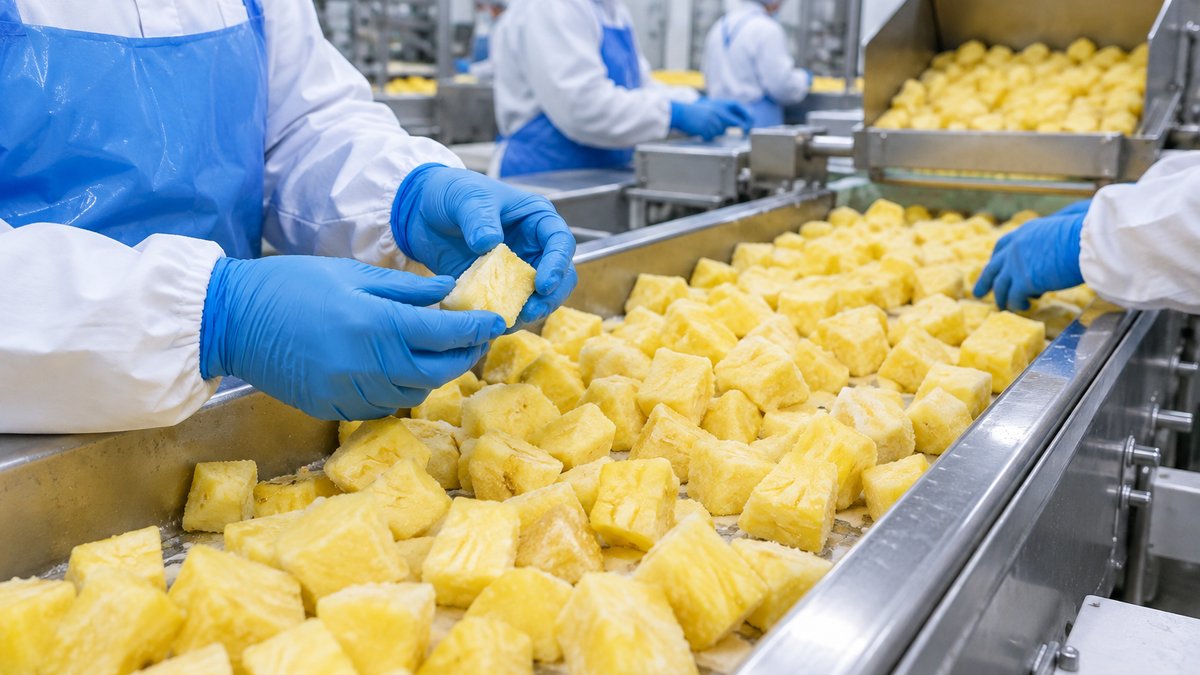
Processing is the first distinction to confirm. Frozen pineapple is cut and frozen; suppliers may pack it as individually quick frozen (IQF) pieces or in a block. Canned pineapple is packed with a liquid medium or another permitted formulation and receives a commercial heat process appropriate to the product and container. Codex describes regular packs with a liquid packing medium, as well as heavy and solid packs for specified crushed or chip styles.
The two forms also differ in logistics. Codex’s Code of Practice for the Processing and Handling of Quick Frozen Foods sets -18°C or colder as the product temperature for quick-frozen storage and transport. Frozen pineapple therefore needs a functioning cold chain from dispatch through the buyer’s freezer. Canned pineapple in an intact, commercially processed hermetic container can be stored without frozen transport when the product label and applicable rules allow it.
Neither form has one universal shelf-life period. Buyers should use the packer’s supported shelf-life declaration and confirm the storage conditions behind it. For frozen fruit, extended storage can affect quality even while the product remains frozen. For canned fruit, confirm the date code, storage instructions, container condition and the packer’s shelf-life basis. Once a container is opened or frozen fruit is thawed, the original unopened-product conditions no longer apply.
2. Compare pineapple specifications before comparing quotations
A fair comparison starts with the same product form and the same commercial basis. A price per kilogram of frozen chunks and a price per can of pineapple rings describe different units of sale, usable formats and storage obligations. Ask suppliers to state net weight and, for canned product, drained weight so the quantities can be compared on a consistent basis.
The table lists points to settle in a contract, not universal specifications. For example, the USDA frozen pineapple standard describes U.S. grades using factors such as color, uniformity of size and symmetry, defects, character, flavor and odor. Those U.S. grades are not automatically the grade required in another market. The U.S. canned pineapple grade standard and the Codex canned pineapple standard also have their own product scopes and terms.
For canned product, specify both the fruit style and the packing medium. “Pineapple chunks” does not say whether the pack is in juice, water or syrup. The Codex standard distinguishes pack types and includes drained-fruit-weight requirements for specified heavy and solid packs. Buyers should request the declared packing medium, net contents and drained weight on the supplier’s specification and label artwork.
For frozen product, name the cut and freezing format, then set the acceptable piece-size range and defect tolerances. If the product is IQF, clarify whether the pieces should remain free-flowing after handling. If it is block frozen, agree on block weight and dimensions. Confirm the temperature required at loading, during carriage and at delivery, and ask how the supplier records product temperature.
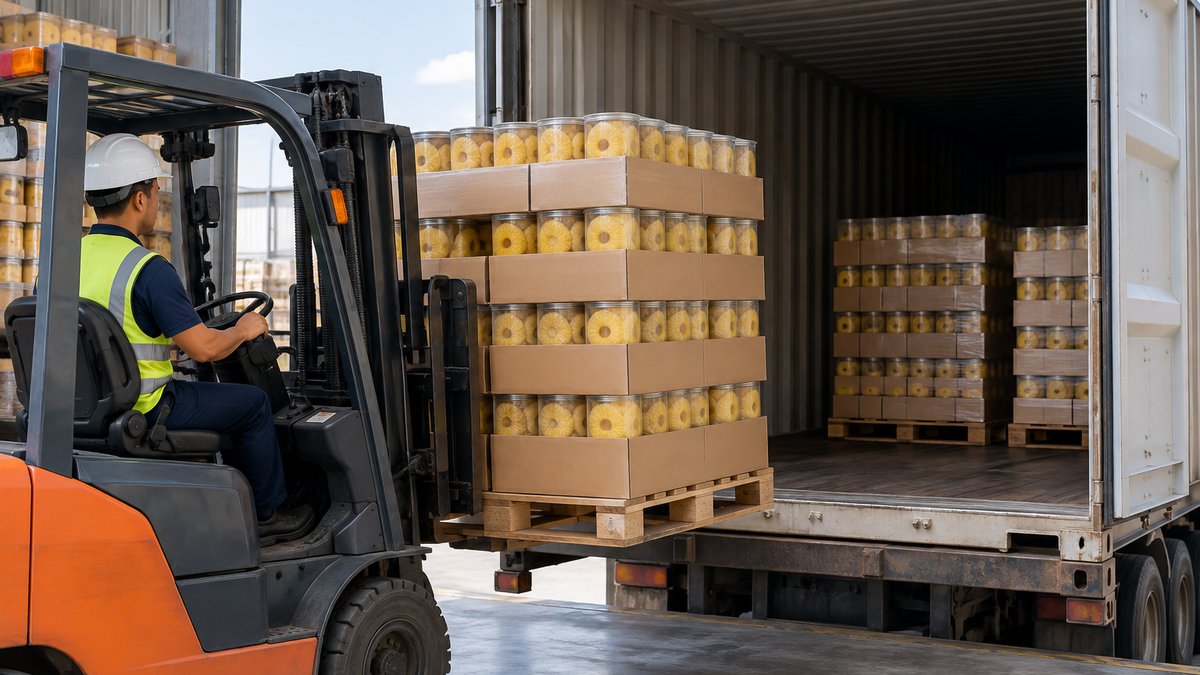
Packaging details affect receiving and downstream use. For frozen pineapple, buyers commonly need the retail or food-service inner pack size, food-contact liner, outer-case strength, case net weight and pallet configuration. For canned pineapple, identify the can size and material, number of cans per case, case weight and pallet pattern. The buyer should also state any language, date-code, allergen or destination-market labeling requirements.
When checking a supplier’s offer, separate product attributes from commercial details. A specification can state the fruit style, ingredient list, declared weights and quality limits; the purchase agreement can then set the inspection method and the documents the supplier must provide. For canned goods, agree how the buyer will verify drained weight and container condition. For frozen goods, identify the temperature records and inspection point used to assess delivery condition. That separation gives both parties a clearer basis for reviewing a shipment if the delivered product differs from the agreed specification.
Buying consideration: Before comparing offers, check that each quotation covers the same cut, ingredients, weight basis, quality criteria, packaging, shipment temperature and destination. If one supplier quotes drained fruit weight and another quotes total can contents, request a corrected comparison.
3. A buyer’s intended use changes the better format
Consider an importer supplying a food manufacturer that produces fruit fillings and desserts. The production team needs a consistent pineapple cut for a recipe and has freezer capacity at its factory. Frozen chunks may fit the operation if the buyer sets piece dimensions, freezing format, acceptable defects and delivery temperature. The importer must also plan frozen storage after arrival and protect the product during unloading.
A second buyer supplies cafés and small retailers with limited freezer space. Canned pineapple may fit that distribution model if the customer accepts the packing medium and can size. The importer still needs to verify drained weight, container integrity, case format, label details and the packer’s shelf-life declaration. A shelf-stable product avoids frozen storage during distribution only when its validated process, packaging and label support that handling.
The scenario does not make one form universally preferable. A manufacturer may need frozen fruit for its recipe, or canned fruit for a product that uses the packing liquid. A food-service buyer may prioritize convenient opening and portioning, while a processor may care more about a particular cut and input consistency. Buyers should start from the final use, then check whether the supplier can meet that specification.
Illustrative inquiry format:
Product: Pineapple, specified cut and style
Form: Frozen IQF or canned; state the required option
Ingredients: State permitted additions or required packing medium
Quality: Set piece size, grade or other measurable criteria
Quantity and packing: State order quantity, inner pack and case configuration
Delivery: Name destination, requested Incoterm rule and version, and required product temperature if frozen
This is an illustrative inquiry format, not a universal pineapple specification. Set each requirement to match the product’s intended use and destination.
A buyer can test the draft specification against the actual receiving and production process before asking suppliers to quote. If the factory feeds fruit directly into a line, confirm that the cut and pack format can be handled by its equipment. If the product will be repacked or portioned, account for the package size and the controls needed after opening. For frozen fruit, make sure the receiving site has freezer capacity ready before the shipment arrives. For canned fruit, check that the intended can size and case format suit the storage and dispensing system. These checks help the buyer avoid requesting an attractive specification that the operation cannot use.
Looking to Source Pineapple?
Connect with verified suppliers, discover matching products, and explore sourcing opportunities from global markets.
4. Choose frozen pineapple when the operation can manage frozen handling
Frozen pineapple is a practical fit when the buyer needs a frozen ingredient or a specific cut and can maintain the required temperature after delivery. Food manufacturers, food-service distributors and processors may select frozen fruit when it fits their recipes, production equipment and storage systems. The specification should say whether the buyer accepts IQF or block-frozen product.
A frozen purchase adds cold-chain work to the transaction. The importer should confirm the reefer booking, set-point instructions, loading condition, temperature records, port and warehouse arrangements, and procedures for unloading. Codex’s quick-frozen food guidance addresses product temperature in storage and transport; buyers should also check the destination’s rules and the contract’s requirements. A container set-point alone does not prove that the fruit itself remained at the required temperature.
Choose canned pineapple when the buyer needs a sealed, commercially processed product that can be stored under the conditions on its label, or when the recipe calls for a particular canned style or packing medium. Canned packs can simplify distribution where frozen warehousing is unavailable, but importers must manage container handling, date coding, rotation and damage checks. A dent, seam defect, leak, swelling or other container issue should be handled under the buyer’s inspection and food-safety procedures.
Destination rules matter for both forms. Food import requirements can cover ingredient declarations, food-contact packaging, labeling, contaminants, pesticide residues and facility or process obligations. For the United States, FDA guidance describes requirements for imported foods and separate requirements that apply to qualifying low-acid canned and acidified foods. Applicability depends on the product, its formulation and processing; importers should verify the actual classification rather than assume every canned pineapple product falls under the same filing rules.
Commercial delivery terms are separate from the food specification. Incoterms® 2020 allocates particular obligations, costs and risk between the buyer and seller; it does not replace the product’s temperature, quality, packaging or food-safety clauses. If the contract uses a maritime rule such as FOB or CIF, state the named port and the Incoterms® version. For frozen pineapple, write the cold-chain obligations separately and specify who arranges and monitors each leg.
The cold chain should be treated as a sequence of handoffs, rather than a single transport instruction. The buyer and seller can document the agreed product condition at loading, the carriage temperature requirement, the party responsible for monitoring the shipment and the receiving procedure. They should also decide how to handle delays, equipment interruptions and temperature records that show an excursion. Incoterms® allocate defined delivery obligations and risks, but the parties still need contract language for food condition and quality claims.
Buying consideration: Select frozen pineapple when the product’s cut and application justify the cold-chain cost and the buyer can maintain frozen storage. Select canned pineapple when its processed form, packing medium and storage conditions suit the product and distribution plan. In both cases, make the contract specification precise enough to verify on arrival.
5. Use product standards and contract details as related resources
The Codex Standard for Canned Pineapple provides internationally recognized descriptions of canned styles and pack types. The USDA Agricultural Marketing Service publishes separate grade standards for frozen and canned pineapple. These are useful reference points, but they do not automatically become a contract term or a legal requirement in every destination. State the specific standard, edition and grade in the purchase agreement if the parties intend to use it.
For frozen shipments, Codex’s Code of Practice for the Processing and Handling of Quick Frozen Foods gives guidance on storage and transport temperature. For U.S.-bound canned goods, FDA’s importing and canned-food guidance helps importers identify which regulatory requirements may apply. The International Chamber of Commerce’s Incoterms® 2020 materials explain the allocation of seller and buyer obligations under the chosen trade rule. Each resource has a different scope, so use the food standard for product description, the regulator for market access and the Incoterms rule for delivery responsibilities.
A supplier comparison should capture the product form, style, ingredients, quality criteria, net and drained weights where relevant, package configuration, shelf-life declaration, storage temperature, shipment term and destination. Ask for a current product specification and label details before placing an order. For Freshdi, buyers can review pineapple buying requests and suppliers can review pineapple supplier listings as a starting point for identifying relevant B2B listings.
References
1. Codex Alimentarius Commission – Standard for Canned Pineapple (CXS 42-1981), 1981.
2. Codex Alimentarius Commission – Code of Practice for the Processing and Handling of Quick Frozen Foods (CXC 8-1976), 2008.
3. U.S. Department of Agriculture, Agricultural Marketing Service – Frozen Pineapple Grades and Standards, Accessed November 16, 2026.
4. U.S. Department of Agriculture, Agricultural Marketing Service – Canned Pineapple Grades and Standards, Accessed November 16, 2026.
5. U.S. Food and Drug Administration – Importing Human Foods, Accessed November 16, 2026.
6. International Chamber of Commerce – Incoterms® 2020, 2019.
Disclaimer: This article is compiled from platform data, public sources and information provided by third parties, for general informational purposes only. We do not guarantee its accuracy or completeness. Please conduct your own due diligence before making business decisions.