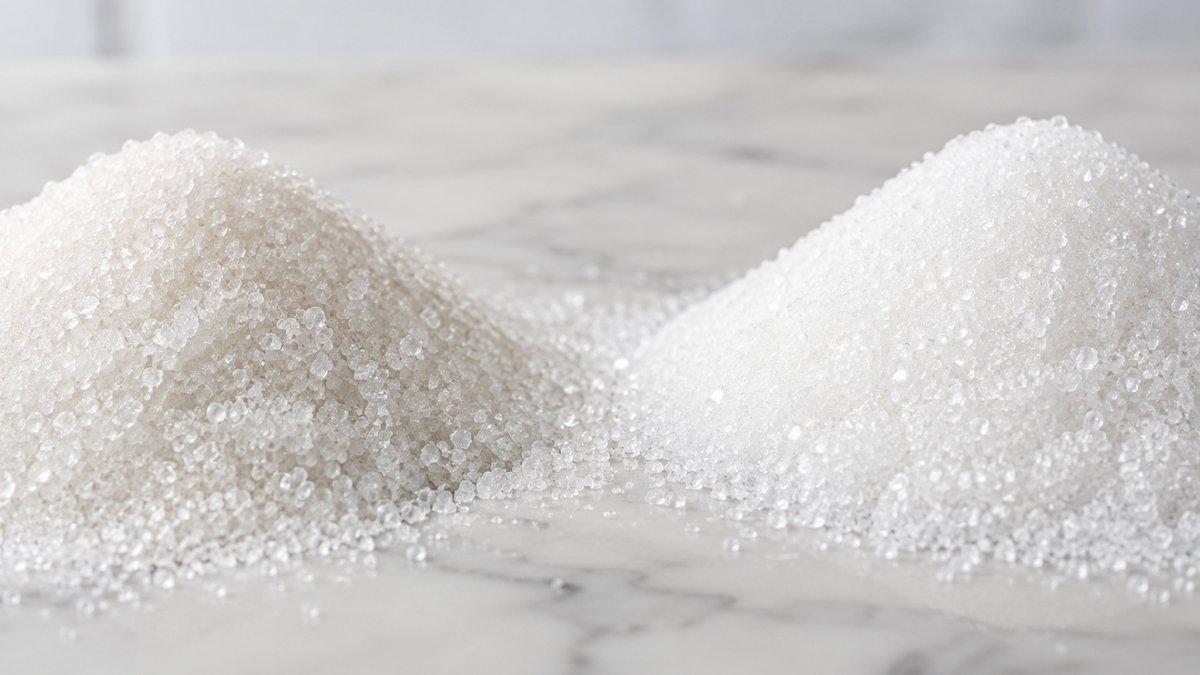

1. ICUMSA 45 and ICUMSA 150 differ mainly in their specified color limit
ICUMSA 45 and ICUMSA 150 describe sugar color limits used in product specifications. A lower number means a lower permitted color reading. The number alone does not define every quality attribute, prove a specific refining process, or establish a complete grade.
ICUMSA, the International Commission for Uniform Methods of Sugar Analysis, publishes laboratory methods for measuring sugar characteristics. Its color methods use spectrophotometry to measure the absorbance of a filtered sugar solution at 420 nm. The result is expressed in ICUMSA Units, or IU. The method measures color; it does not by itself certify the sugar’s origin, safety, intended use or overall quality.
The Codex Standard for Sugars makes an important distinction. It sets a maximum color of 60 IU for white sugar and 150 IU for plantation or mill white sugar. Those Codex limits are category specifications. They do not establish a universal commercial product named “ICUMSA 45” or “ICUMSA 150,” and local requirements or a sales contract may set other conditions.
A contract that says “ICUMSA 45” generally needs to define a maximum color of 45 IU and the test method used to verify it. A contract stating “ICUMSA 150” needs the same clarity. A 150 IU ceiling matches the Codex color limit for plantation or mill white sugar; it is higher than Codex’s 60 IU ceiling for white sugar. Buyers should therefore check the product category and applicable market rules rather than relying on the grade label alone.
The contrast is about the permitted color reading, not a guarantee that every other specification changes with it. Polarization, moisture, ash, granulation, packaging and other limits must be agreed separately. A 45 IU limit is more restrictive on color than a 150 IU limit, but the label does not tell a buyer whether a shipment meets the rest of the purchase specification.
2. The specification and test method determine what the color comparison means
A useful comparison starts with the agreed color ceiling and test method, then checks the remaining product limits separately. ICUMSA’s GS2-9 method, updated in 2024, covers sugar colors above 20 and below 600 IU using a pH-adjusted solution. Its GS2-10 method, also updated in 2024, covers sugar and syrup colors up to 50 IU without pH adjustment. Buyers can ask the seller and inspection provider to state which applicable method will be used.

The Codex Standard for Sugars also lists limits for characteristics such as conductivity ash, invert sugar and loss on drying, with limits varying by sugar category. Those values should not be assumed from the ICUMSA color number. For a transaction, the contract or attached technical specification should list each required parameter, its limit, unit, test method and the procedure for resolving a disputed result.
Color results are meaningful only when the test and acceptance conditions are clear. ICUMSA’s 2024 GS2-9 method notes that repeatability and reproducibility vary by color range. For sugars between 50 and 200 IU, for example, it gives different tolerances for repeated results from the same conditions and results from different laboratories. This is one reason to specify the method, sampling plan and referee-lab process before shipment rather than negotiating them after a disagreement.
The term “refined” also needs a precise definition in the contract. A low color ceiling can be part of a refined sugar specification, but a number alone does not document the production route. Codex distinguishes white sugar from plantation or mill white sugar by category and quality factors, not by color alone. If the buyer needs a particular process or category, the specification should name it.
3. A color-sensitive product and a general-use purchase call for different checks
Consider a buyer making a white confectionery product with a color limit in its own recipe specification. The buyer can request sugar with a maximum color of 45 IU, then verify that the supplier’s complete product sheet meets the buyer’s limits for other relevant properties. The buyer should also confirm the method of analysis and how the shipment will be sampled.
In this case, the narrower color ceiling is a purchasing requirement tied to the finished product. It is not proof that 45 IU sugar will always produce a better finished good. The buyer still needs trials or production checks if color affects the recipe, and should confirm that the sugar’s grain size, moisture and other characteristics suit the process.
Now consider a buyer sourcing plantation or mill white sugar for a process whose accepted specification permits color up to 150 IU. The buyer may consider a product with that ceiling if the applicable food rules and the finished-product requirements allow it. The specification should still state the buyer’s required color test and separate limits for polarization, moisture, ash and packaging.
These examples are illustrative. A color ceiling does not establish the sugar’s suitability for a particular recipe, factory or destination market. Buyers should compare the product specification with their own process requirements and the rules that apply where the sugar will be sold or used.
For either purchase, a short label is not enough to make quotations comparable. One seller’s “ICUMSA 45” offer may include a different moisture limit, bag format, shipment basis or inspection arrangement from another seller’s offer. Compare the full product and delivery terms, and request supporting test results for the stated lot when the contract requires them.
Looking to Source Refined Sugar?
Connect with verified suppliers, discover matching products, and explore sourcing opportunities from global markets.
4. Choose the color ceiling that fits the buyer’s specification and market
Choose ICUMSA 45 when the purchase specification requires a color ceiling of 45 IU or less and the supplier can document that limit using the agreed test method. Choose an ICUMSA 150 specification only when a 150 IU ceiling is acceptable for the application and consistent with the product category and destination-market rules.
Before requesting quotations, write down the parameters that will affect acceptance. At minimum, define the sugar category, maximum color, test method, polarization, moisture, ash, granulation, packaging, shipment quantity and destination. Add any other product or regulatory requirements relevant to the buyer’s use and market.
- Name the product category and the required color ceiling. Avoid treating “45” or “150” as a complete technical specification.
- State the applicable ICUMSA color method, the sampling plan and how the parties will handle differences between test results.
- List separate limits for polarization, moisture, ash, granulation and any other characteristics needed for the buyer’s use.
- Confirm whether the destination market’s rules permit the specified sugar category and characteristics.
- Compare quotations only after matching the product limits, packaging, quantity, shipment basis, payment conditions and delivery timing.
There is no price premium that can be calculated from the color number alone. A quotation may reflect origin, crop and supply conditions, specification, packaging, shipment size, freight, delivery term, payment conditions and the date of the offer. Since those factors can differ between offers, ask suppliers to quote the same specification and commercial basis before drawing a price comparison. Treat any quotation as time-specific, not as a standing market price.
Check certificates of analysis against the contract limits, and confirm that each result refers to the lot being offered. Agree who will inspect, where sampling will occur and which laboratory result will govern if the parties disagree. These conditions matter for both color limits; a product name cannot replace an agreed inspection procedure.
Buyers and exporters comparing specifications can use Freshdi to review refined sugar buying requests or potential refined sugar suppliers.
References
1. Codex Alimentarius Commission – Standard for Sugars, CXS 212-1999, 1999.
2. ICUMSA – ICUMSA Method GS2-9 (2024), Colour in Solution of Sugars with more than 20 and less than 600 ICUMSA Units and pH Adjustment with TEA/HCl Buffer, 2024.
3. ICUMSA – ICUMSA Method GS2-10 (2024), Colour in Solution of Sugars, Liquid Sugar and Syrups with less than 50 ICUMSA Units and with no pH Adjustment, 2024.
4. ICUMSA – Methods Book Supplement 2024, 2024.
Disclaimer: This article is compiled from platform data, public sources and information provided by third parties, for general informational purposes only. We do not guarantee its accuracy or completeness. Please conduct your own due diligence before making business decisions.