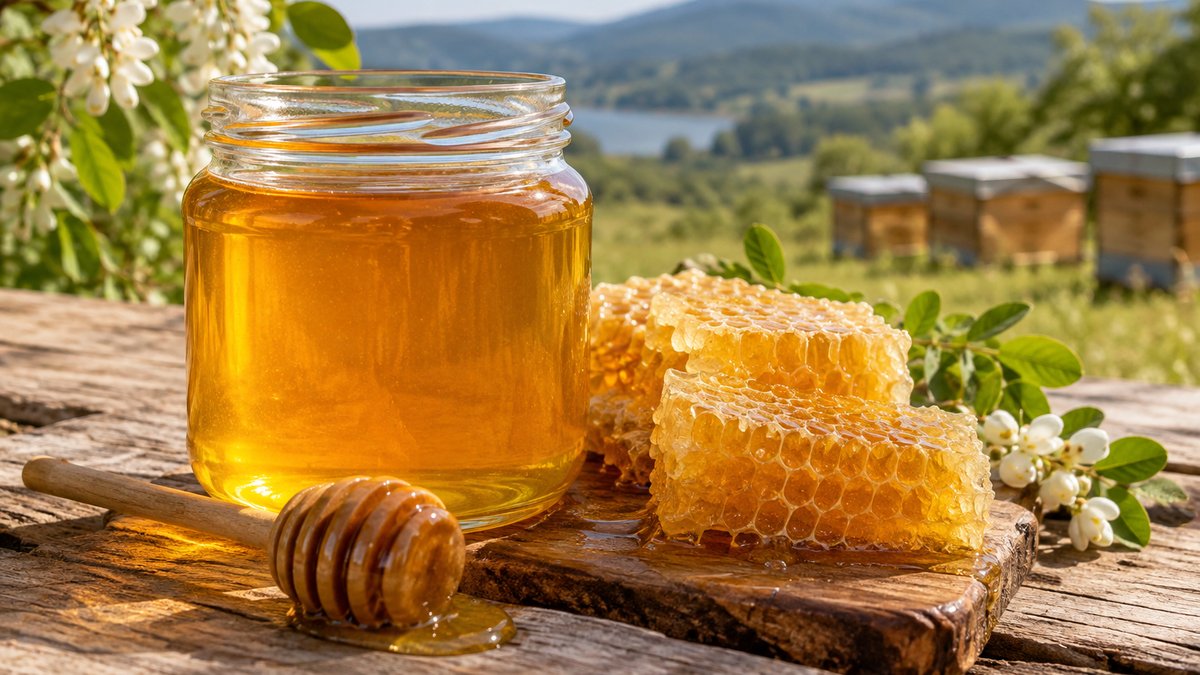

Honey can originate from flower nectar, plant secretions or insect excretions on plants. That source distinction separates blossom honey from honeydew honey, two recognized honey types that buyers may encounter in bulk and ingredient sourcing.
The key difference is not a processing method or a grade: it is the material bees collect. That origin can affect the honey’s composition and the details buyers need to verify, but neither term alone establishes a price, sensory profile or overall quality ranking.
For importers and exporters, understanding the distinction helps make product descriptions, documentation and quotations more precise.
Key Takeaways
- Blossom honey comes from plant nectar; honeydew honey comes mainly from plant-sucking insect excretions or secretions from living parts of plants.
- The Codex Standard for Honey sets a lower minimum fructose-and-glucose sum for honeydew honey and blends than for honey not listed under that exception.
- The type does not, by itself, establish the honey’s color, flavor, floral source, processing method, grade or price.
- Buyers should specify the claimed origin, blend status, intended use, quality parameters, test documentation, packaging and destination-market labeling requirements.
- The Codex Standard is an international reference; applicable legal requirements depend on the importing market.
1. The Key Difference Between Blossom Honey and Honeydew Honey
The Codex Alimentarius Commission’s Standard for Honey (CXS 12-1981, as listed in the Codex standards catalogue in 2022) distinguishes these honeys by origin. Blossom honey, also called nectar honey, comes from plant nectar. Honeydew honey comes mainly from excretions of plant-sucking insects in the order Hemiptera on living plant parts, or from secretions of living plant parts. The standard covers honey intended for direct consumption and also addresses honey packed in bulk for repacking or use as an ingredient.
Put simply, bees collect nectar from flowers to produce blossom honey. For honeydew honey, bees collect honeydew associated with living plants. The distinction concerns the source collected by bees; it does not mean honeydew honey is made by adding an ingredient to finished honey.
That origin category should not be confused with other ways honey is described. A honey can also be described by a named floral or plant source, geographic origin, physical form or production method. For example, liquid versus crystallized describes physical state, while extracted describes how honey is obtained from combs. These are separate specification details, not synonyms for blossom or honeydew.
Composition is one measurable point of difference. Under Codex CXS 12-1981, the sum of fructose and glucose is at least 60 g per 100 g for honey not listed under the relevant exception, and at least 45 g per 100 g for honeydew honey and blends of honeydew honey with blossom honey. These are Codex composition criteria, not a score of which type is better. The applicable rule in a particular market may differ; the European Union, for example, has its own honey rules under Council Directive 2001/110/EC, as amended.
Codex also says honey should not be heated or processed to an extent that changes its essential composition or impairs its quality. The source category therefore does not tell a buyer whether the honey has been filtered, heated, blended or otherwise handled; those details need their own declarations and supporting records. The distinction was checked against the Codex standard and EU rules on November 25, 2026.
For buyers comparing honey buying requests on Freshdi, the practical point is to treat the source term as one part of the specification—not a complete quality description.
2. Blossom Honey vs Honeydew Honey: Comparison Table
The table summarizes the main distinction and the questions it raises for a commercial specification. Codex provides the definitions and composition criteria; the buyer still needs to agree on measurable product and delivery requirements with the supplier.
| Comparison point | Blossom honey | Honeydew honey |
|---|---|---|
| Primary source | Nectar of plants | Mainly plant-sucking insect excretions or secretions from living plant parts |
| Other name | Nectar honey | Honeydew honey |
| Codex fructose and glucose sum | At least 60 g per 100 g for honey not covered by a listed exception | At least 45 g per 100 g; the same minimum applies to blends with blossom honey |
| What the term does not specify | Plant species, region, processing, physical state or price | Plant or insect species, region, processing, physical state or price |
| Buyer verification | Substantiate the claimed source and any named floral origin | Substantiate honeydew origin and state whether the lot is blended |
Composition figures in the table are from the Codex Alimentarius Commission’s Standard for Honey (CXS 12-1981; catalogue edition listed in 2022). They are stated per 100 g of honey. The 60 g criterion applies to honey not covered by the standard’s specified exceptions; it is not a universal threshold for every named honey. Codex also sets exceptions for certain honey types and requirements for other composition factors.
Do not infer a particular color or taste from the category alone. Codex describes honey’s color as ranging from nearly colorless to dark brown and says flavor and aroma vary with plant origin. A buyer who needs a specific color range or sensory profile should state the acceptance criteria and agree on a sample or testing approach rather than rely on the words “blossom” or “honeydew.”
Labeling claims also need attention. Under EU Council Directive 2001/110/EC, as amended, a floral or vegetable origin may accompany the product name when the honey comes wholly or mainly from the indicated source and has the relevant organoleptic, physicochemical and microscopic characteristics. This is an EU rule, not a universal labeling rule for every destination. Buyers should check the current requirements for the market where the product will be sold.
When assessing honey suppliers on Freshdi, request a product specification that makes the claimed source, blend status and supporting evidence clear. The category name alone is not a substitute for agreed acceptance criteria.
Looking to Source Honey?
Connect with verified suppliers, discover matching products, and explore sourcing opportunities from global markets.
3. Sourcing Scenario: Selecting Honey for an Ingredient Contract
Consider a food manufacturer seeking bulk honey as an ingredient. One supplier offers blossom honey, while another offers honeydew honey. A comparison based only on the product names or price per kilogram would leave important questions unanswered.
First, the buyer should decide whether the source category is essential to the intended product. If the recipe, brand description or customer specification requires blossom honey, honeydew honey is not an automatic substitute. If the application permits either type, the buyer can assess samples against agreed sensory and technical requirements before deciding.
Next, the buyer should make the two offers comparable. Ask each supplier to state whether the lot is a single source category or a blend, and to identify any additional floral or geographic claim. Request the relevant specification and test documentation, including the composition parameters that matter for the intended application and destination. Where a supplier uses a named floral-origin claim, ask what evidence supports that claim and whether it meets the destination market’s rules.
Illustrative inquiry format:
Product: Honey; state blossom, honeydew or blend
Intended use: Food ingredient; describe the application
Required declaration: State any requested floral, plant or geographic origin
Quality specification: List applicable composition, sensory and other acceptance criteria
Documentation: Request the product specification and relevant test records
Commercial details: State quantity, packaging, delivery destination and requested trade terms
This is an illustrative inquiry format, not a universal honey specification.
For a buyer, the commercial decision should compare fit for use, evidence, consistency, packaging and delivered terms—not assume that one source category is inherently superior or cheaper. If either type is acceptable, a documented trial can help assess how the specific lots perform in the actual formulation.
You can review honey buying opportunities on Freshdi and use the stated requirements as a starting point for a sourcing inquiry. Freshdi listing details are not a substitute for verifying the product specification and commercial terms with a prospective business partner.
4. When Should Buyers Choose Blossom Honey or Honeydew Honey?
There is no universal answer: the appropriate choice depends on the product brief, the buyer’s requirements and the evidence available for the offered lot. The following checks help keep the decision tied to the actual use.
4.1 Choose blossom honey when the source requirement is nectar-based
Blossom honey is the relevant category when a buyer’s specification requires honey from plant nectar. If the buyer also needs a named floral or vegetable origin, state that claim separately and confirm the applicable substantiation and labeling requirements in the destination market. “Blossom honey” by itself does not identify a particular flower, region, color, flavor or season.
4.2 Choose honeydew honey when the source requirement is plant-associated honeydew
Honeydew honey fits a specification that calls for honey made mainly from the defined plant secretions or insect excretions. Confirm the supplier’s description of the lot and whether it is pure honeydew honey or a blend. Under Codex, honeydew honey and blends with blossom honey share the stated minimum fructose-and-glucose sum of 45 g per 100 g; verify all other relevant composition and quality parameters separately.
4.3 If either category may work, compare the lot rather than the label
Where the application does not require one source, ask for samples and specifications from both offers. Compare the properties that matter to the product, such as sensory profile, processing behavior, composition, packaging and consistency between lots. Confirm the method and documentation used to assess each requirement before including it in a contract.
- State the required source category and whether blends are acceptable.
- List any named floral, plant or geographic-origin claims separately.
- Set measurable quality and composition criteria for the intended use.
- Ask for product specifications and relevant test documentation.
- Check labeling and import requirements for the destination market.
- Agree on packaging, lot identification, quantity, delivery terms and inspection arrangements.
These checks help importers and exporters negotiate comparable offers without treating a source designation as a complete grade or guarantee. Buyers can also review Freshdi’s supplier listings and explore suppliers for the wider Herbs, Spices & Seasonings category when broadening a search.
Once your honey specification is clear, compare relevant buying requests and supplier listings for the wider product category.
View Latest Herbs, Spices & Seasonings Buying Requests →
View Potential Herbs, Spices & Seasonings Suppliers →
5. Related Honey Sourcing Resources
For the definitions and composition criteria behind this comparison, consult the Codex Alimentarius Commission’s Standard for Honey (CXS 12-1981, catalogue edition listed in 2022). For EU trade, consult Council Directive 2001/110/EC relating to honey, including its amendments, and check the rules in force for the specific product and destination.
You can browse honey buying requests on Freshdi or explore honey suppliers on Freshdi. For category-specific listings, see honey buying requests and honey suppliers. Buyers looking across the parent category can also review Herbs, Spices & Seasonings buying requests.
Before proceeding with an inquiry, confirm the product’s source category, blend status, quality specification, supporting documents and destination-market requirements. To discuss sourcing needs, you can contact a Freshdi Account Manager.
Frequently Asked Questions
What is the main difference between blossom honey and honeydew honey?
Blossom honey comes from plant nectar. Honeydew honey comes mainly from plant-sucking insect excretions on living plants or secretions from living parts of plants. The distinction is about the material bees collect, not a processing method.
Is honeydew honey a blend?
Not necessarily. Honeydew honey is a defined source category. A blend of honeydew honey with blossom honey is a separate description; buyers should ask suppliers to state clearly whether a lot is a single category or a blend.
Does blossom honey always come from one flower?
No. The term means honey from plant nectar and does not, by itself, identify a particular flower. A named floral-origin claim should be stated separately and supported according to the requirements of the destination market.
Does honeydew honey have a different Codex sugar criterion?
Yes. Codex CXS 12-1981 sets a minimum sum of fructose and glucose of 45 g per 100 g for honeydew honey and blends of honeydew honey with blossom honey. For honey not covered by the specified exceptions, the minimum is 60 g per 100 g. These are composition criteria, not a ranking of quality.
Which type should a food manufacturer buy?
Choose according to the product’s source requirement, intended use, agreed quality parameters and applicable labeling rules. If either type is acceptable, request specifications and samples, then compare the actual lots against the formulation’s requirements.
Does the term honeydew honey specify color or flavor?
No. The term identifies the source category, not a guaranteed sensory profile. Codex describes honey’s color, consistency, flavor and aroma as variable. Buyers who require particular sensory characteristics should state and assess them separately.
References
1. Codex Alimentarius Commission, FAO and WHO – Standard for Honey, CXS 12-1981, Catalogue edition listed in 2022; checked November 25, 2026.
2. European Parliament and Council of the European Union – Council Directive 2001/110/EC relating to honey, consolidated text, Consolidated text dated June 14, 2026; checked November 25, 2026.
Disclaimer: This article is compiled from platform data, public sources and information provided by third parties, for general informational purposes only. We do not guarantee its accuracy or completeness. Please conduct your own due diligence before making business decisions.