
Navel and Valencia oranges are both sweet oranges sold fresh, but buyers often choose them for different reasons. Navel oranges are commonly associated with fresh eating, while Valencia oranges are especially valued for their juiciness and use in juice. Those are useful starting points—not universal rules for every cultivar, growing area or buyer.
For importers and exporters, the practical differences include the fruit’s typical form and use, seed expectations, harvest timing and how well a lot suits its intended channel. A variety name alone does not establish size, maturity, quality, shelf life, packing format or delivery condition.
The comparison below summarizes the common distinctions and turns them into sourcing questions. It was checked on November 26, 2026. Harvest windows are examples from cited sources, not a global calendar; production area, cultivar and season can change availability.
Key Takeaways
- Navel oranges are commonly selected for fresh eating; Valencia oranges are particularly associated with juicy fruit and juice use.
- Navel oranges are typically seedless, while Valencia oranges may contain some seeds; confirm the actual cultivar and lot specification.
- Seasonality varies by production area and cultivar. California reference sources describe navels as winter-maturing and Valencias as generally maturing in summer.
- The Codex Standard for Oranges covers fresh commercial varieties and sets general quality and maturity criteria; it does not make the variety name a complete buyer specification.
1. Key Differences Between Navel and Valencia Oranges
In brief, navel oranges are often chosen as eating oranges, while Valencia oranges are often chosen when juiciness and juice use matter. The distinction is a common commercial shorthand, not a guarantee that every navel will be unsuitable for juicing or every Valencia will be sold only for processing. Both varieties can be marketed as fresh fruit, and the best fit depends on the buyer’s product, channel and quality requirements.
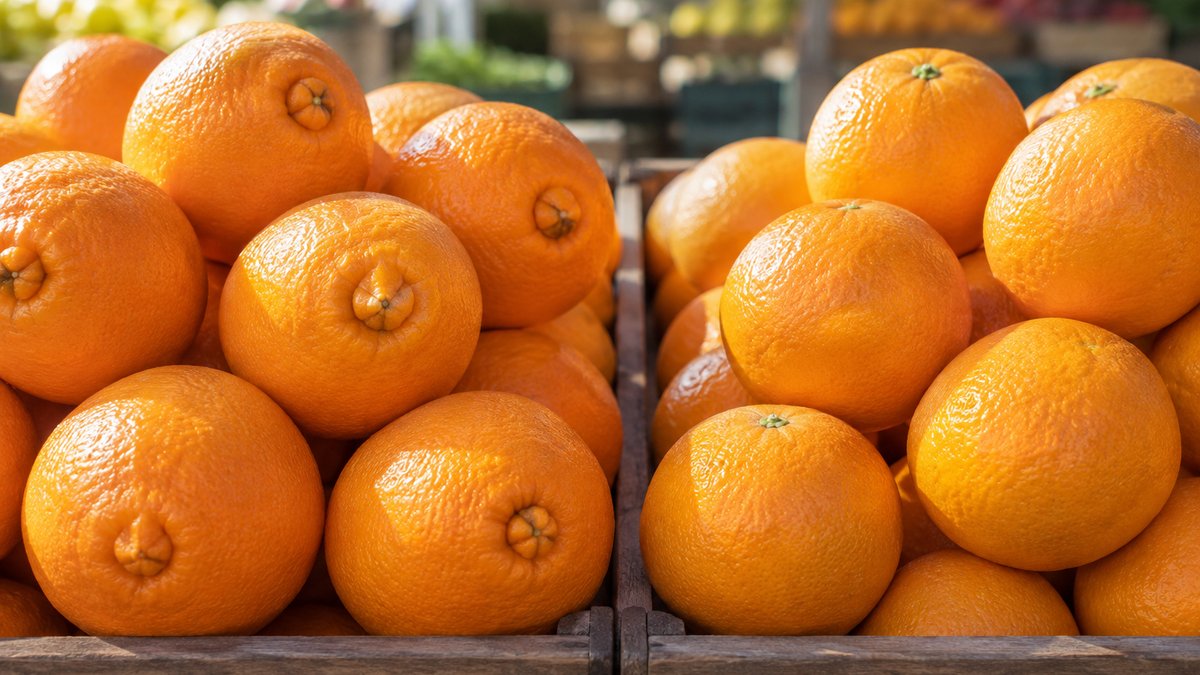
A navel orange is recognized by the small, secondary-fruit-like formation at the blossom end that gives it its name. The University of California Riverside Givaudan Citrus Variety Collection describes Washington navel oranges as seedless, easy to peel and suited to fresh eating; its cultivar notes also describe the fruit as relatively poor for processing. The collection gives November to January as the ripeness season for its Washington navel accession at Riverside. That is a location- and accession-specific reference, not a universal availability schedule.
Valencia oranges are known commercially for their juicy pulp and use as juice oranges. UC Agriculture and Natural Resources’ Santa Clara County citrus guidance describes Valencia fruit as thin-skinned, very juicy and having few seeds. It gives an April-to-October harvest period for that local growing context. Season and seed characteristics can vary across Valencia selections and production regions, so buyers should not treat these general descriptions as shipment guarantees.
A further practical distinction is that Valencia fruit may develop a greener-looking peel in summer even when mature. UC Statewide IPM notes that some Valencia oranges can remain greenish while fully ripe, and that color alone does not establish sweetness or maturity. For trade, maturity should be assessed against the applicable destination requirements and the agreed product specification—not peel color alone.
These variety descriptions are separate from formal grade or maturity requirements. The Codex Alimentarius Commission’s Standard for Oranges (CXS 245-2004, amended in 2011) applies to commercial orange varieties supplied fresh to consumers after preparation and packaging; it excludes oranges for industrial processing. It sets general quality and maturity criteria, including coloring and minimum juice content, while taking variety, harvest time and production area into account. It does not certify a particular lot or replace the buyer’s contract specification.
2. Navel vs Valencia Orange Comparison Table
The table compares common commercial characteristics rather than promising the attributes of any specific shipment. Cultivar, origin, harvest timing and postharvest handling can affect the fruit received. Confirm the details with the supplier and agree the inspection basis before concluding that two offers are comparable.
| Feature | Navel oranges | Valencia oranges |
|---|---|---|
| Typical buyer shorthand | Often selected for fresh eating | Often selected for juiciness and juice use |
| Recognition | Usually has a small navel-like formation at the blossom end | Does not have the characteristic navel formation |
| Seeds | Washington navel is seedless; confirm the named cultivar | Often described as having few seeds; verify the cultivar and lot |
| Peel and handling | Washington navel is described as easy to peel; actual condition varies | Santa Clara County guidance describes Valencia as thin-skinned |
| Season example | Washington navel at Riverside: November to January | Santa Clara County guidance: April to October |
| Juice considerations | Fresh eating is a common use; juice quality after extraction and storage can differ | A common juice-orange choice because of its juicy pulp |
| Important sourcing check | Cultivar, maturity, size, peel condition and destination requirements | Cultivar, maturity, size, peel condition and destination requirements |
The season examples above come from different California sources and should not be read as a direct, like-for-like harvest comparison for another origin. UC Statewide IPM describes navels as potentially not ready until late winter and Valencias as usually mature in summer in its guidance. In other production areas, crop calendars may differ. Ask the exporter for the origin, cultivar, expected packing window and harvest status for the actual shipment.
The Codex standard provides another useful distinction for contract discussions: it defines minimum juice-content criteria for fresh oranges by groups, including the Navels group and other varieties. Those values are maturity criteria within that standard—not a promise of the juice yield, flavor, sweetness or processing performance of a particular consignment. Buyers with processing needs should agree any additional juice, soluble-solids, acidity or extraction requirements directly with the supplier and inspection provider.
Buying consideration: When comparing quotations, ask suppliers to state the cultivar, origin, harvest or packing period, size range, maturity basis, packaging, quantity, delivery term and inspection method. For juice applications, specify the relevant performance measures separately rather than relying on “Valencia” or “navel” as a substitute.
Looking to Source Fresh Orange?
Connect with verified suppliers, discover matching products, and explore sourcing opportunities from global markets.
3. Example Sourcing Scenario
Consider an importer buying fresh oranges for two channels: a retail program selling whole fruit for household consumption and a food-service customer that wants fruit for juicing. The importer could request navel and Valencia offers separately, but should avoid assuming the variety name alone settles the choice. The retail buyer may prioritize appearance, easy preparation, size consistency and a dependable arrival condition. The juice customer may focus more on juice content, flavor profile, supply timing and processing performance.
A practical request would first identify the intended use and destination, then ask each supplier to confirm the exact cultivar and production origin. The importer can also request representative product photos, packing details and the supplier’s available quality data. Where sampling or third-party inspection is part of the buyer’s process, the contract should clarify when and how that check will take place. These steps make offers easier to compare without assuming that variety descriptions guarantee a particular result.
Illustrative fresh-orange inquiry:
Product: Fresh oranges; specify navel or Valencia cultivar
Intended use: Fresh retail sale or juice use
Origin and timing: State production origin and proposed packing window
Quality details: Agree size range, maturity basis and any buyer-defined quality measures
Packing and shipment: Specify pack format, quantity, destination and delivery term
Verification: Agree documents, sample or inspection arrangements, if required
This is an illustrative inquiry format, not a universal orange specification.
A buyer can use a Fresh Orange buying-request page on Freshdi to review sourcing opportunities and compare stated requirements. Each listing’s details and current status should be checked directly; platform listings do not replace contract review or product verification.
4. When Should Buyers Choose Each Orange?
4.1 When navels may fit
Navel oranges may be a suitable option when the buyer’s main need is whole fruit for fresh consumption, especially where the customer values a familiar eating-orange presentation. The University of California Riverside Citrus Variety Collection describes Washington navel as seedless and easy to peel, characteristics that can be relevant to fresh-market positioning. Buyers should still confirm the specific cultivar, seed expectations, size, external appearance and condition with the supplier.
A navel can also be considered for a fresh retail program that needs a defined variety and a seasonal sourcing plan. Because the navel season cited by California sources is region-specific, the buyer should compare the supplier’s actual harvest and packing calendar with the planned shipping and sales window. Do not infer that fruit will be available year-round from a variety name alone.
4.2 When Valencia may fit
Valencia oranges may be a stronger candidate when the buyer prioritizes juicy fruit or needs a fresh-orange input for juice. The variety’s common association with juicing is useful when screening offers, but buyers should ask suppliers for any measurable quality information required by their process. A customer producing fresh juice, for example, may need to assess taste, extraction performance and how quickly the juice will be used or stored.
Valencia may also help a buyer plan a different procurement window from a navel program, depending on origin and cultivar. UC Statewide IPM’s California-oriented guidance places typical Valencia maturity in summer and navels later in the season, but this is not a global schedule. Importers should obtain a current origin-specific crop and packing outlook before committing to a delivery plan.
4.3 When neither variety name is enough
If an offer is being assessed for a strict retail program, processing line or long-distance shipment, the buyer should not choose on variety alone. Fresh-fruit condition, maturity, pack style, arrival timing and destination-market requirements can determine whether a lot is commercially acceptable. The Codex orange standard is a reference for fresh oranges, but the relevant legal requirements depend on the destination and may include national or regional rules beyond a voluntary or internationally adopted standard.
Before committing, make the following points explicit in the inquiry or contract:
- Named variety or cultivar, production origin and harvest or packing window.
- Intended use: fresh eating, retail display, food service or juice processing.
- Size or count range, permitted variation and the method used to assess it.
- Maturity and quality criteria, including any buyer-defined juice or flavor requirements.
- Packaging, labeling, quantity, shipment temperature arrangements and destination.
- Inspection, sampling, document and rejection procedures agreed by the parties.
- Delivery term, payment terms and the parties’ responsibilities for transport and handling.
The choice is therefore conditional: navels often align with fresh-eating programs, while Valencias often align with juice-oriented needs. Compare the delivered fruit and the buyer’s actual specifications before making a final selection.
Once the required variety, destination and shipment details are clear, compare relevant fresh-fruit sourcing opportunities and supplier listings.
View Latest Fruit Buying Requests →
View Potential Fruit Suppliers →
Exporters can use the same distinction when presenting offers. State whether the product is a navel or Valencia and provide the cultivar and origin when known. Explain the product’s intended commercial fit without claiming that all buyers in a market prefer one type. A Fresh Orange supplier category on Freshdi can help buyers discover potential suppliers, while exporters can review Freshdi supplier resources to understand the platform’s supplier area.
5. Related Sourcing Resources
The Codex Alimentarius Commission’s Standard for Oranges (CXS 245-2004, amended in 2011) is a relevant international reference for fresh commercial oranges. Its scope is fresh oranges prepared and packed for consumers; industrial-processing oranges are excluded. It describes general minimum quality and maturity criteria, including variety-aware maturity considerations. Buyers should check the destination country’s applicable rules and confirm which contractual criteria will govern the shipment.
For a sourcing discussion, a useful next step is to prepare a short specification before requesting offers. Include product variety, origin, intended application, quantity, size range, timing, packaging, destination, requested delivery term and any quality checks. If some details remain flexible, say so. Clear requests help suppliers identify which requirements they can meet and give the buyer a better basis for comparing responses.
Buyers can browse Fresh Orange buying requests and Fruit buying requests for category-level sourcing activity. Potential partners can also be explored through Freshdi’s Fruit supplier category. These listings are discovery resources; verify specifications, business information and commercial terms with the other party before making a transaction.
For broader discovery, Freshdi also provides buyer listings. If you need platform guidance, the Freshdi Account Manager page is another resource. Neither page establishes the quality or suitability of an individual orange lot; those remain matters for the buyer’s due diligence and agreed transaction documents.
With the variety and shipment requirements defined, buyers can continue their supplier search using the product-specific category.
View Related Suppliers for This Product →
Frequently Asked Questions
What is the main difference between navel and Valencia oranges?
Navel oranges are commonly selected for fresh eating, while Valencia oranges are particularly associated with juicy fruit and juice use. This is a general commercial distinction, not a guarantee for every cultivar or shipment. Confirm the intended use and product characteristics with the supplier.
Are navel oranges seedless?
Washington navel oranges are described as seedless by the University of California Riverside Givaudan Citrus Variety Collection. Buyers should still confirm the specific cultivar and lot requirements rather than assuming every product sold under a broad navel description has identical characteristics.
Do Valencia oranges have seeds?
Some guidance describes Valencia oranges as having few seeds, but seed presence can depend on cultivar and growing conditions. If seed count matters to the buyer’s use, request the supplier’s cultivar information and agree how the requirement will be checked.
Which oranges are better for juice?
Valencia oranges are commonly associated with juice use because of their juiciness. Navel oranges can also be juiced, but buyers should assess the required taste and processing performance rather than relying on the variety name. Specify any juice-content or other process requirements in the inquiry.
Are Valencia oranges available after navel season?
In California-oriented guidance, navels are generally associated with the winter period and Valencia oranges with later or summer maturity. Actual supply timing depends on production origin, cultivar and season. Ask the exporter for the current crop and packing window for the fruit being offered.
Does the Codex Standard for Oranges cover both varieties?
The Codex Standard for Oranges, CXS 245-2004, applies to commercial varieties of oranges supplied fresh after preparation and packaging, so its scope is not limited to navels or Valencias. It excludes oranges for industrial processing. Destination-specific legal requirements and the buyer’s contract specification should also be checked.
References
1. FAO/WHO Codex Alimentarius Commission – Standard for Oranges (CXS 245-2004; amended 2005 and 2011), 2004; amendments 2005 and 2011.
2. FAO/WHO Codex Alimentarius Commission – All Standards: CXS 245-2004, Standard for Oranges, Listed as 2011.
3. University of California Riverside, Givaudan Citrus Variety Collection – Parent Washington Navel Orange (CRC 1241B), Accessed November 26, 2026.
4. University of California Agriculture and Natural Resources, UC Master Gardeners of Santa Clara County – Growing Great Citrus, Accessed November 26, 2026.
5. University of California Agriculture and Natural Resources, UC Statewide Integrated Pest Management Program – Harvesting and Storing Citrus, Accessed November 26, 2026.
Disclaimer: This article is compiled from platform data, public sources and information provided by third parties, for general informational purposes only. We do not guarantee its accuracy or completeness. Please conduct your own due diligence before making business decisions.