
1. Dehydrated Garlic Flakes and Garlic Powder Differ Mainly in Particle Form
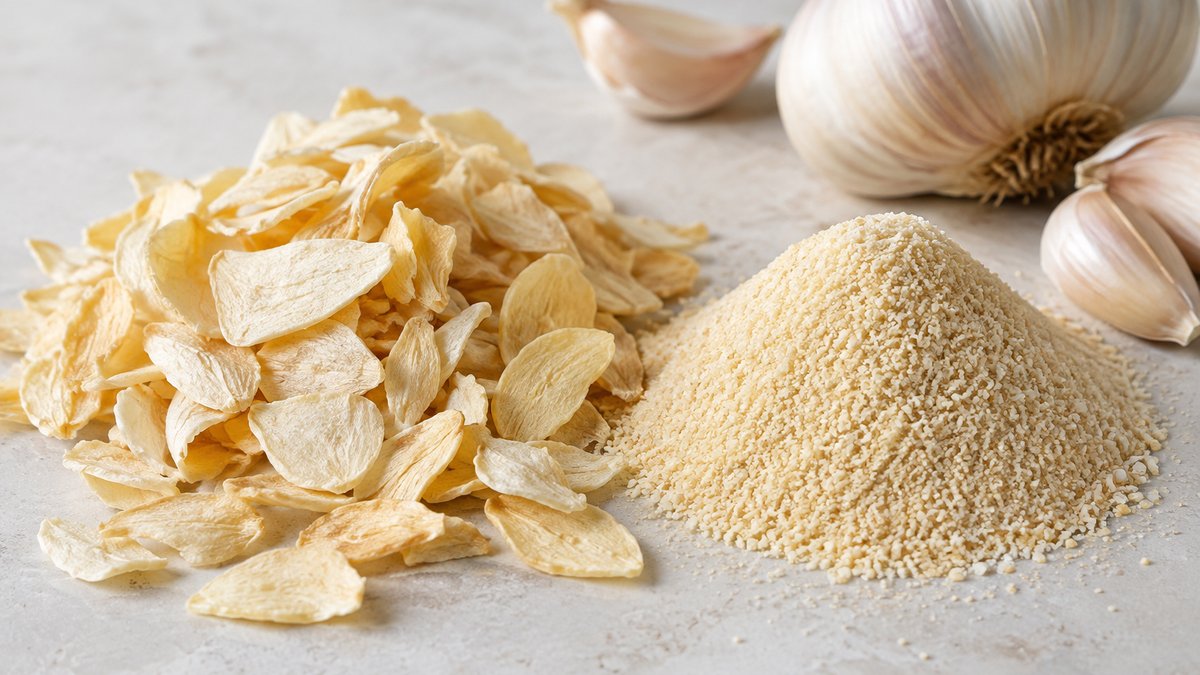
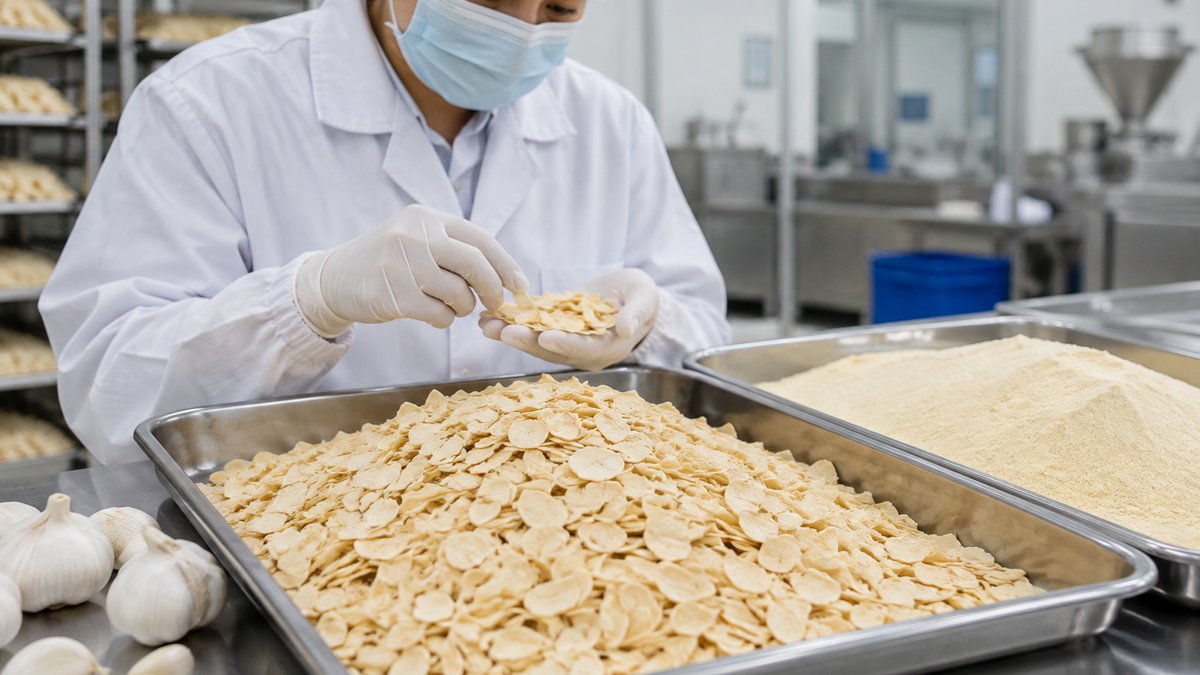
Dehydrated garlic flakes are visible, irregular pieces of dried garlic. Garlic powder is the finely ground form. Both are dehydrated garlic, but their particle size changes how they look in a finished food, how evenly they mix, and how buyers need to specify and handle them.
The Codex Alimentarius standard defines dried or dehydrated garlic as a product made by drying garlic cloves or bulbs. It recognizes ground or powdered styles and allows other styles when they are labelled accordingly. For pieces and powdered products, Codex leaves particle size to an agreement between buyer and seller. A product name alone therefore does not set a precise size range.
The terms “flakes” and “powder” describe broad commercial forms. Suppliers may also sell slices, granules, minced garlic, or grades screened to a buyer’s size specification. A buyer comparing two quotations should ask for the stated particle-size range and the test method used, particularly when the product will run through a dosing or blending line.
China is a major origin for dehydrated garlic. A 2025 Centre for the Promotion of Imports from Developing Countries report, citing Chinese customs figures, puts China’s dehydrated garlic exports at 240,000 tonnes in 2024. That total covers dehydrated garlic as a broader category; it does not distinguish flakes from powder or establish a current price for either form.
For an ingredient buyer, the practical distinction is the role of the garlic in the finished product. Flakes retain a visible piece and contribute texture. Powder distributes through a mix as a fine ingredient. Their aroma and flavour also depend on the garlic variety, drying conditions, storage, and processing. Particle form alone does not establish strength, grade, microbiological quality, or freshness.
2. Compare Flakes and Powder Against the Product Specification
Compare dehydrated garlic flakes and powder by the requirements of the production line and the finished food. The Codex standard sets product-level quality expectations, while the buyer and seller agree the particle size for the particular product. A purchase specification should make both parts clear.
The table describes general processing considerations, not a universal performance guarantee. Garlic powders can differ in density, water absorption, solubility, colour, and rehydration behavior. A 2023 open-access study of garlic powder measured several of these properties and reported differences between processing treatments. Buyers should test the actual lot or a representative sample in the intended formulation rather than assuming all powders behave alike.
The moisture specification deserves attention for either form. Drying reduces moisture and water activity, while storage and packaging protect the product from moisture pickup. Ask the supplier to state the agreed moisture limit, test basis, packaging material, inner liner, and storage conditions. If the product cakes, loses flow, or changes aroma during storage, the intended particle form may no longer perform as expected.
The Codex standard also addresses aroma, flavour, colour, and physical and chemical quality factors for dehydrated garlic. Buyers should set acceptance criteria that match the product’s use and destination requirements. Import rules depend on the destination and product; the Codex standard is an international food standard, not a substitute for checking the importing country’s requirements.
Buying consideration: Before comparing quotations, confirm that both suppliers are quoting the same garlic form, particle-size method, moisture basis, packaging, treatment, and shipment terms. A lower price per kilogram does not show which ingredient performs better in the buyer’s formula.
3. A Seasoning Blend Shows When the Form Changes the Result
Consider a food manufacturer developing a dry seasoning for a prepared vegetable product. The product team wants visible garlic pieces in the final seasoning and expects some of those pieces to remain recognizable after cooking. Flakes may fit that brief if their size and texture survive the process.
The manufacturer also needs the seasoning to flow through a dosing system and distribute consistently across production batches. A coarse flake may separate from smaller ingredients during handling, or the equipment may dose larger particles unevenly. The buyer can test the proposed flake size in the actual blend and line, then set acceptable limits for pieces, fines, and batch variation.
If the same seasoning is intended to provide garlic flavour without visible pieces, powder may suit the product better. Its fine form can be mixed into a dry base, though the buyer still needs to check how it behaves in the chosen equipment. A fine powder can absorb moisture and cake, and the formulation may change its dispersion. The team should test mixing order, exposure to humidity, and the packaged product’s storage conditions.
Illustrative product-development scenario:
Product: Dry seasoning for a prepared vegetable product
Flakes trial: Check visible piece size, fines, distribution and texture after cooking
Powder trial: Check blend uniformity, flow, moisture pickup and garlic flavour
Supplier specification: Request particle-size test, moisture basis, packaging details and sample-lot results
This is an illustrative sourcing scenario, not a universal formulation or processing recommendation.
A supplier sample should match the commercial specification as closely as possible. Ask whether the sample comes from the same product grade and process intended for the order. Record the lot, test conditions, mixing time, temperature, and any changes made to the formula. The trial then gives the buyer a useful basis for accepting future shipments.
This comparison also helps purchasing teams define what “equivalent” means when two suppliers quote different forms. Flakes and powder may share a garlic origin and drying process, yet they can produce different texture and processing results. Replacing one with the other should trigger a formulation and line trial, plus an updated label or ingredient declaration where applicable.
Looking to Source Dehydrated Garlic?
Connect with verified suppliers, discover matching products, and explore sourcing opportunities from global markets.
4. Choose the Form That Fits the Finished Product and Process
Choose flakes when the application calls for visible garlic pieces, a distinct texture, or a product presentation that benefits from identifiable dried garlic. Choose powder when the formula needs garlic distributed through a dry ingredient blend without the same visible pieces. The product trial should decide the final choice.
4.1 Flakes suit applications that retain a piece
Flakes can suit seasoning mixes, toppings, prepared foods, and other formulations where the buyer wants a visible garlic component. The fit depends on the cut size, how much fines the buyer accepts, and whether the process retains the piece. A product that hydrates or cooks for a short time may handle flakes differently from a product with a longer wet or heated process.
Ask the supplier to identify whether the quoted product is a flake, slice, minced cut, or another style. Request a particle-size range, screening method, fines tolerance, and the expected share of pieces outside the range. Those details help the buyer check blending, appearance, and dosing before agreeing a shipment.
4.2 Powder suits applications needing a fine ingredient
Powder can suit dry seasoning bases, spice blends, sauces, coatings, and other formulations where the buyer wants garlic spread through the ingredient mix. The level of fineness affects flow and blending, so the term “powder” needs a measurable particle-size specification. Ask for the sieve or other test method and agree the proportion that must meet the stated size.
Check powder performance in the buyer’s actual process. A powder that mixes well in a small laboratory batch may behave differently in a larger ribbon blender or automated feeder. Test flow, dusting, segregation, moisture pickup, aroma, and the finished product’s garlic distribution. The buyer should also confirm whether the product contains only garlic or includes any permitted carrier or other ingredient, then match that information to the label and destination rules.
4.3 Set a complete specification before ordering
For either form, identify the botanical product as dehydrated garlic and state the style, particle size, and test method. Add moisture limit and method, colour and aroma expectations, foreign matter limits, microbiological and contaminant requirements relevant to the destination, packaging, net weight, lot identification, and shelf-life basis. The requirements should reflect the buyer’s market and application; do not assume a voluntary grade or one country’s rule applies everywhere.
For Chinese-origin offers, confirm the production site, product origin, lot traceability, export documents, and any destination-specific food-safety requirements. China’s 2024 export total provides origin context, while the 2025 report does not tell a buyer whether a particular supplier’s flakes or powder meet a specific formulation need. Keep that distinction clear during supplier evaluation.
Buying consideration: A useful request for quotation names the garlic form, particle-size specification, quality tests, packaging, order quantity, destination, delivery term, and required documents. Buyers comparing offers can review relevant dehydrated garlic buying requests and potential suppliers on Freshdi, then verify each supplier’s specifications and commercial terms.

References
1. FAO and WHO Codex Alimentarius – Standard for Dried or Dehydrated Garlic, CXS 347-2019, 2019.
2. Centre for the Promotion of Imports from Developing Countries – European imports of dried garlic by main origin, 2020-2024, 2025.
3. American Society of Baking – Dehydrated Garlic, n.d..
4. Journal of Food Science and Technology – Effect of ohmic blanching on drying kinetics, physicochemical and functional properties of garlic powder, 2023.
Disclaimer: This article is compiled from platform data, public sources and information provided by third parties, for general informational purposes only. We do not guarantee its accuracy or completeness. Please conduct your own due diligence before making business decisions.