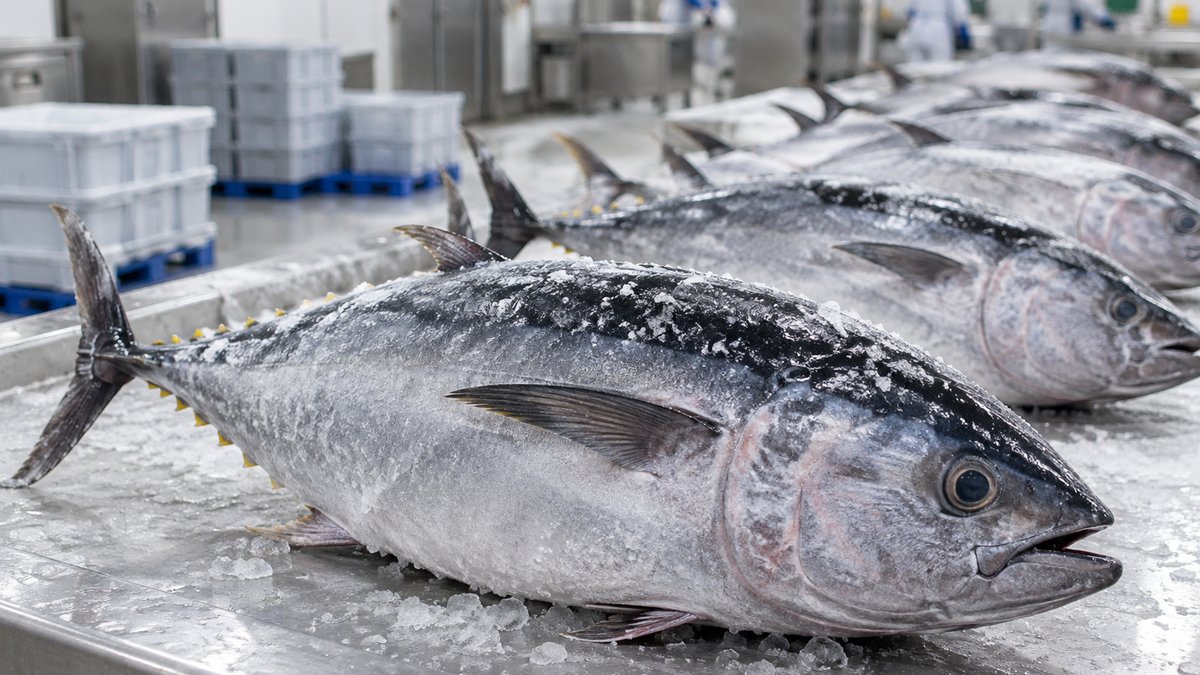

Frozen tuna is traded in different product forms, and the form can shape what a buyer needs to do after arrival. A processor with tuna-handling facilities may want whole fish, while a foodservice buyer or portion cutter may prefer loins that are already separated from the carcass.
The main difference is processing: frozen whole tuna arrives as a largely intact fish, while frozen tuna loins are sections of muscle cut from the fish. Neither form is automatically better or higher quality. The right choice depends on the buyer’s processing capacity, intended product, yield expectations and requirements for traceability and handling.
This comparison covers commercial product forms, not a universal grading system. Product terminology and customs classification can vary by species, processing details and destination. Information checked on November 23, 2026.
Key Takeaways
- Frozen whole tuna is supplied as a largely intact fish; frozen tuna loins are muscle sections separated from the carcass.
- Whole fish may suit buyers with facilities and labor for receiving, thawing and further processing. Loins can suit buyers who want to begin closer to cutting, portioning or further processing.
- A product form does not, by itself, establish species, catch area, quality, freezing method, temperature history or suitability for a particular end use.
- Compare total usable output and processing needs—not only the quoted price per kilogram—and agree on the product specification before shipment.
1. Key Difference Between Frozen Whole Tuna and Frozen Tuna Loins
Frozen whole tuna is supplied in a whole-fish presentation, although the contract should clarify whether it is truly unprocessed or has been eviscerated, headed, tailed or otherwise dressed. The International Pacific Halibut Commission’s 2023 observer manual, summarizing product codes used by regional tuna fisheries bodies, distinguishes whole fish from dressed or otherwise processed forms. Those codes are useful for describing presentation, but they are not a substitute for a buyer’s full commercial specification.
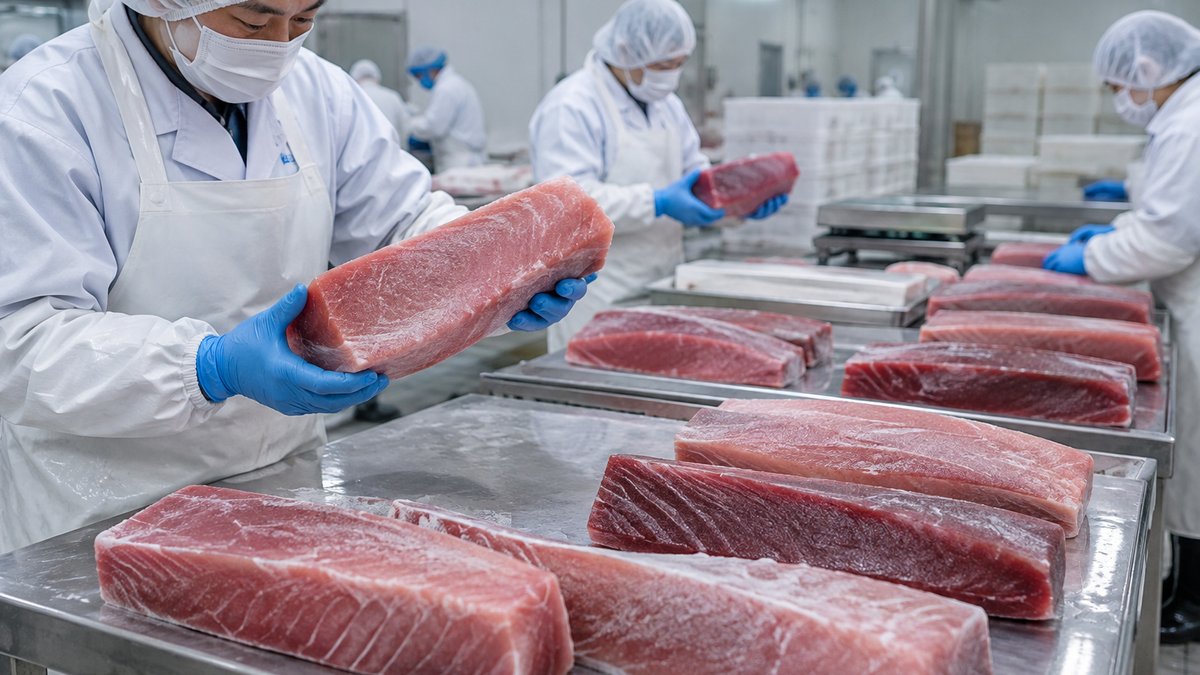
Frozen tuna loins are sections of tuna muscle produced through cutting and trimming. The word “loin” alone does not tell the buyer whether the product is raw or cooked, skin-on or skinless, trimmed to a particular profile, individually packed or frozen as a block. These details should be stated separately. For example, a buyer sourcing cooked loins for further manufacture should not rely on a general description such as “frozen tuna loins.”
The processing distinction affects where work takes place. A buyer receiving whole fish may need equipment, trained staff and a plan for thawing, handling, cutting and using or disposing of the resulting parts. A buyer receiving loins has already purchased a more processed form, but may still need to trim, portion, cook or otherwise process it. The extra preparation completed before export can change the cost structure and the buyer’s control over the finished cut.
These are product forms, not quality grades. The Centre for the Promotion of Imports from Developing Countries (CBI), in its market-entry guidance for tuna loins, identifies size, freshness, shape, fat content, texture and colour as quality considerations for fresh and frozen raw tuna loins. A product’s presentation alone does not confirm those characteristics.
The U.S. International Trade Commission’s 2014 report on the tuna industry also discusses the processing and quality considerations associated with frozen whole tuna and frozen loins. The practical lesson for buyers is to compare products on equivalent specifications and handling history. A more processed form does not automatically guarantee a better result; the quality of the fish and the controls applied through processing and storage remain relevant.
Buying consideration: Before comparing offers, define the exact form—whole, gilled and gutted, headed, or loins—and state the remaining processing work each shipment will require at your facility.
2. Frozen Whole Tuna vs Frozen Tuna Loins: Comparison Table
The table summarizes typical commercial differences. Actual specifications vary, so buyers and sellers should define the product in the contract rather than assume that a short label covers every detail.
| Comparison point | Frozen whole tuna | Frozen tuna loins |
|---|---|---|
| Presentation | Whole fish; confirm any dressing or evisceration | Separated muscle sections; confirm trimming and skin |
| Processing before sale | Usually less cutting at the product-form stage | Cut and separated before sale; may be further processed |
| Buyer’s work after receipt | May include thawing, cutting and further preparation | May include trimming, portioning, cooking or further manufacture |
| Potential buyer fit | Processors with suitable fish-handling capacity | Portion cutters, foodservice suppliers and other processors |
| Specification details to confirm | Species, whole or dressed form, size, freezing and packing | Species, raw or cooked, trim, skin, size and packing |
| What the form does not establish | Grade, quality, handling history or end-use suitability | Grade, quality, handling history or end-use suitability |
The table is a practical comparison, not a universal classification standard. In the United States, for example, tariff categories distinguish some frozen tuna forms, while the exact classification depends on product details and the nomenclature in force. Importers should check the current destination-country tariff and documentation requirements for the specific species and presentation.
Price comparisons also need care. Whole fish and loins are not equivalent on a simple per-kilogram basis because their edible or usable portions, processing requirements and possible by-products differ. The Seychelles Ministry of Fisheries and Blue Economy’s value-chain study describes yield differences in a specific yellowfin processing scenario. Such figures are tied to that study’s assumptions; they should not be treated as a guaranteed yield for another species, supplier or lot.
Buying consideration: Ask suppliers to quote against the same species, product form, size range, freezing and packing requirements, shipment terms and inspection basis. If processing yield matters, agree how it will be evaluated before placing the order.
Looking to Source Frozen Tuna?
Connect with verified suppliers, discover matching products, and explore sourcing opportunities from global markets.
3. Example Shipment Scenario
Consider a processor comparing two offers for frozen tuna intended for further production. One offer is for whole fish; the other is for loins. The buyer should first confirm that the species, origin information, intended application, freezing condition and other relevant quality requirements are comparable. Otherwise, the difference in price may reflect more than the product form.
3.1 If the processor buys whole fish
The buyer needs to establish exactly how the fish is presented: whole and ungutted, gilled and gutted, headed, or another dressed form. The buyer should assess whether its facility can receive, store, thaw and process that form under its operating procedures. It should also account for labor, equipment, processing time and the handling of parts that do not enter the final product.
This option may give the buyer more control over cutting and the disposition of the fish. It also means that the buyer takes responsibility for more processing steps after receipt. The cost comparison should therefore consider the buyer’s own processing capability and the expected usable output, rather than treating the shipment’s gross weight as finished-product weight.
3.2 If the processor buys loins
The buyer should state what “loin” means for the order: raw or cooked, trim level, skin status, packaging and whether any additional treatment or preparation is required. It should check that the supplier’s description matches the buyer’s planned process. Loins can reduce the amount of primary cutting required at destination, but they do not remove the need to review product condition, lot identification and the agreed specification.
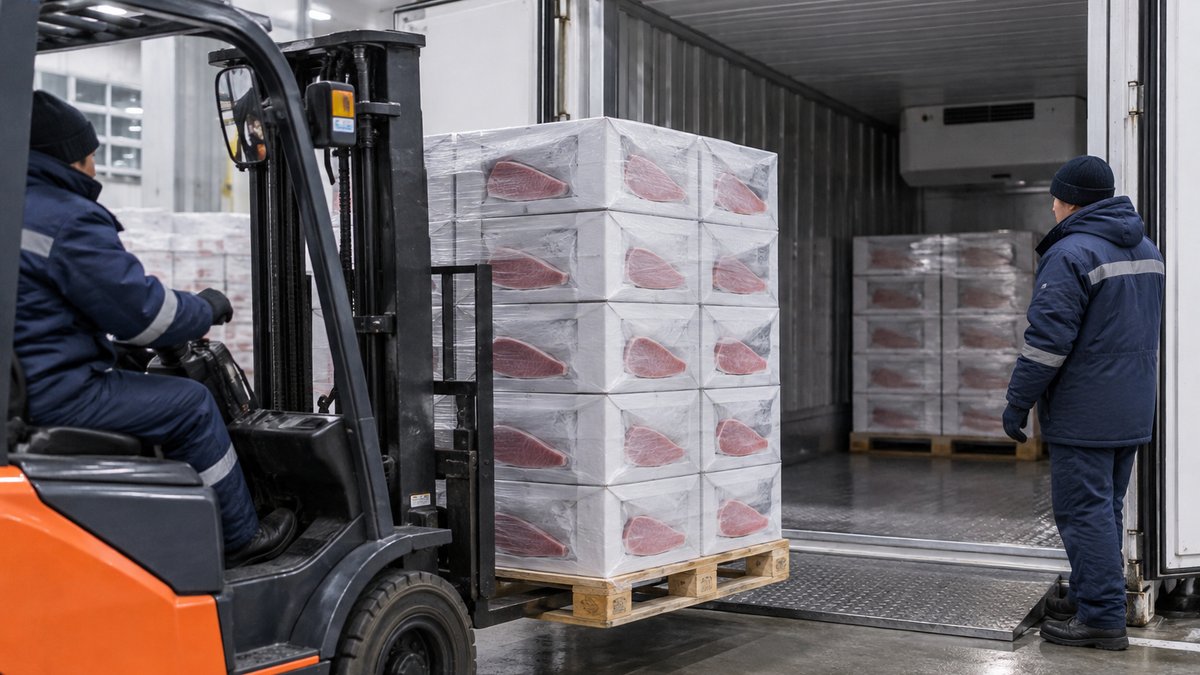
The buyer should also consider how the loins were handled before freezing and how they will remain frozen through transport and storage. The U.S. Food and Drug Administration’s Fish and Fishery Products Hazards and Controls Guidance, June 2022 edition, explains that histamine formed in tuna is not removed by freezing. The FDA’s 2024 compliance policy guidance likewise emphasizes prompt chilling and time-and-temperature controls. Buyers should review the applicable food-safety controls and records with their supplier and their own food-safety team.
Illustrative inquiry format:
Product: Frozen tuna; state species and whole or loin form
Processing: State dressing, trim, raw or cooked condition
Quality: State required size, condition and inspection basis
Handling: Request relevant lot identification and time-temperature records
Shipment: State quantity, packaging, destination and requested trade terms
This is an illustrative inquiry format, not a universal specification or a guarantee of suitability.
Once the product requirements are written clearly, buyers can compare frozen tuna buying requests on Freshdi and identify whether the listed needs match their supply plan.
A complete product specification gives suppliers a clearer basis for responding to a frozen tuna inquiry.
View Related Suppliers for This Product →
4. When Should Buyers Choose Whole Tuna or Tuna Loins?
The better choice is the form that fits the buyer’s operation and end product. A buyer should consider its processing capacity, required level of control, storage and handling procedures, expected output and the supplier’s ability to meet the specification.
4.1 Whole tuna may suit buyers who:
- Have the facilities and trained staff to handle and process the agreed whole or dressed form.
- Want to control cutting and subsequent processing at their own plant.
- Can evaluate the economics of the entire fish, including usable portions and by-products where relevant.
- Have receiving, storage and processing procedures appropriate to the size and condition of the fish.
4.2 Tuna loins may suit buyers who:
- Need product closer to a cutting, portioning or further-manufacturing stage.
- Prefer to reduce some primary cutting work at the destination facility.
- Require defined loin characteristics and can describe the required trim, skin, raw or cooked condition.
- Have reviewed the supplier’s processing and handling information and can maintain the required storage conditions after receipt.
Neither choice removes the need for due diligence. The FDA’s June 2022 hazards guidance and its 2024 compliance policy on scombrotoxin-forming fish identify tuna as a product for which time-and-temperature control matters. The FDA notes that once histamine has formed, freezing does not remove it. These U.S. materials describe U.S. agency guidance and policy; buyers elsewhere should also confirm the mandatory rules that apply in their own destination and supply chain.
For either form, ask for the scientific species name, catch area and catch-method information where applicable, product condition, freezing method, storage and transport requirements, packaging, lot identification and relevant food-safety documentation. The precise legal and labeling requirements depend on the destination and product. Do not treat a commercial phrase such as “sashimi quality” as a globally standardized grade or as a replacement for agreed measurable specifications.
If you are comparing offers, use the same basis for each: product form, net weight, quality characteristics, packaging, delivery term, inspection arrangements and relevant documentation. Explain which details are mandatory and which can be flexible. This makes it easier to assess whether an offer is technically suitable before negotiating price.
After deciding which form fits your processing plan, compare relevant seafood buying and supply opportunities.
View Latest Seafood & Aquatic Products Buying Requests →
View Potential Seafood & Aquatic Products Suppliers →
5. Related Resources for Frozen Tuna Buyers and Exporters
A sourcing decision starts with a clear specification and continues with checks on the actual lot, supplier information and destination requirements. Buyers can review frozen tuna supplier listings on Freshdi and compare them with their defined product needs. Exporters can also review frozen tuna buying requests to see the requirements stated in individual listings.
For broader seafood sourcing, Freshdi provides seafood buying requests and seafood supplier listings. Listings are a starting point for discovery, not a substitute for verifying business details, product specifications, food-safety records, and commercial terms directly with a potential trading partner.
Buyers and sellers can explore buyer resources on Freshdi and supplier resources on Freshdi. For platform-related assistance, the Freshdi Account Manager page is also available.
The references below provide further information on tuna product forms, tuna quality and handling. Always check that the source applies to your product and destination, and verify current mandatory requirements before shipment.
Frequently Asked Questions
What is the difference between frozen whole tuna and frozen tuna loins?
Frozen whole tuna is supplied as a largely intact fish, although the contract should state whether it is gutted, headed or otherwise dressed. Frozen tuna loins are sections of muscle cut from the fish. Loins have undergone more processing before sale, but the term does not specify every detail, such as raw or cooked condition, trim or skin status.
Are frozen tuna loins a higher grade than whole frozen tuna?
No. Whole fish and loins describe product forms, not a universal quality ranking. Buyers should assess the actual species, condition, colour, texture, fat characteristics, processing, freezing and handling against their requirements.
Which form is more economical for an importer?
There is no universal answer. Whole fish may involve additional processing work at the buyer’s facility, while loins include more processing before sale. Compare the total cost of the shipment and the buyer’s processing, usable output, labor, storage and handling requirements. Do not compare only the quoted price per kilogram.
What should a tuna loin specification include?
State the species, raw or cooked condition, trim and skin requirements, size or dimensions, freezing and packaging details, lot identification, destination, quantity and trade terms. Add the quality, inspection and documentation requirements that apply to the buyer’s use and destination.
Does freezing remove histamine from tuna?
No. The FDA’s Fish and Fishery Products Hazards and Controls Guidance, June 2022 edition, and its 2024 compliance policy explain that histamine already formed in tuna is not removed by freezing. Buyers should review the supplier’s relevant time-and-temperature controls and documentation, along with the rules applicable to their destination.
References
1. U.S. Food and Drug Administration – Fish and Fishery Products Hazards and Controls Guidance, June 2022 Edition, June 2022.
2. U.S. Food and Drug Administration – Sec. 540.525 Scombrotoxin (Histamine)-forming Fish and Fishery Products – Decomposition and Histamine, Compliance Policy Guide, 2024.
3. U.S. International Trade Commission – Tuna: Current Issues Affecting the U.S. Industry, 2014.
4. Centre for the Promotion of Imports from Developing Countries (CBI) – Entering the European Market for Tuna Loins, Accessed November 23, 2026.
5. International Pacific Halibut Commission – ICCAT / IOTC / CCSBT ROP Observer Manual, 2023.
6. Seychelles Ministry of Fisheries and the Blue Economy – Value Chain Study, Accessed November 23, 2026.
Disclaimer: This article is compiled from platform data, public sources and information provided by third parties, for general informational purposes only. We do not guarantee its accuracy or completeness. Please conduct your own due diligence before making business decisions.