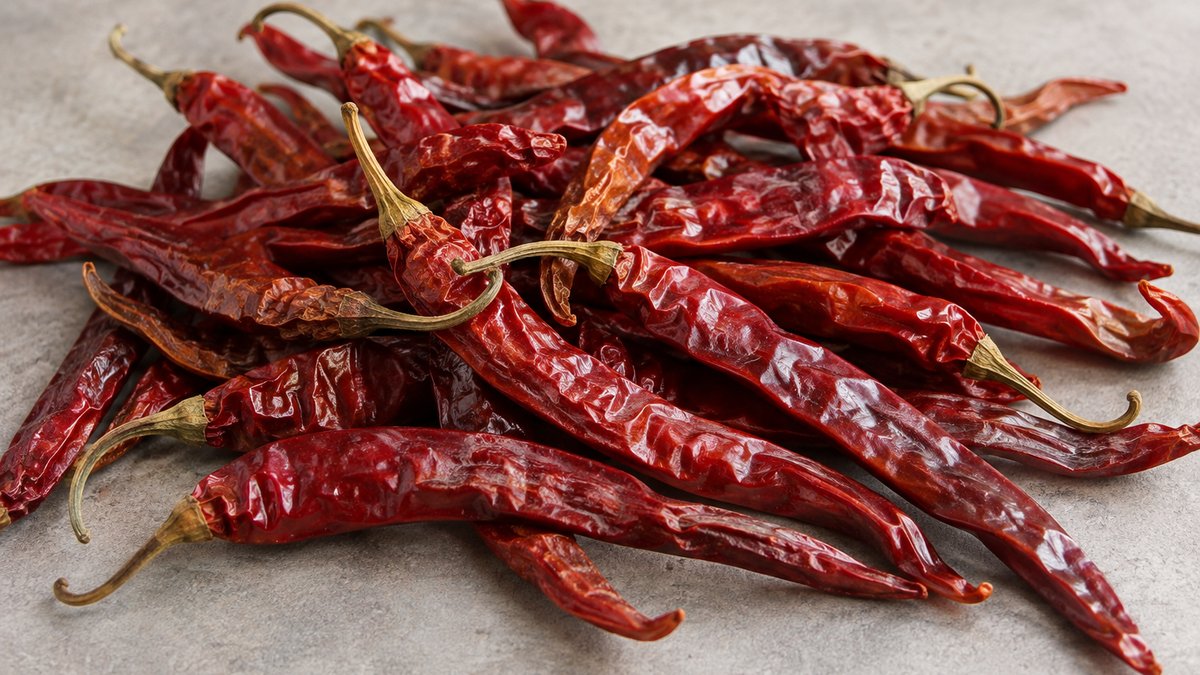

Whole dried chili and chili flakes are two styles of the same basic product, but they arrive at a buyer's facility in different forms. Whole pods preserve the chili's shape; flakes are made by crushing, cracking or breaking dried chilies into pieces.
For importers, exporters and food manufacturers, that difference affects handling, further processing, visual presentation and how a product specification should be written. It does not, by itself, establish the chili's variety, pungency, color or overall quality.
The Codex Alimentarius Commission's Standard for Dried or Dehydrated Chilli Pepper and Paprika (CXS 353-2022; 2026 edition) recognizes whole and crushed/cracked/broken/flakes as separate styles. This comparison follows that terminology. Information was checked on 23 November 2026.
Key Takeaways
- Whole dried chili is supplied as intact pods, with or without stalks; flakes are supplied as crushed, cracked or broken pieces.
- Codex lists whole and crushed/cracked/broken/flakes as different dried-chili styles. The standard does not make flakes a separate variety or indicate that either style is inherently better.
- Buyers should specify variety, origin, heat, color, particle size, seed and stalk inclusion, quality parameters, packaging and destination-market requirements.
- Choose the form based on how the product will be inspected, processed, packed or used—not on the style name alone.
1. Whole Dried Chili vs Chili Flakes: The Difference at a Glance
The main difference is physical form. Whole dried chili consists of dried pods supplied intact, either with or without stalks. Chili flakes are pieces of dried chili produced by crushing, cracking or breaking it. The terms describe styles of the product, not separate species or heat grades.
Codex Alimentarius Commission’s Standard for Dried or Dehydrated Chilli Pepper and Paprika (CXS 353-2022; 2026 edition) lists whole, crushed/cracked/broken/flakes, and ground/powdered as styles. It defines dried chili as dried fruit from specified Capsicum species, with or without seeds or stalks. The standard also says the product name should include an indication of its style. For buyers, this is a useful basis for clear product naming, while applicable destination-market rules and contract specifications should still be checked.
A whole pod leaves more of the physical product available for inspection before processing. Flakes are already reduced in size, which can make them easier to blend or portion for some operations. But a style label alone does not settle important commercial questions: how hot the chili is, whether it is a particular cultivar, how much seed or stem is present, or what particle-size range the flakes meet.
The Codex standard groups crushed, cracked, broken and flakes together as a style. It does not prescribe one universal flake size in that style definition. A buyer who needs a particular cut should state it separately and agree how particle size will be assessed. Likewise, buyers of whole pods should state whether stalks are acceptable and whether pod size or breakage limits matter.
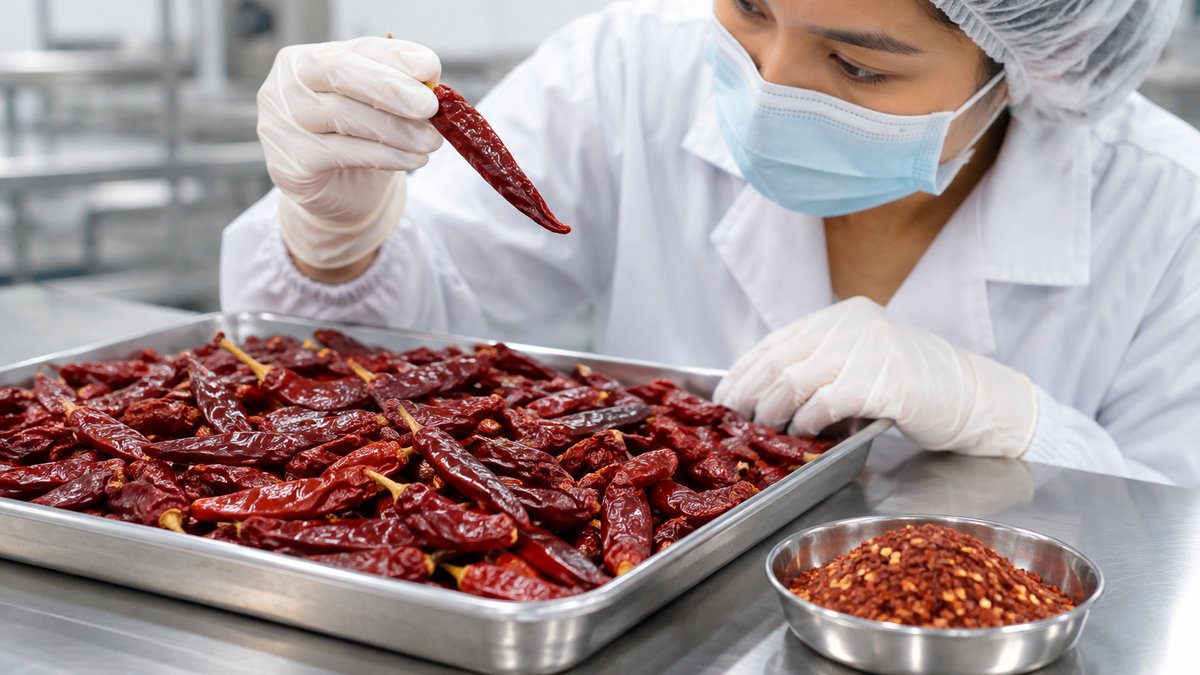
These forms may be relevant to different production workflows. A processor buying whole pods may carry out its own cleaning, destemming, crushing or milling. A seasoning blender buying flakes may be sourcing a ready-to-blend ingredient. Those are possible use cases, not fixed rules: the same buyer may require either form depending on the product and process.
If you are comparing offers, describe the required form clearly when you review dried chili buying requests on Freshdi. This helps distinguish a whole-pod offer from a crushed or flaked product before comparing the rest of the specification.
2. Whole Dried Chili vs Chili Flakes: Comparison Table
The comparison below focuses on trade and processing distinctions. Codex’s terminology identifies the style, while the supplier specification and applicable requirements determine the details of each shipment.
| Feature | Whole dried chili | Chili flakes |
|---|---|---|
| Product form | Intact dried pods | Crushed, cracked or broken pieces |
| Codex style | Whole, with or without stalk | Crushed/cracked/broken/flakes |
| Further processing | May need destemming, crushing or milling | Already reduced in size; may need screening or blending |
| Specification focus | Variety, pod size, stalks, breakage and appearance | Cut or particle-size range, seed content and uniformity |
| Inspection consideration | Pod condition and visible defects can be assessed on intact pieces | Particle distribution and consistency need to be agreed |
| Potential fit | Buyers processing pods or choosing a whole-pod presentation | Buyers blending or using a crushed chili ingredient |
Neither form guarantees a particular pungency or color. The Codex standard treats product style separately from other quality characteristics. New Mexico State University Extension also describes dehydrated chiles as sold whole or processed into flakes or powder, and notes that cultivar affects color and pungency. Buyers should therefore request evidence or agreed test results for the characteristics that matter to their application rather than inferring them from the form.
For a like-for-like quotation, compare products with the same variety or agreed product identity, origin, heat target, color requirement, condition, packaging and delivery basis. A whole-pod offer and a flake offer may involve different processing stages, so the unit price alone does not show which is more suitable or economical for the buyer's production.
Once you have decided which dried chili form fits your operation, compare sourcing options with the product requirements in view.
View Latest Herbs, Spices & Seasonings Buying Requests →
View Potential Herbs, Spices & Seasonings Suppliers →
Looking to Source Dried Chili?
Connect with verified suppliers, discover matching products, and explore sourcing opportunities from global markets.
3. An Illustrative Sourcing Scenario
Consider a food manufacturer that makes a seasoning blend. It needs a dried chili ingredient that will be combined with other spices and packed for sale. One supplier offers whole dried pods; another offers chili flakes. The buyer should not compare the offers only by the words “whole” and “flakes.” First, it should establish whether both offers meet the same product and quality requirements.
If the manufacturer has equipment and capacity to process pods, whole chili may fit its workflow. The buyer can specify whether stalks must be removed, the acceptable pod condition, the required variety or product identity, and whether the supplier should provide samples or agreed quality documentation. The buyer should also account for the additional steps it will perform after receiving the product.
If the manufacturer wants a product ready for blending, flakes may be more directly suited to the process. The inquiry can state the requested flake cut or particle-size range, how that range should be checked, and whether seeds or other parts of the pod are acceptable. The buyer can then compare the samples and documentation against its own formulation and production needs.
In either case, the commercial specification should cover more than style. The buyer should state the required variety or name, country of origin, heat or pungency target and measurement basis, color expectations, moisture and physical-quality requirements, packaging, quantity, delivery destination and trade terms. Codex CXS 353-2022 includes chemical and physical quality provisions and refers to applicable Codex texts for contaminants, pesticide residue limits and hygiene. It is an international reference; the buyer must also check the requirements applicable to the intended market and use.
The buyer should ask suppliers to identify what is included in each offer and what remains unconfirmed. For example, if seed inclusion or particle size is not stated, it should be treated as an open point rather than assumed to meet the buyer's needs. The same applies to certificates, test methods, packaging details and any destination-specific documents.
A practical comparison can therefore focus on the delivered product and the buyer's total workflow: what processing is required after arrival, what checks are needed, and whether the product can be used consistently in the intended application. This avoids treating the form itself as a proxy for quality or value.
Buyers can also compare dried chili suppliers on Freshdi and use a clear specification to ask whether each supplier can provide the required form and supporting details.
4. When Should Buyers Choose Whole Chili or Flakes?
There is no universal answer. The right style depends on the buyer's operation, intended product and purchasing specification. These questions can help narrow the choice.
4.1 Choose whole dried chili when the pod form matters
Whole pods may suit a buyer that needs intact chili for its own processing or for a product where the whole-pod presentation matters. They can also give the buyer an opportunity to assess pod appearance before carrying out further processing. This does not remove the need for inspection or testing: the buyer should still agree the relevant quality parameters and sampling approach.
When writing a whole-chili inquiry, specify whether stalks are included, whether the pods will be further processed, and which size, appearance and breakage characteristics matter. Codex says whole dried chili may be sized by length or according to existing trade practices, with the sizing method indicated when sizing is used. If size matters commercially, state the method and tolerance in the specification rather than using an undefined term such as “large.”
4.2 Choose chili flakes when a crushed ingredient fits the process
Flakes may suit buyers that need a crushed ingredient for seasoning, blending or another food-production process. The supplier has already changed the product from whole pods to pieces, but buyers should not assume that all flake products have the same cut or composition. State the target particle size or cut, acceptable range, seed content and any required uniformity.
CBI’s Entering the European market for dried chillies identifies mesh count as a common way of describing crushed-flake size. That is a trade reference, not a universal specification for every product or destination. Buyers should agree the measurement or inspection method with the supplier and confirm that it reflects their own process.
4.3 Compare the product specification, not the product name alone
For either form, an inquiry becomes easier to evaluate when it includes the following details:
- Product identity and style: whole or crushed/cracked/broken/flakes, with any additional form details.
- Variety or agreed product name, origin and whether stalks or seeds are included or permitted.
- Pungency target and the test method or supporting analysis expected, if relevant to the application.
- Color requirement and any other agreed quality characteristics, with clear limits or test references where needed.
- For whole pods, sizing method and tolerances; for flakes, particle-size or cut range and how it will be checked.
- Packaging, net weight, order quantity, destination, delivery term and required shipment schedule.
- Applicable food-safety, contaminant, residue, documentation and labeling requirements for the destination and intended use.
Codex lists separate styles but does not make the style alone a complete commercial specification. Its standard also describes the common product name as including an indication of style. Clear naming helps, but the agreed product details, applicable rules and contract remain important.
Once these points are defined, buyers can review dried chili buying opportunities on Freshdi or explore suppliers in Herbs, Spices & Seasonings and assess whether a listing matches the requirement.
With the form, quality targets and shipment details written down, buyers can ask suppliers for offers against the same specification.
View Related Suppliers for This Product →
5. Related Resources for Dried Chili Buyers and Exporters
For terminology, Codex Alimentarius Commission’s Standard for Dried or Dehydrated Chilli Pepper and Paprika (CXS 353-2022; 2026 edition) is a useful reference for product definition, styles, quality provisions and labeling. The standard applies to products offered for direct consumption, as food-processing ingredients or for repackaging, and excludes products for industrial processing. Buyers should check the standard alongside the rules and contractual requirements that apply to their transaction.
CBI’s Entering the European market for dried chillies discusses quality parameters, packaging, labeling and market-entry considerations for the European market. Its guidance is relevant to buyers and exporters evaluating that destination, but should not be treated as a substitute for checking current destination-country requirements or a buyer’s own specification.
On Freshdi, buyers can browse dried chili buying requests and explore broader Herbs, Spices & Seasonings requests. Suppliers can review dried chili supplier listings and explore the wider supplier category. Listings are a starting point for discovery; confirm product details, business information and commercial terms directly with a potential business partner.
To review the wider Freshdi buyer directory or supplier directory, use the directory pages as discovery resources rather than as a substitute for due diligence. For help navigating the platform, see the Freshdi Account Manager page.
The most useful next step is to turn the chosen style into a complete specification. Whether you request whole pods or flakes, describe the product clearly enough that a supplier can confirm what is available and the buyer can compare offers on equivalent requirements.
Frequently Asked Questions
Are whole dried chili and chili flakes different products?
They are different styles of dried chili, not necessarily different species or varieties. Codex CXS 353-2022 lists whole and crushed/cracked/broken/flakes as separate styles. Whole refers to intact dried pods, with or without stalks; flakes are pieces produced by crushing, cracking or breaking dried chili.
Does chili flakes mean a specific particle size?
No single particle size is established by the Codex style name. Buyers should state the required cut or particle-size range and agree how it will be measured or checked. Mesh count is one way described in CBI’s European market guidance, but the method and target should fit the buyer’s product and destination.
Are chili flakes hotter than whole dried chili?
The form alone does not establish pungency. Heat depends on the chili product and its characteristics, not simply whether it is whole or flaked. Buyers needing a particular pungency should specify a target and agree on the test method or supporting analysis with the supplier.
What should buyers specify when sourcing whole dried chili?
State the product identity or variety, origin, whether stalks are included, any sizing method and tolerance, relevant quality requirements, packaging and shipment details. If the pods will be processed further, specify the requirements that matter to that process and confirm them with the supplier.
What should buyers specify when sourcing chili flakes?
State the product identity, origin, requested cut or particle-size range, how particle size should be checked, seed inclusion, heat and color targets, packaging, quantity and delivery details. Add the food-safety and destination-market requirements applicable to the transaction.
References
1. FAO and WHO, Codex Alimentarius Commission – Standard for Dried or Dehydrated Chilli Pepper and Paprika (CXS 353-2022), 2026 edition; accessed 23 November 2026.
2. Centre for the Promotion of Imports from Developing Countries (CBI) – Entering the European market for dried chillies, Accessed 23 November 2026.
3. New Mexico State University Extension – Postharvest Handling of Dehydrated Chiles, Accessed 23 November 2026.
Disclaimer: This article is compiled from platform data, public sources and information provided by third parties, for general informational purposes only. We do not guarantee its accuracy or completeness. Please conduct your own due diligence before making business decisions.