
1. Granular and Prilled Urea Differ Mainly in Particle Formation and Handling
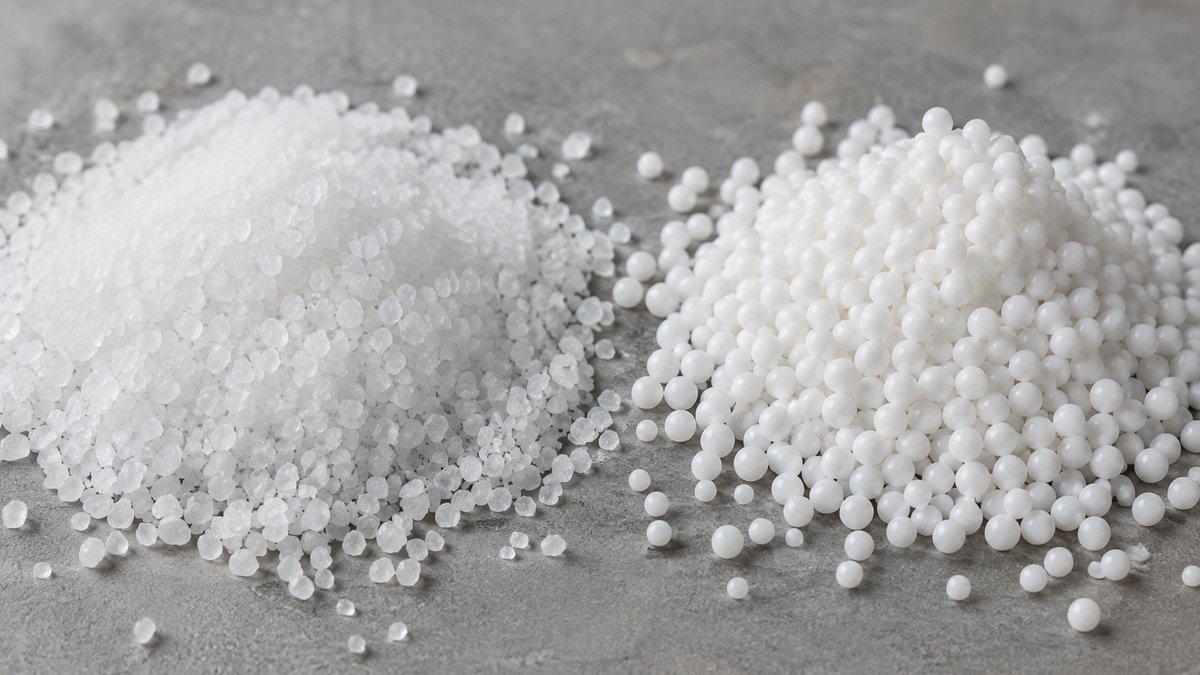
Granular urea and prilled urea are solid forms of the same fertilizer compound, CO(NH₂)₂. Their main differences are physical: how the particles are formed, their typical size and strength, and how they behave during handling, blending and application. Neither name by itself guarantees a particular nitrogen content, moisture level or particle size.
Prills form when droplets of urea melt solidify, commonly in a prilling tower. Granules grow in a granulation process, where material builds into larger particles. The manufacturing process and individual producer affect the resulting product, so buyers should use the shipment specification and test results instead of treating the product name as a complete grade description.
Both forms are used as nitrogen fertilizer. University of Minnesota Extension describes fertilizer urea as containing about 46 percent nitrogen and notes that granular material is generally larger and harder than prills. Actual guaranteed nitrogen content should still be checked against the contract specification and the applicable national requirements.
Particle size can influence equipment performance and whether urea mixes evenly with other solid fertilizers. The US International Trade Commission’s 2011 report describes granular urea as having higher impact and crushing strength in general and identifies its physical integrity as a reason it is commonly used in bulk blending. Those are general characteristics, not a guarantee for every cargo: manufacturing quality, fines, moisture, coatings and handling can change the product’s condition.
The distinction is not a claim that one form supplies a different kind of nitrogen. Buyers usually choose between them to meet a physical specification: for example, a blending plant may require a particle size that matches its other fertilizer components, while a contract may call for prills. For field use, the selected form still has to fit the spreader and application plan.
2. How Granular Urea and Prilled Urea Compare
Granules are commonly larger, with greater mechanical strength than conventional prills, while prills are usually smaller and rounder. These are typical differences, not fixed limits. ISO 18642:2016 covers fertilizer-grade urea in solid forms including granular and prilled material; it lists particle-size requirements as indicative and notes that buyers and sellers can negotiate size parameters for their intended use.

A 2026 study by Zafarnak, Sandhu and Rahmanian measured samples with average particle diameters of 2.81 mm for granules and 1.64 mm for prills. Those figures describe the samples examined in that study, not a universal size standard or a promise about a particular supplier’s cargo. A buyer should request the seller’s sieve analysis and agree on the permitted size distribution.
Strength claims also need a defined test method and result. A general statement that granules are stronger does not tell a buyer how many fines a shipment will contain after loading, transit and discharge. The contract can specify the test method, the minimum acceptable strength if relevant, and the maximum fines or undersize fraction. Buyers should also agree where and how a sample will be taken.
Moisture and storage conditions affect both forms. Urea can cake when moisture enters the product, and abrasion during conveying can create fines. The product name cannot establish that a shipment is free flowing. Buyers should check moisture and anti-caking treatment where required, then protect cargo from rain, damp storage and condensation during transport.
The fertilizer analysis remains a separate comparison. Ask for total nitrogen, moisture and biuret values, plus any other parameters required for the destination market or the buyer’s process. ISO 18642:2016 sets general requirements for fertilizer-grade urea, but regulations in the destination country and the specific purchase contract govern what applies to an individual transaction.
For field application, particle form alone does not establish nutrient performance or fertilizer rate. Application method, soil conditions, timing and local agronomic advice matter. University of Minnesota Extension notes that nitrogen from surface-applied urea can be lost to the air under certain conditions and describes incorporation or rainfall as ways to reduce that risk. The buyer’s agronomist should set the application plan for the crop and location.
3. A Bulk Blending Shipment Shows Why Particle Size Matters
Consider an illustrative bulk-blending purchase: a fertilizer manufacturer plans to combine urea with phosphate and potash granules. The buyer needs a consistent blend that can move through the plant’s conveying and mixing equipment, so particle-size compatibility and resistance to breakage become part of the purchase specification.
If the urea particles differ substantially in size or density from the other components, the buyer should assess whether handling or movement could separate the blend. A USITC report describes granular urea as commonly used in bulk blends because of its physical characteristics and irregular surface. That observation supports asking about blending suitability; it does not replace a trial with the buyer’s actual materials and equipment.
Before confirming the order, the blending plant could request a representative sample and compare the urea’s size distribution with its other inputs. The buyer should also establish how the supplier measures fines and strength, what limits the cargo must meet, and whether the test report applies to the offered lot. If the shipment will travel in bulk, include the loading, storage and discharge conditions in the handling review.
For a grower or distributor buying a single nutrient product for field application, the same blending question may not decide the purchase. The buyer may focus instead on the spreader’s operating requirements, the product’s stated particle-size range, delivery form, handling equipment and local agronomic guidance. These are different purchasing needs, so the contract should state the intended use when it affects the required grade.
This scenario is illustrative, not a universal specification. A buyer should not accept a product solely because it is labelled granular or prilled. The specification should say what the operation needs, and the supplier’s documents and agreed inspection should establish whether the offered lot meets it.
Illustrative inquiry format:
Product: Fertilizer-grade granular urea
Intended use: Bulk blending with specified phosphate and potash products
Particle size: Buyer to state the agreed sieve range and tolerance
Quality documents: Request the lot specification and test report
Inspection: Agree sampling point, test method and acceptance limits
This format is illustrative. Buyers must set requirements for their product, equipment, destination and contract.
Looking to Source Urea Fertilizer?
Connect with verified suppliers, discover matching products, and explore sourcing opportunities from global markets.
4. Choose by Equipment, Blending Need and Contract Specification
Choose granular urea when the buyer’s process calls for larger particles, mechanical handling characteristics or compatibility with other granular fertilizers. These reasons are especially relevant to blending and bulk movement. Confirm the offered product’s particle-size distribution and physical test results instead of assuming every granular shipment will perform alike.
Choose prilled urea when the contract or receiving process specifically calls for prills, or when the buyer’s equipment and use are suited to that form. Do not assume that prills always dissolve faster, cost less, or suit every application. Those outcomes depend on the actual product, production quality, logistics and commercial terms.
When either form could work, compare quotations only after aligning the specifications. Check the product’s nitrogen guarantee, particle-size range, fines, moisture, biuret limit, packaging, loading method, shipment quantity and inspection terms. For bulk blends, state the other components and the buyer’s target size distribution. For field application, confirm the spreader and local use requirements.
The contract should identify whether the shipment is granular or prilled and define any measurable requirements that matter to acceptance. It should also identify the applicable sampling and test methods, the point of inspection, and the remedy if results fall outside the agreed limits. A product label is not a substitute for those details.
Buyers comparing a particular lot can request a current certificate of analysis and ask whether it represents the production batch being offered. If the buyer’s equipment is sensitive to fines or size variation, a pre-shipment sample or agreed inspection may be appropriate. Keep physical quality requirements distinct from the nutrient analysis: one addresses handling and use, while the other establishes the fertilizer composition.
5. Check Standards and Sourcing Information Before You Buy
Start with the destination market’s fertilizer rules and the buyer’s own product specification. ISO 18642:2016 describes general requirements for agricultural fertilizer-grade urea, including testing, sampling, labelling, packaging, transport and storage. It covers solid granular and prilled urea, while noting that some particle-size parameters are indicative and may be negotiated. Check whether the destination has additional or newer requirements before contracting.
FAO’s fertilizer specifications provide a separate procurement reference, including a granular urea specification for machine application. Treat those specifications as a reference for the procurement context described by FAO, not as a universal legal rule for every country or transaction. The destination authority and contract determine the applicable requirements.
For supplier discussions, send the same technical specification to each candidate. Request the guaranteed nitrogen content, particle-size distribution, moisture and biuret limits, relevant test reports, packing details and shipment terms. If the supplier proposes a different particle form or size range, assess it against the plant or application requirements before comparing the price.
Freshdi’s urea fertilizer supplier listings can help buyers find potential suppliers to review against their requirements. Confirm product specifications and commercial terms with the supplier before making a purchasing decision.

References
1. International Organization for Standardization – ISO 18642:2016, Fertilizer and soil conditioners — Fertilizer grade urea — General requirements, 2016.
2. Food and Agriculture Organization of the United Nations – Fertilizer Specifications, Accessed 2026-11-17.
3. University of Minnesota Extension – Fertilizer urea, Accessed 2026-11-17.
4. United States International Trade Commission – Urea from Russia and Ukraine, Investigation No. 731-TA-340 and 341, 2011.
5. Chemical Papers – Comparative analysis of physical and thermal properties of prilled and granulated urea, 2026.
Disclaimer: This article is compiled from platform data, public sources and information provided by third parties, for general informational purposes only. We do not guarantee its accuracy or completeness. Please conduct your own due diligence before making business decisions.