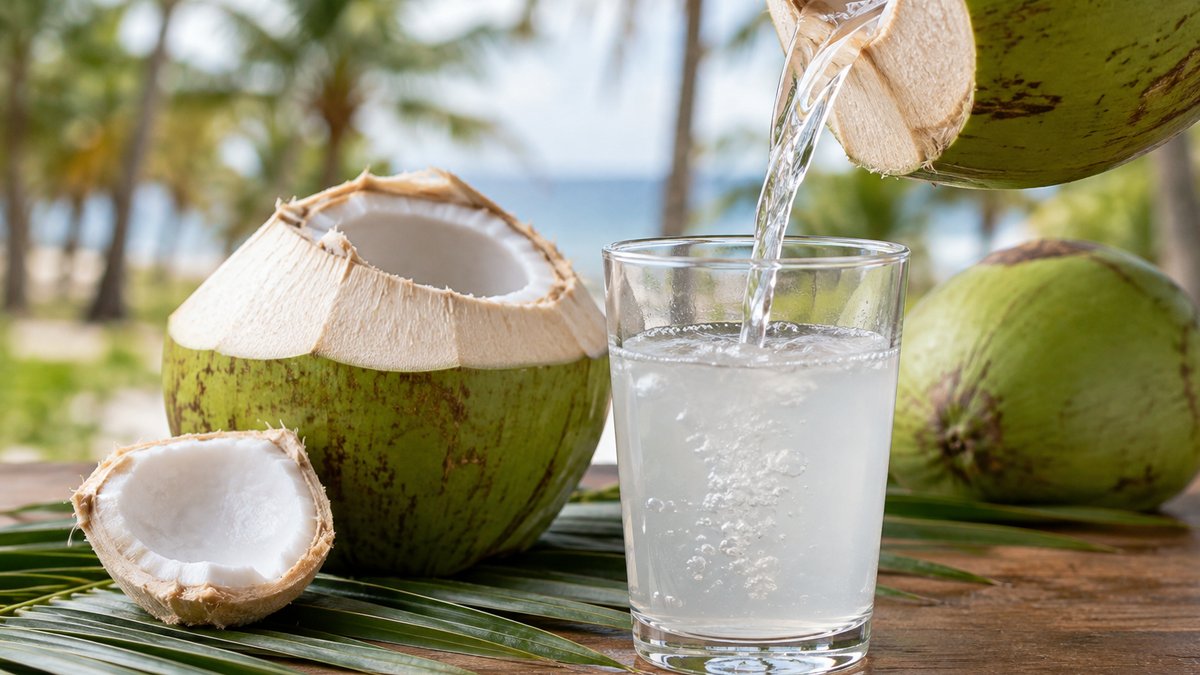

1. NFC and concentrated coconut water differ in whether water is removed and added back
NFC means “not from concentrate.” In commercial use, NFC coconut water is extracted and processed without first removing water to make a concentrate and then adding water back to restore a single-strength product. Concentrated coconut water has had some water removed; it may be sold as concentrate for later use or reconstituted with potable water before sale as a beverage.
The distinction describes a processing route. It does not, by itself, tell a buyer whether the product is raw, pasteurized, sterile, frozen, aseptically packed, sweetened or made from one coconut variety. Nor does NFC mean that the product received no processing after extraction. Buyers need to check those attributes separately in the product specification.
The Codex General Standard for Fruit Juices and Nectars defines coconut water as a product directly extracted from the coconut without expressing the coconut meat. The standard also recognizes fruit juice made by reconstituting concentrate with water. In the European Union, the current fruit-juice rules similarly use “coconut water” for liquid directly extracted without pressing coconut meat, and provide for coconut juice from concentrate. NFC is useful shorthand in trade, but buyers should confirm the supplier’s process and the destination market’s legal naming rules.
Concentration removes water from the extracted liquid. The result is a product with more soluble solids per unit of volume or weight than the original juice. A processor can later add potable water to reach the required composition for a reconstituted beverage. The exact concentration level and method depend on the producer’s specification; the word “concentrate” alone does not state a Brix value, concentration ratio or processing technology.
Brix is a measurement of soluble solids, commonly used to describe juice concentration. It is not a complete description of coconut water quality or sweetness. A buyer should compare Brix together with product identity, ingredients, acidity where relevant, sensory requirements and the intended use. In the EU, the minimum Brix for reconstituted coconut juice is 4.5 under the fruit-juice rules in force at the date of writing, 17 November 2026. Requirements in other markets may differ.
The processing route can affect logistics and product handling. Removing water can reduce the volume transported for a given amount of original juice, which may suit buyers who have suitable reconstitution and filling operations. NFC arrives without that concentration-and-reconstitution step, but its shipping format, storage conditions and shelf life still depend on the supplier’s preservation method and packaging. A buyer should request the actual shipping specification rather than infer it from the NFC or concentrate description.
Taste should be assessed from samples against an agreed reference. Reconstitution does not automatically make two products taste identical, and NFC does not guarantee a particular flavor profile. Coconut maturity, source material, processing, storage and formulation can all affect the finished beverage. When the buyer has a target flavor, the specification should state how samples will be evaluated and whether any flavor, pulp or other ingredient may be added.
2. Compare the products by form, processing and intended use
The main commercial difference is whether the buyer receives single-strength coconut water or a concentrated input that must be used as supplied or reconstituted. A quotation is meaningful only when its product form, composition, packaging and delivery basis are clear.
The table gives a purchasing framework, not a universal product standard. A supplier may describe concentrate using a specified Brix value or another agreed measure. The buyer should obtain that value in writing and verify whether the quotation refers to the concentrate itself or to a beverage made after dilution.
The United States has specific juice-labeling provisions for beverages containing juice. Under 21 CFR 102.33, when a named juice in a beverage is made from concentrate, the product name generally must identify it as “from concentrate” or “reconstituted,” subject to the regulation’s stated conditions and exceptions. FDA guidance also treats coconut liquid as juice for purposes of the Juice HACCP regulation. These are U.S. rules; exporters should not apply them automatically to another destination.
For the European Union, Directive 2001/112/EC as amended includes coconut water as a designation for coconut juice directly extracted without expressing the coconut meat. Its rules also set a minimum Brix of 4.5 for reconstituted coconut juice. That value is a legal specification for the EU category, not a general global target for every coconut-water product or every buyer.
For quotation comparisons, ask whether the quoted unit is a kilogram of concentrate, a liter of reconstituted beverage or a case of finished product. Record the Brix or agreed solids specification, dilution ratio if applicable, ingredients, preservation method, packaging, minimum order quantity, delivery term and destination. Compare equivalent delivered products, not a concentrate price against a finished-drink price.
Buying consideration: Before comparing offers, ask each supplier to identify the product form and give the specification on the same basis. If concentrate is quoted, request its Brix, recommended dilution and the resulting finished volume under the supplier’s stated instructions.
3. A beverage manufacturer’s sourcing decision depends on its production setup
Consider a beverage manufacturer evaluating two quotations for a coconut-water drink. One quotation is for NFC liquid in a specified pack; the other is for concentrate intended for reconstitution. The buyer should first establish whether its plant can receive, store, dilute and process concentrate, and whether the finished drink can meet its target specification after dilution.
For the NFC offer, the manufacturer would confirm whether the liquid is single-strength, its Brix, permitted ingredients, preservation treatment, storage temperature, shelf life and packaging. It would also check whether the product can be used directly in its filling process or needs additional blending or treatment. “NFC” alone answers none of those operational questions.
For the concentrate offer, the manufacturer would ask for the concentrate’s Brix, the required water quality, the dilution instructions and the finished product’s expected Brix. It would confirm how the concentrate is packed and stored, what equipment is needed to reconstitute it, and whether the supplier’s specification allows any restoration of flavor or other components. The buyer should not assume that adding water alone will produce a beverage identical to a separate NFC product.
The two quotations should then be put on a comparable basis. The manufacturer can calculate the concentrate quantity and water needed for the intended batch using the supplier’s verified instructions, then compare the resulting finished volume and specification with the NFC quotation. The calculation should include losses and handling costs only when the buyer has reliable plant or supplier figures. Do not treat a theoretical dilution calculation as a confirmed production yield.
A sample trial can resolve questions that a label or specification cannot. The buyer can assess the beverage after its own dilution and processing, using agreed criteria for flavor, appearance and consistency. The contract should identify the approved sample or measurable specifications, the test method where applicable, and the process for handling a shipment that fails the agreed criteria.
This scenario is illustrative. Actual plant capability, import rules, product formulation and supplier terms vary. A buyer should use its own production data and destination-market requirements before selecting a product or placing an order.
Illustrative inquiry format:
Product form: NFC coconut water or coconut water concentrate
Composition: Brix and ingredient specification
For concentrate: Concentration strength and supplier dilution instructions
Processing: Preservation method and storage conditions
Packaging: Pack type, net contents and shipment format
Commercial terms: Quantity, delivery term, destination and required delivery window
Market: Destination country and applicable product-name or label requirements
This is an illustrative inquiry format, not a universal product specification.
Looking to Source Coconut Water?
Connect with verified suppliers, discover matching products, and explore sourcing opportunities from global markets.
4. Choose NFC or concentrate according to the finished product and plant
Choose NFC when the requested product specification calls for liquid that has not been concentrated and reconstituted, and the buyer’s receiving, storage and production systems suit the offered pack. NFC can simplify the dilution step because the buyer is not purchasing a concentrate for that purpose. It still requires checks on Brix, processing, ingredients, microbiological controls, storage and shelf life.
Choose concentrate when the buyer needs a concentrated ingredient or has the equipment and procedures to reconstitute it to the intended product specification. Its reduced water content can make it a practical format for some supply chains, but the buyer must account for dilution, handling, storage and final-product checks. Confirm the delivered form and intended use in the contract.
Some buyers may need both forms for different product lines. A ready-to-drink product with a set NFC claim may require a different raw material from a product designed to be made from concentrate. The formulation, manufacturing process and destination labeling rules determine whether the two are interchangeable for a particular use.
Use a short decision sequence before requesting final quotations:
- Define the finished product, including intended flavor, composition and pack format.
- Check the destination’s legal product name and labeling rules for the specific form.
- Confirm whether the plant can receive, store and process NFC, concentrate or both.
- Set the required Brix, ingredients, processing treatment, packaging and storage conditions.
- Request samples and assess them using agreed criteria.
- Compare offers on equivalent finished-product quantities and delivery terms.
Contract language should identify the product form instead of relying on a broad label. For NFC, state that it is not concentrated and reconstituted, then define the other composition and process requirements. For concentrate, state the Brix or other agreed concentration measure, packaging, storage, dilution instructions and resulting product specification. List any allowed ingredients and the required label designation for the destination.
Quality acceptance should also match the form being purchased. A concentrate specification can include its concentration and agreed sensory or compositional criteria. A reconstituted product may need criteria for the finished beverage. For NFC, identify the relevant measurements and sample handling. The parties should agree on sampling, testing, records and remedies before shipment rather than trying to resolve a mismatch after arrival.
If a quotation uses “coconut water” without stating NFC or concentrate, ask the supplier to clarify the manufacturing route. If a quotation says “concentrated,” ask whether the offer is for concentrate or a drink already reconstituted from it. These terms affect the quantity delivered, the buyer’s processing steps and, in some markets, the product name on the label.
5. Use official standards and a complete sourcing request to check product fit
Start with the Codex General Standard for Fruit Juices and Nectars for international terminology, then check the importing country’s current food and labeling rules. Codex provides an international reference; it does not replace national law. The European Union and United States examples above illustrate why the destination matters.
For EU-bound products, check the current consolidated version of Directive 2001/112/EC and its amendments for the applicable definition, product designation and Brix requirement. For U.S.-bound products, check FDA juice guidance and the relevant federal labeling provisions. A buyer should confirm the full legal requirements for its product category, formulation, processing and distribution channel.
When requesting offers, include enough detail for suppliers to quote the same product. State whether you need NFC liquid, concentrate or reconstituted beverage; provide the required Brix and ingredient profile; identify processing and storage needs; and specify package size, quantity, destination and delivery term. Ask suppliers to identify any specification they cannot meet rather than accepting an assumed substitution.
Buyers and exporters can use Freshdi to review coconut-water buying requests or related suppliers, then compare each listing with the product specification and destination requirements. Verify commercial details and product documents directly through the buyer’s or supplier’s stated process before making a sourcing decision.
Once the product form and specification are clear, buyers can review related requests and suppliers on Freshdi.
View Latest Non Alcoholic Beverage Buying Requests →View Potential Non Alcoholic Beverage Suppliers →
For each opportunity, confirm whether the requested product is NFC, concentrate or reconstituted, and whether its Brix, ingredients, processing and pack format match your own requirements. A product name alone is not enough to establish that two quotations are comparable.

References
1. Codex Alimentarius Commission – General Standard for Fruit Juices and Nectars (CXS 247-2005), 2005, current version accessed 17 November 2026.
2. European Parliament and Council – Directive 2001/112/EC relating to fruit juices and certain similar products, consolidated version, 14 June 2026.
3. European Parliament and Council – Directive (EU) 2024/1438 amending rules for fruit juices and certain similar products, 14 May 2024.
4. U.S. Food and Drug Administration – Guidance for Industry: Questions and Answers on Juice HACCP Regulation, 2003.
5. U.S. Electronic Code of Federal Regulations – 21 CFR § 102.33, Beverages that contain fruit or vegetable juice, Current e-CFR accessed 17 November 2026.
6. Elsevier – Nonthermal preservation of coconut water by forward osmosis concentration and high pressure processing, 2025.
Disclaimer: This article is compiled from platform data, public sources and information provided by third parties, for general informational purposes only. We do not guarantee its accuracy or completeness. Please conduct your own due diligence before making business decisions.