
1. Spray-dried and freeze-dried instant coffee differ at the drying stage
Spray-dried and freeze-dried instant coffee begin with coffee extract, then use different methods to remove water. Spray drying atomizes the concentrated extract into hot air, producing dry particles. Freeze drying freezes the extract and removes ice under low pressure. The process affects particle form, aroma retention, equipment needs and production cost.
For buyers sourcing instant coffee from Vietnam, these are commercially relevant formats. Intimex lists spray-dried instant coffee made at its facility in Binh Duong, while Louis Dreyfus Company and Instanta announced a freeze-dried coffee facility in the same province in 2023. Those examples establish that both processes are used in Vietnam; they do not establish that every Vietnamese supplier makes both types or that products from different factories will taste alike.
The drying method is one part of the product specification. It does not by itself identify the coffee species, roast profile, extract strength, aroma additions, solubility performance, packaging or intended use. Buyers should treat the process name as a useful starting point, then compare samples and written specifications.
Research generally finds that freeze drying can retain more volatile aroma compounds than conventional spray drying, though results depend on the coffee extract and processing conditions. A 2015 comparative study measured higher volatile retention in its freeze-dried sample than in its spray-dried sample. That finding describes the tested samples and method, not a guaranteed sensory result for every commercial lot.
2. The two drying processes produce different particles and production requirements
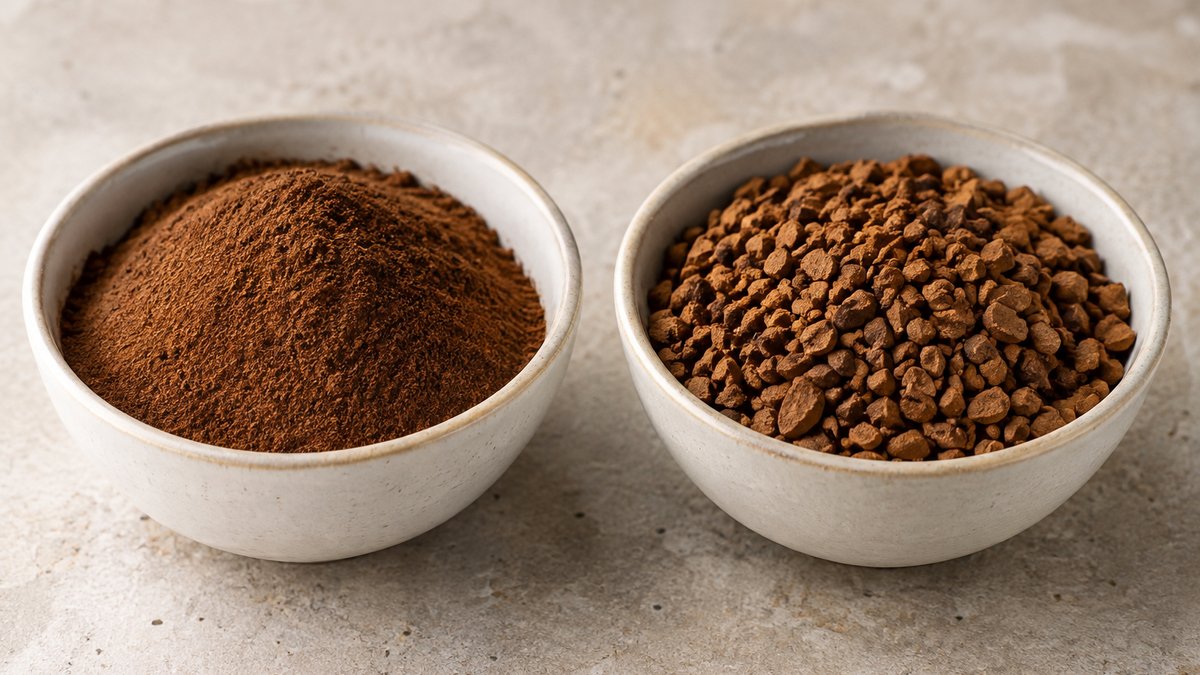
Spray drying turns liquid extract into droplets that dry in a stream of hot air. Freeze drying removes water from frozen coffee by sublimation, the change of ice directly into water vapor under reduced pressure. Both methods produce soluble coffee, but they require different equipment and usually result in visibly different particles.

The appearance descriptions are common production outcomes, not formal guarantees. Spray-dried coffee can be agglomerated, which joins smaller particles into larger granules. A granular product is therefore not automatically freeze-dried. Buyers should request the declared process and a product specification rather than identifying the method from a photograph alone.
The sensory difference also depends on what happens before and after drying. Bean species and lot, roast, extraction, concentration, aroma recovery, storage and packaging can all affect the cup. A comparison of drying methods is meaningful only when the products are evaluated in a preparation that matches the buyer’s intended use.
One published comparison illustrates why results need context. Ishwarya and Anandharamakrishnan’s 2015 study measured volatile retention of 77% for its freeze-dried coffee and 57% for its spray-dried coffee, relative to the feed used in that experiment. Those values are study results, not a commercial specification or a universal performance benchmark. Buyers should use a tasting and application test to establish whether a particular product meets their requirements.
3. A sourcing scenario shows why the process name is only the starting point
Consider an importer comparing two Vietnam-origin instant coffee offers for a branded retail product. One sample is a fine spray-dried powder; the other is a freeze-dried granule. The process label suggests differences in particle form and manufacturing, but it does not settle which offer fits the product. The importer still needs to evaluate the coffee in the intended recipe, serving size and package.
If the retail product is a granulated black coffee, the buyer can compare how each sample smells when the package is opened, how it dissolves in the prescribed water volume and temperature, and how the prepared drink tastes after a consistent steep or mixing period. If the product is a coffee mix, the buyer should test the instant coffee with the actual creamer, sugar or other ingredients. A result from black coffee alone may not predict performance in a finished mix.
The comparison should use a single agreed preparation protocol. For both samples, keep water volume and temperature, coffee dose, mixing method and evaluation time the same. Record the sensory result and any practical issue, such as clumping, undissolved material or excessive fines. The buyer can then connect the assessment to the product’s requirements instead of relying on claims such as “strong aroma” without a defined test.
Illustrative comparison brief:
Product: Vietnam-origin soluble instant coffee
Process to compare: Spray-dried powder and freeze-dried granules
Application: State the intended finished beverage or food use
Evaluation: Use the same preparation method and dosage for both samples
Commercial details: Request specifications, packaging, MOQ and shipment terms
This is an illustrative comparison brief, not a universal product specification or purchasing recommendation.
The buyer should also check whether the offers describe pure soluble coffee or a formulated product. Ingredient declarations matter when a powder includes carriers or other ingredients. Request the current specification and ingredient statement for the exact item being quoted, and make sure the sample, specification and commercial offer refer to the same product.
Looking to Source Instant Coffee?
Connect with verified suppliers, discover matching products, and explore sourcing opportunities from global markets.
4. Choose the drying method according to the finished product and supply plan
Spray-dried coffee may fit a buyer’s brief when fine powder, large-scale production or a cost-conscious formulation is the priority. Freeze-dried coffee may fit when the buyer places greater weight on aroma retention or a visible granule format. These are decision tendencies, not fixed rules: actual cost and cup performance must be confirmed with the supplier and the product sample.
4.1 Consider spray-dried coffee for powder-based applications
A fine spray-dried powder can suit products that require a consistent soluble ingredient, including beverage mixes and manufacturing applications. Buyers should state whether they want a fine powder or agglomerated granules, because those forms can behave differently during storage, dosing and mixing. Specify the product’s required particle form rather than assuming that “spray-dried” alone describes it.
For a high-volume purchase, compare offers using the same coffee content, product form, package size, delivery basis and shipment period. Ask for a sample from the quoted production specification. A lower quoted price cannot be compared fairly if one offer uses a different formulation, package or delivery basis.
4.2 Consider freeze-dried coffee when aroma or granule presentation is important
Freeze-dried granules can suit retail or foodservice products where the buyer wants a visible granulated form and is assessing aroma as part of the finished cup. Scientific comparisons support the possibility of greater volatile-aroma retention under freeze drying, but the measured advantage varies with the tested process and extract. The importer should taste samples from the actual supplier and confirm the commercial specification before setting a product claim.
The process also has supply implications. Freeze drying uses freezing and vacuum equipment and is generally more energy-intensive than spray drying. Buyers should ask about available production volume, lead time, packing format and repeat-lot consistency rather than assuming that a process category guarantees a certain supply capacity.
4.3 Compare product specifications before comparing quotations
Request a specification that identifies the coffee product, declared drying method, ingredients, moisture and relevant physical properties. Ask the supplier to state the test method and specification limits where those measures are offered. Confirm particle form, package material, net weight and storage conditions, and check whether the quoted product is intended for retail, foodservice or industrial use.
For a Vietnam-origin shipment, establish the declared origin and the documents available for the intended destination. Origin, processing location and raw-material sourcing are separate details; request the documents needed for your market instead of inferring origin from a factory address or product name. Import rules depend on destination and product composition, so check the applicable requirements for the shipment.
Buying consideration: Before choosing, compare matched samples in the finished application, reconcile the stated process with the written specification, and evaluate the complete commercial offer on the same basis.
5. Use standards, research and supplier information to verify the comparison
Standards and research help define the processes; supplier documents establish what is being offered. Vietnam’s TCVN 4334 terminology standard distinguishes spray-dried instant coffee, made by spraying liquid coffee extract into hot air, from low-temperature dried instant coffee, made by freezing the solution and removing ice through sublimation. The definitions clarify the process terms, but they do not set a buyer’s taste preference or guarantee a specific aroma level.
USDA Agricultural Marketing Service product descriptions also distinguish spray-dried agglomerated soluble coffee from freeze-dried soluble coffee by their production method and appearance. These descriptions can help buyers read product language consistently. They should not be treated as a substitute for the contract specification or destination-market rules.
Research papers can explain measured differences in aroma compounds and particle properties, but results belong to the samples and methods tested. In the article’s cited 2015 study, freeze-dried coffee retained more measured volatile compounds than the spray-dried sample. A separate open-access review describes the processing stages used for soluble coffee and discusses the operating demands of conventional drying methods. Neither source determines the quality of an individual supplier’s batch.
For commercial screening, ask suppliers for the product specification, ingredient declaration, sample and available production documents. Compare only products that match the intended application and commercial basis. Freshdi’s Instant Coffee buying requests and Instant Coffee suppliers are starting points for reviewing relevant listings; verify each listing’s current details and assess the product directly.

References
1. Vietnam Standards and Quality Institute – TCVN 4334:2007, Coffee and coffee products: Vocabulary, 2007.
2. USDA Agricultural Marketing Service – Coffee, Soluble, 2023.
3. S. Padma Ishwarya and C. Anandharamakrishnan – Spray-Freeze-Drying approach for soluble coffee processing and its effect on quality characteristics, 2015.
4. Food – Spray-freeze-drying as emerging and substantial quality enhancement technique in food industry, 2023.
5. Intimex Group – Instant Coffee, n.d..
6. Louis Dreyfus Company and Instanta – Louis Dreyfus Company and Instanta Inaugurate Instant Coffee Joint Venture in Vietnam, 2023.
Disclaimer: This article is compiled from platform data, public sources and information provided by third parties, for general informational purposes only. We do not guarantee its accuracy or completeness. Please conduct your own due diligence before making business decisions.