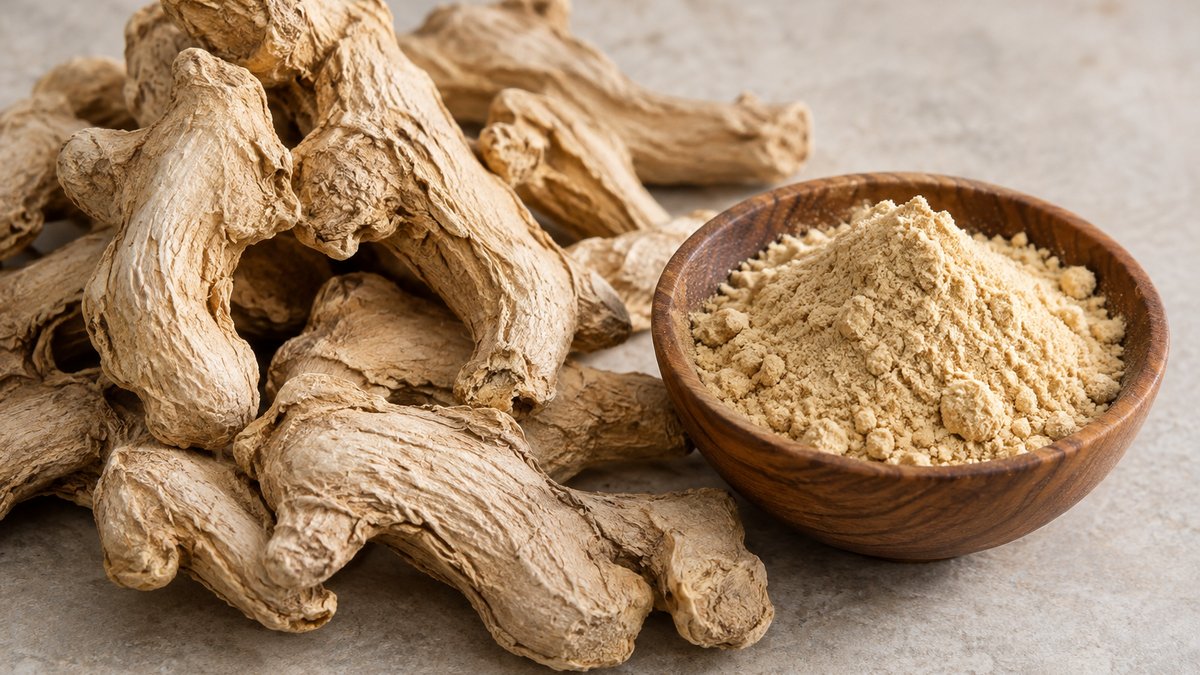

1. How Whole Dried Ginger and Ginger Powder Differ
Whole dried ginger and ginger powder come from the same plant, Zingiber officinale Roscoe. Their main difference is physical form: whole ginger retains the dried rhizome shape, while powder is milled. Codex also recognizes pieces, including sliced, diced and cut forms, as a separate style.
For buyers, form affects how the product is handled, checked and used. Whole ginger lets a buyer inspect visible pieces before milling or processing. Powder can go directly into a recipe or blend, but the buyer receives a milled product and should define the required fineness and quality checks in the specification.
FAO/WHO Codex Alimentarius Standard CXS 343-2021 covers dried or dehydrated ginger offered for direct consumption, food processing or repackaging. The standard lists whole, pieces and ground or powdered as forms. Its chemical limits distinguish whole and pieces from ground or powdered ginger for minimum volatile oil: 1.5 mL per 100 g on a dry basis for whole and pieces, and 1.0 mL per 100 g on a dry basis for ground or powdered. Both forms have a maximum moisture content of 12% by mass under the standard.
These Codex values are a useful reference for product discussions, not a substitute for checking the rules of the destination market or agreeing a contract specification. The standard also states that characteristic odour, flavour and colour can vary with growing conditions, while the product should be free from foreign odour, flavour and colour, especially rancidity and mustiness. Checked 13 November 2026; the cited Codex text was amended in 2025.
The form alone does not establish origin, harvest year, variety, cleanliness, processing method or suitability for a particular recipe. Buyers should treat “whole dried ginger” and “ginger powder” as starting descriptions, then add the details needed for the intended use.
2. Whole Dried Ginger vs Ginger Powder: Comparison
The comparison below focuses on purchasing and inspection. Codex uses the terms whole, pieces and ground or powdered; commercial descriptions may also specify slices, cuts or powder fineness.
The volatile-oil figures are different product-form limits in the Codex standard. They do not mean that every whole ginger lot will have stronger aroma than every powder lot. Product condition, source material, processing and storage also affect the lot. Compare test results against the agreed specification and the same analytical method.
Codex sets the same maximum moisture and the same total-ash limits for whole, pieces and ground or powdered ginger: 12% moisture by mass and total ash of 8% on a dry basis for unbleached ginger or 12% for bleached ginger. The maximum acid-insoluble ash is 1.5% on a dry basis for both form groups. Buyers should confirm whether the contract applies the standard and how the supplier will document conformity.
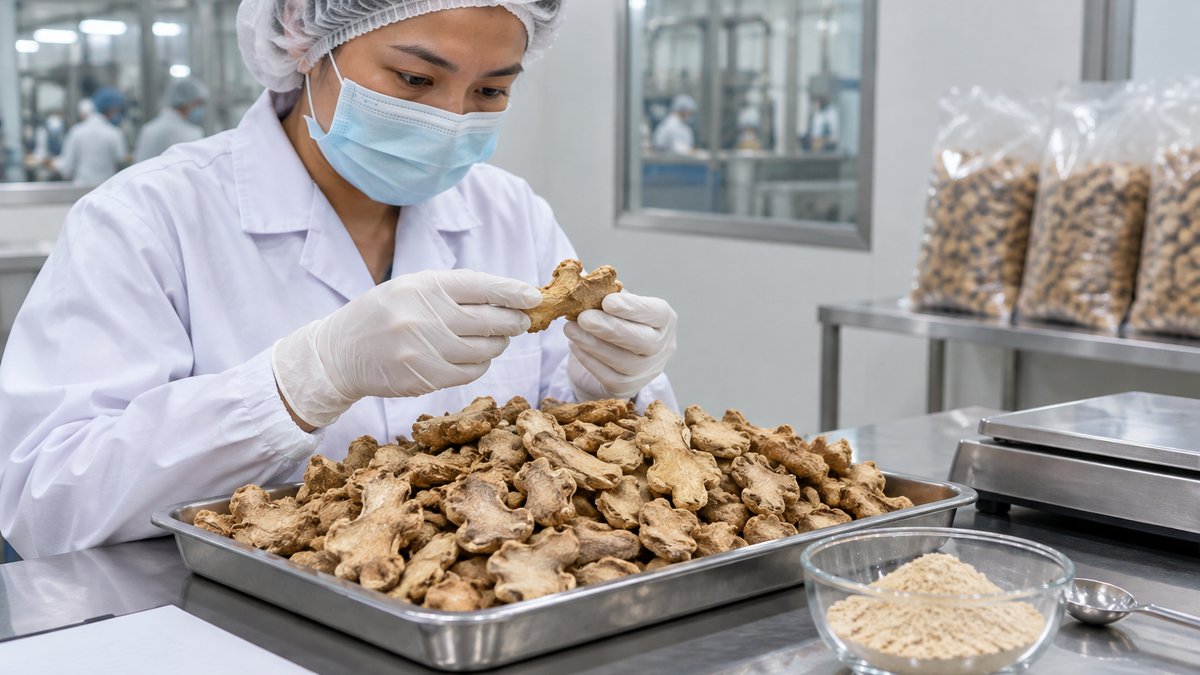
Inspection differs because the product is presented differently. A buyer can visually assess whole ginger for its visible condition and foreign matter. Powder requires a specification that makes particle size clear; appearance and odour checks do not establish the powder’s full composition or compliance. The purchase contract should state the agreed sampling and analysis arrangements for either form.
Powder can contain permitted anticaking agents under the Codex standard, subject to the additives listed in the General Standard for Food Additives. Buyers who require ginger without anticaking agents should say so explicitly and confirm the ingredient declaration. Do not assume the word “powder” means pure ginger or a particular grind.
Buying consideration: When comparing quotations, match the form and specification first. A price per kilogram for powder and a price per kilogram for whole ginger do not describe equivalent levels of processing or readiness for use.
3. A Sourcing Scenario: Choosing a Form for a Spice Blend
Consider a food processor preparing a dry spice blend that requires ginger to be dosed directly into a mixing line. Ground ginger fits that production step because the processor does not need to mill the rhizome after delivery. The buyer still needs to set the required particle size and confirm that the powder’s odour, flavour and other agreed characteristics suit the blend.
If the same company already mills spices and wants control over that step, it may request whole dried ginger instead. The buyer can then define the accepted form and condition of the incoming rhizomes, as well as its own milling process. That choice adds a processing step at the buyer’s site, so the buyer should account for equipment, handling and yield when planning the purchase.
Illustrative inquiry format:
Product: Dried ginger, whole or ground as specified
Use: Ingredient for a dry spice blend
Form: State whole rhizomes or ground/powdered
Quality: Set agreed moisture, volatile-oil and other applicable limits
Powder detail: State the required particle size or mesh, if purchasing powder
Commercial details: State quantity, packaging, destination and requested delivery terms
This is an illustrative inquiry format, not a universal product specification.
A contract should identify the purchased form clearly and describe any measure that affects acceptance. For powder, that may include a particle-size requirement and a sampling plan. For whole ginger, it may include the accepted style, size or visible-defect limits. The Codex standard defines product forms and quality characteristics, but the buyer and seller still need to agree the commercial details.
The buyer should also distinguish quality parameters from food-safety and market-access requirements. CXS 343-2021 refers to applicable Codex limits for contaminants and pesticide residues and recommends relevant hygiene practices for low-moisture foods. Importers must check the requirements that apply in the destination jurisdiction and to the product’s intended use.
Looking to Source Dried Ginger?
Connect with verified suppliers, discover matching products, and explore sourcing opportunities from global markets.
4. When to Choose Whole Dried Ginger or Ginger Powder
Choose whole dried ginger when the buyer’s next step includes milling, slicing or other processing, or when the contract requires the unground form. Agree whether the order is for whole rhizomes or pieces, then describe any size, preparation or condition requirements that affect acceptance.
Whole form gives the receiving team a visible product to inspect before further processing. That does not replace laboratory analysis or a formal sampling plan. Buyers should specify the tests, methods and acceptance limits needed for their contract, and record how any nonconforming lot will be handled.
Choose ground ginger when the downstream process needs powder and the buyer wants to receive that form ready for its recipe or blending operation. State particle size in a measurable way, such as an agreed sieve or mesh requirement, and specify whether additives are permitted. The supplier and buyer should agree how the lot will be sampled and assessed.
A powder specification should also address intended use and packaging. Fine powder can behave differently during filling and handling from larger pieces, so the buyer should check that the proposed packaging protects the product during the planned storage and transport conditions. Do not infer a shelf life or storage condition from the form alone; request the supplier’s documented product information and agree the applicable terms.
For either form, set the product name, country of origin, requested quantity, packaging, destination and delivery terms in the inquiry. Codex CXS 343-2021 says the country of origin should be declared and allows the product name to include a style indication. Destination-market labeling rules and the exact contract remain relevant.
Buying consideration: Before placing an order, ask for a specification sheet and a representative lot sample where appropriate. Check the declared form, origin, test parameters and packaging against the contract, then confirm that the product fits the receiving process.
5. Related Resources for Dried Ginger Buyers
FAO and WHO’s Codex CXS 343-2021 is the relevant Codex text for dried or dehydrated ginger in whole, pieces and ground or powdered forms. It covers product description, quality characteristics, additives, contaminants, hygiene, labeling and analysis. The standard is a reference for trade discussions; buyers should confirm its application alongside destination-country rules and contract terms.
Freshdi is a place to review dried ginger buying requests and supplier listings. Compare each listing’s stated product form and details with the specification your business needs.
Buyers who have defined the required form and specification can review suppliers listing dried ginger.
View Related Suppliers for This Product →
References
1. FAO and WHO Codex Alimentarius – Standard for Dried Roots, Rhizomes and Bulbs: Dried or Dehydrated Ginger, CXS 343-2021, 2025.
2. FAO and WHO Codex Alimentarius – All Codex Standards: CXS 343-2021, Standard for Dried or Dehydrated Ginger, 2025.
Disclaimer: This article is compiled from platform data, public sources and information provided by third parties, for general informational purposes only. We do not guarantee its accuracy or completeness. It is not legal, customs, tax or compliance advice. Regulations, tariffs and requirements differ by country and change frequently, so please consult a qualified professional (such as a customs broker, freight forwarder or lawyer) and confirm product specifications with the supplier before acting.