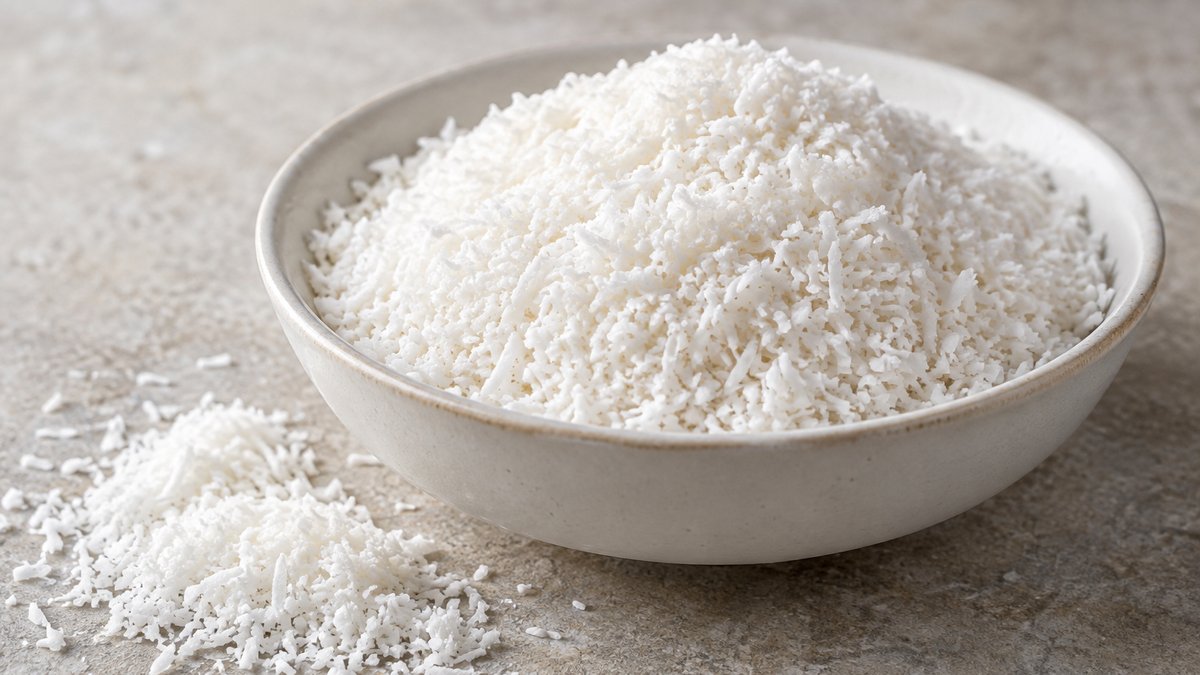

1. Fine and Medium Desiccated Coconut Differ Mainly in Particle Size
Fine and medium desiccated coconut are size classifications for dried coconut kernel. Fine generally has smaller particles, while medium has larger particles. Buyers comparing them should use the agreed sieve specification, since grade names alone do not fully describe a lot.
The Codex Alimentarius Commission’s Standard for Desiccated Coconut, CXS 177-1991, treats sizing as optional. It defines fine by sieve-passing proportions: at least 80% by weight passes a square-aperture 1.40 mm sieve, while no more than 20% passes a 0.71 mm sieve. For medium, at least 90% passes a 2.80 mm sieve, while no more than 20% passes a 1.40 mm sieve.
Those definitions describe a distribution across a sample, not a promise that every particle falls within one exact size band. The buyer and supplier should agree on the sieve apertures, test method, sample size and permitted tolerances in the product specification or contract.
The distinction is about particle sizing, not a separate quality ranking. Codex addresses other quality characteristics independently, including colour, texture, flavour, odour, moisture and oil content. A fine product is not automatically fresher, safer or more suitable than a medium product; those points require their own specifications and checks.
Grade terminology can also differ by standard or supplier. For example, India’s 1994 Desiccated Coconut Grading and Marking Rules use their own mesh and sieve descriptions for fine and medium. Buyers selling into a particular market should state the governing specification instead of assuming that a grade name means the same particle distribution everywhere.
2. How Codex Defines Fine and Medium Desiccated Coconut
Codex distinguishes fine from medium through sieve-passing limits. Its optional sizing definitions give buyers a common reference for writing a specification, while the contract still needs to identify the standard and test details being used.
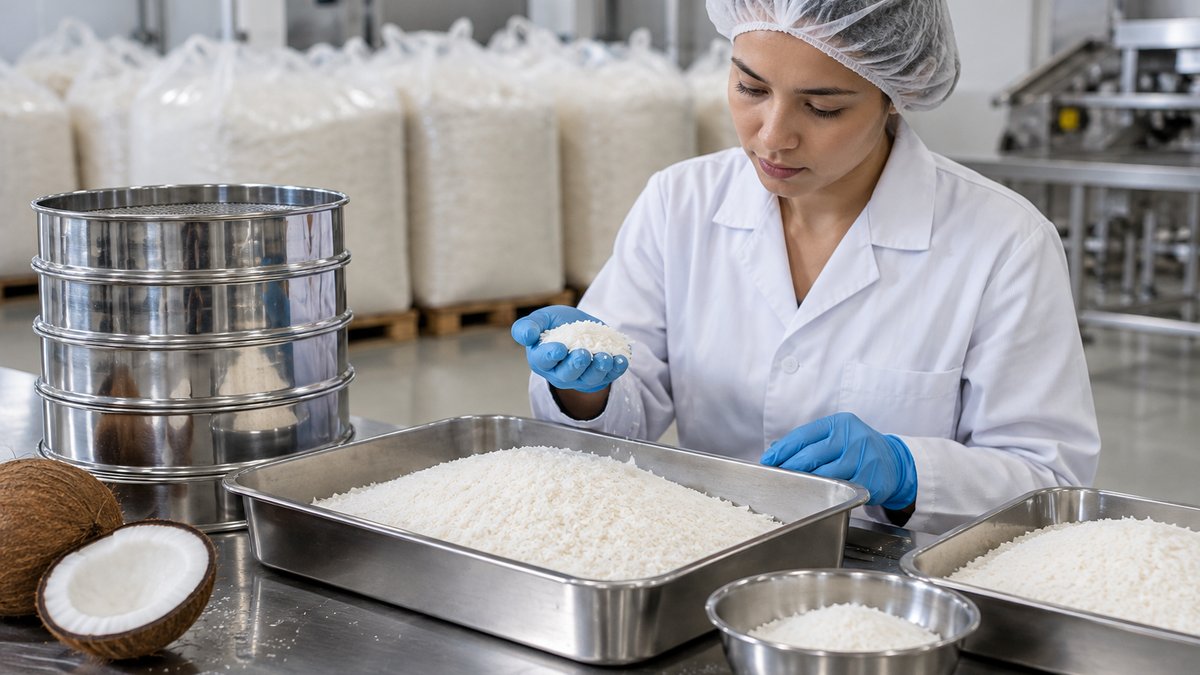
The two Codex descriptions use different sieve cutoffs, so a buyer should not read them as two adjacent, perfectly separated size ranges. A lot is assessed against the relevant passing proportions. For a closer comparison, request the actual sieve analysis for each lot and check the result against the agreed acceptance limits.
Codex’s sizing criteria also do not define the full commercial specification. CXS 177-1991 covers desiccated coconut’s product definition and other quality requirements, but sizing alone does not tell a buyer whether the product is full-fat or low-fat, sweetened, toasted, or treated with an additive. Codex describes full-fat product as having at least 60% oil by mass and a partially oil-extracted product as having at least 35% but less than 60%. Buyers should specify the required composition separately.
For importers, a useful request states the standard and the test result expected, rather than asking only for “fine” or “medium.” Include the sieve aperture sizes, required passing or retention percentages, test method and tolerance. If the buyer’s own quality team uses a particular sieve series, name that series and confirm the supplier can test against it.
Buying consideration: Before accepting a quotation, confirm that each supplier is quoting the same size definition and the same composition, processing and packing requirements. That makes the particle-size comparison meaningful.
3. A Buying Scenario: Selecting a Grade for a Finished Product
A confectionery buyer choosing coconut for a product with a fine, even coating may start by assessing fine desiccated coconut. A manufacturer whose recipe calls for visibly larger coconut pieces may assess medium. These are starting points for product trials, not universal rules about which grade belongs in a particular application.
Suppose a buyer is testing two versions of a baked item. The production team can compare both grades in the actual recipe and record how each mixes, looks after baking and performs against the finished product’s particle-size requirement. The trial can show whether the finer material disperses as intended or whether the larger pieces better match the desired appearance and texture.
The trial should keep the rest of the specification constant. Use comparable coconut composition, moisture limits, processing status and packaging. If the samples differ in more than particle size, the buyer cannot attribute a change in the finished item to fine versus medium grade alone.
A buyer who needs a consistent result across production batches can set an acceptance range based on the trial and require a sieve analysis for each lot or at an agreed frequency. The contract should say how the sample is taken, which test method applies, who tests it and what happens if a lot falls outside the agreed range.
Cost comparisons also need equivalent terms. A quote for fine and a quote for medium should refer to the same fat content, moisture limit, packaging size, order quantity and delivery basis. If one quote includes a different test, treatment or pack format, identify that difference before comparing prices.
Looking to Source Desiccated Coconut?
Connect with verified suppliers, discover matching products, and explore sourcing opportunities from global markets.
4. Choose Fine or Medium by the Product Specification
Choose fine when product trials and the buyer’s written specification call for a smaller particle distribution. Choose medium when the required result calls for larger particles and the supplier can meet the agreed sieve limits. The intended end use helps guide the trial, but the buyer’s acceptance criteria should decide the purchase.
4.1 Fine may suit a smaller-particle requirement
Fine can be a candidate when the recipe or finished product calls for smaller coconut particles. The buyer should confirm whether the grade works in the actual mixing, baking or coating process, since the grade label alone does not establish the finished product’s performance. Ask for the sieve distribution and evaluate a production-relevant sample.
A minimum passing percentage at a stated aperture does not mean every particle is below that aperture. The Codex fine definition also limits the proportion passing through a smaller sieve. Buyers seeking a particularly narrow size distribution should specify the full distribution they require instead of relying on the word “fine.”
4.2 Medium may suit a larger-particle requirement
Medium can be a candidate when the recipe or visual specification calls for larger coconut particles than the fine grade provides. Buyers should confirm the result in a finished-product trial and specify the permitted proportion passing or retained at each relevant sieve. A medium label does not, on its own, guarantee a particular particle profile.
Where the buyer needs visible pieces, medium may still require a comparison with other cuts, such as flakes, shreds or chips. Codex lists those forms separately under other sized presentations. Name the required form directly if the product needs elongated or larger-cut pieces rather than granular material.
4.3 Write the specification before comparing quotations
A clear inquiry should identify the product as desiccated coconut and state the requested grade, standard or sieve limits, full-fat or low-fat requirement, moisture limit, treatment or additive requirements, packaging, quantity and destination. Buyers should also request a current product specification and analysis for the offered lot.
For quality review, specify the checks that matter to the buyer’s market and production process. Particle size does not replace checks for colour, odour, flavour, moisture, foreign matter or microbiological requirements. Import requirements can vary by destination, so confirm applicable rules with the relevant authorities and the importer’s technical team.
Buying consideration: Use the grade name as a starting point, then put measurable sieve criteria and the remaining product requirements in the purchase specification. This gives buyer and supplier a shared basis for sample approval and lot acceptance.
5. Related Standards and Sourcing Resources
Codex CXS 177-1991 is the main international reference used here for the product definition and optional fine and medium sizing criteria. The Codex text also covers composition, quality factors, labelling and other requirements. It does not make the optional size designation a complete commercial specification for every transaction.
The Centre for the Promotion of Imports from Developing Countries notes that European buyers refer to Codex and UNECE standards and that producing countries may set their own standards. For a shipment, check which standard the buyer and supplier have agreed to use, and whether destination-country rules or the buyer’s own specification add requirements.
Freshdi’s Desiccated Coconut supplier listings can help buyers find relevant supplier profiles. Ask each potential supplier for the current product specification and lot analysis, then confirm that the sieve results, composition and delivery terms match the purchase requirement.
References
1. Codex Alimentarius Commission – Standard for Desiccated Coconut, CXS 177-1991, 1991, amended 2023.
2. Centre for the Promotion of Imports from Developing Countries – Entering the European market for desiccated coconut, Accessed November 22, 2026.
3. Government of India – Desiccated Coconut Grading and Marking Rules, 1994, 1994.
Disclaimer: This article is compiled from platform data, public sources and information provided by third parties, for general informational purposes only. We do not guarantee its accuracy or completeness. Please conduct your own due diligence before making business decisions.